E-Paper



Number Theory: Fiscal prudence and its fallout on the Centre's political capital
This is the last of a two-part pre-budget series. The first part looked at government’s tax performance in the last 10 years.
Published on: Jul 22, 2024, 09:16:24 IST

 Prefer HTon Google
Share via


Copy link

The first of this two-part per-budget series looked at the tax performance of the Modi government in the last 10 years and argued that the post-pandemic performance had achieved a creditable performance of increasing the tax-GDP ratio without resorting raising the indirect tax burden. The concluding part of this series will look at the spending pattern of the government between 2019-24 and explore its possible political economy fall out.
Fiscal prudence and its fallout on the Centre's political capital
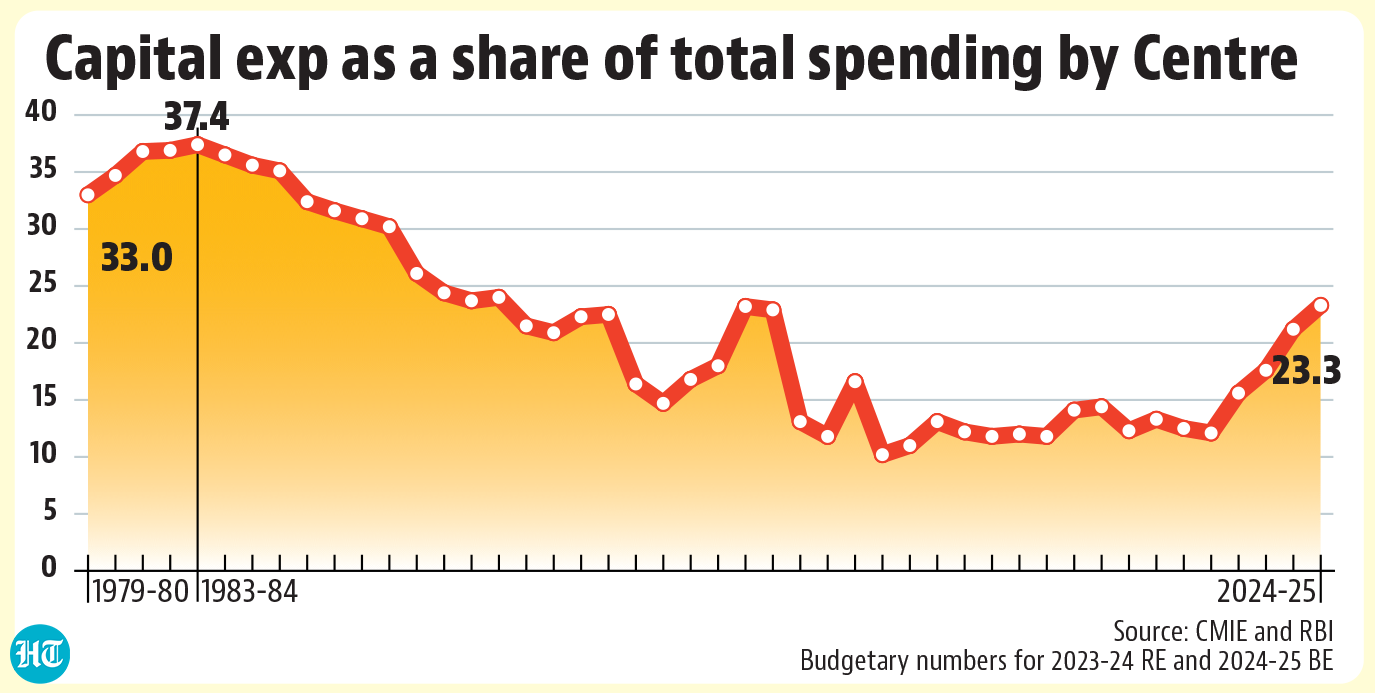
 The most important change in the government’s spending was the rise in share of capital spendingThe share of capital expenditure in central government’s total spending is expected to stay above the 20% mark in 2023-24 and 2024-25 according to Revised Estimate and Budget Estimate numbers available in the Center for Monitoring Indian Economy (CMIE) database. The last time these numbers were in this ballpark two decades ago. The government’s capex push has played a major role in not just boosting short-term growth, but also laying the ground for fixing India’s supply side gaps on the infrastructure front which is absolutely essential for long-term growth.
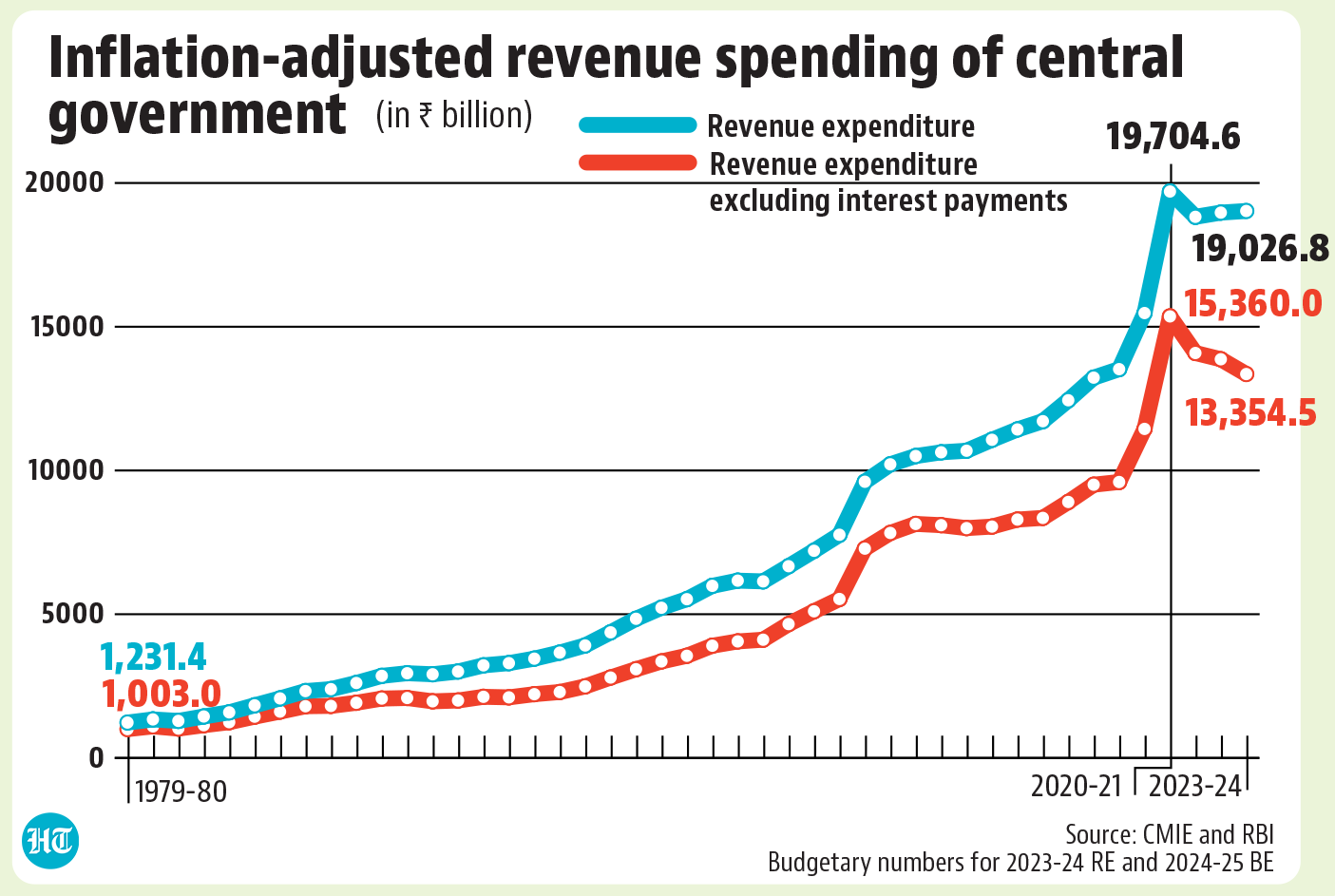
- But this came at the cost of a sharp decline in revenue spendingThat a rise in share of capital spending will lead to a concomitant decline in revenue spending share is a tautology. However, what is worth examining is whether this decline was proportional or a fall in real spending. There are greater chances of a political fallout if the latter turns out to be true. A good way to check whether this has happened is to look at the inflation adjusted – HT has used the inflationary component between GDP at current and constant prices to make this adjustment – trend in capital and revenue spending of the central government. The data highlights a very interesting and unprecedented pattern in the spending cycle of the central government. Inflation adjusted revenue spending shot up sharply in the pandemic year and has, by and large, stabilized at that level in the period after that. Of course, its share in GDP, because the latter has been growing, has come down. However, if one were to take out interest payments from the revenue spending head, we see an absolute decline in real terms. Interest payments are basically going towards servicing past debt rather than supporting current period consumption. From a political economy perspective, a fall in real spending will also lead to a really sharp fiscal consolidation . It is worth underlining the fact that such a sharp fiscal consolidation was seen – CMIE has data from 1979-80 onwards – and is unprecedented in India’s economic history. This is bound to have generated some economic pain and therefore political discontent. To be sure, inflation adjusted revenue spending, even after excluding interest payments is much higher than what it was before the pandemic struck and even what the pre-pandemic trajectory suggested.
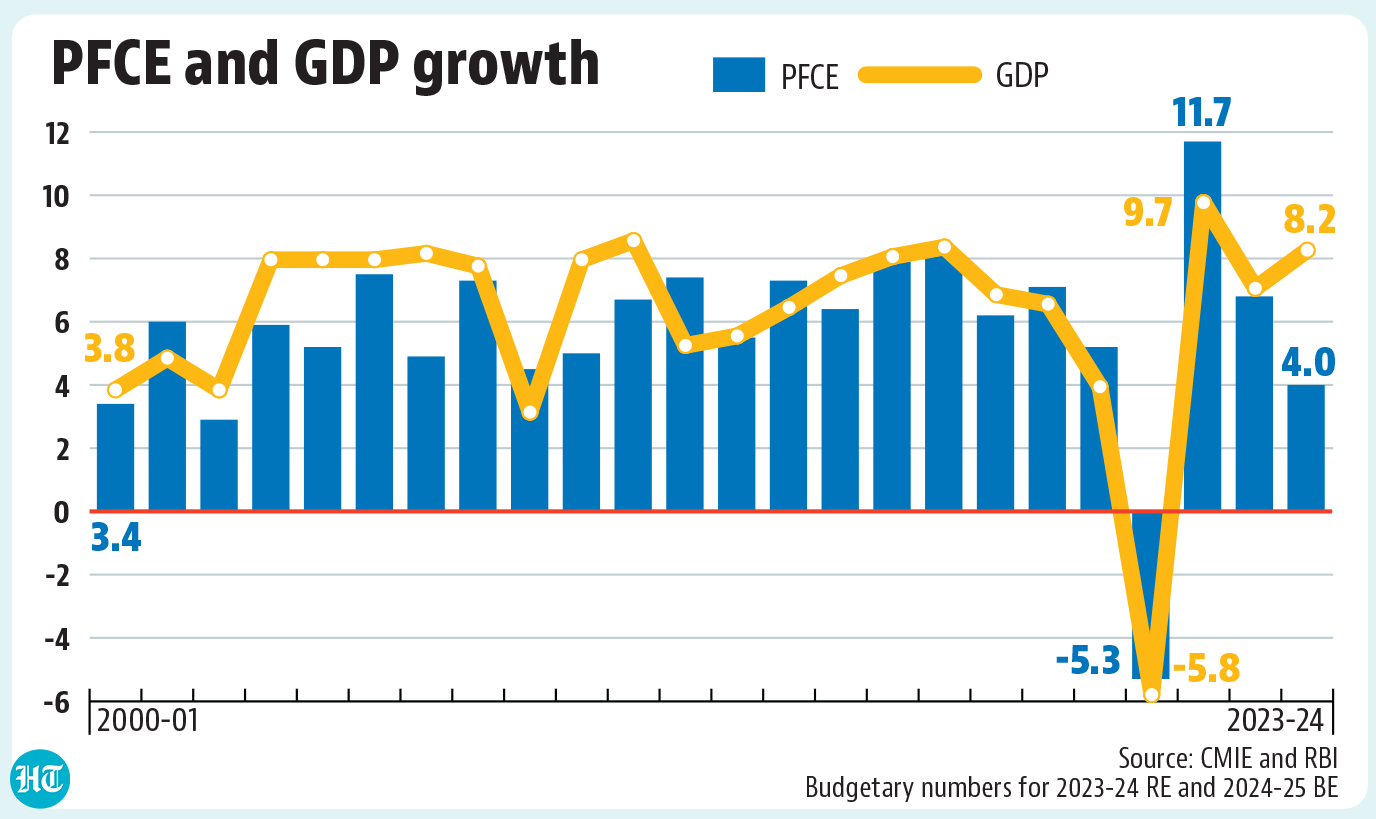
- This fiscal consolidation came at a time when privation consumption growth was among the weakest everThis was the most important political economy factor in the government’s fiscal plan before the 2024 elections. Prioritising capital spending over revenue spending, not letting the fiscal deficit go out of control even in the aftermath of the pandemic’s shock, beginning the process of a gradual but still sharp fiscal consolidation when coupled with a monetary tightening (to be sure, this is not a decision by fiscal policy) are all policies aimed at boosting long-term growth and macroeconomic stability. But they came at a time when the economy was seeing a K-shaped recovery, thriving on the income and spending of the rich rather than the not-so-well-off. Given the fact that the non-rich have a higher propensity to consume, this manifested itself in a weak private consumption growth which in real life must have meant a struggle or even erosion in consumption levels at the bottom of the economic pyramid. The fact that private final consumption growth was just 4% in 2023-24 against the overall GDP growth rate of more than 8% shows this clearly. Long-term growth considerations aside, the election results show that this might have come at a great political cost to the BJP . Will the budget tweak the interim budget’s framework to rebalance politics and economics? This is the biggest question as far as tomorrow’s budget is concerned.