E-Paper



Number Theory: Piecemeal efforts, passing the buck will not fix Delhi's air
This is the first of a two-part series asking for a holistic approach to Delhi’s pollution. The second part will discuss what can be done to solve the problem.

 Prefer HTon Google


With the advent in Delhi of what can only be described as pollution season , all arms of the state are yet again pretending to find solutions to the problems. The courts have been asking the executive to take action against farmers burning stubble and seeking detailed plans to control pollution. Governments are busy playing the blame game and selling snake oil solutions which are targeted more at managing the narrative than pollution itself.
What will it take to manage the pollution problem in Delhi and adjoining areas for good? This two-part series will argue that it requires understanding the structural nature of the problem and marshalling political will and sustained resources rather than pretending to be seen as doing something when the air really becomes bad. The first part of the series will highlight why it is wrong to see India’s air-pollution crisis as a Delhi-centric winter problem and the second part will show what needs to be done to control this successfully.
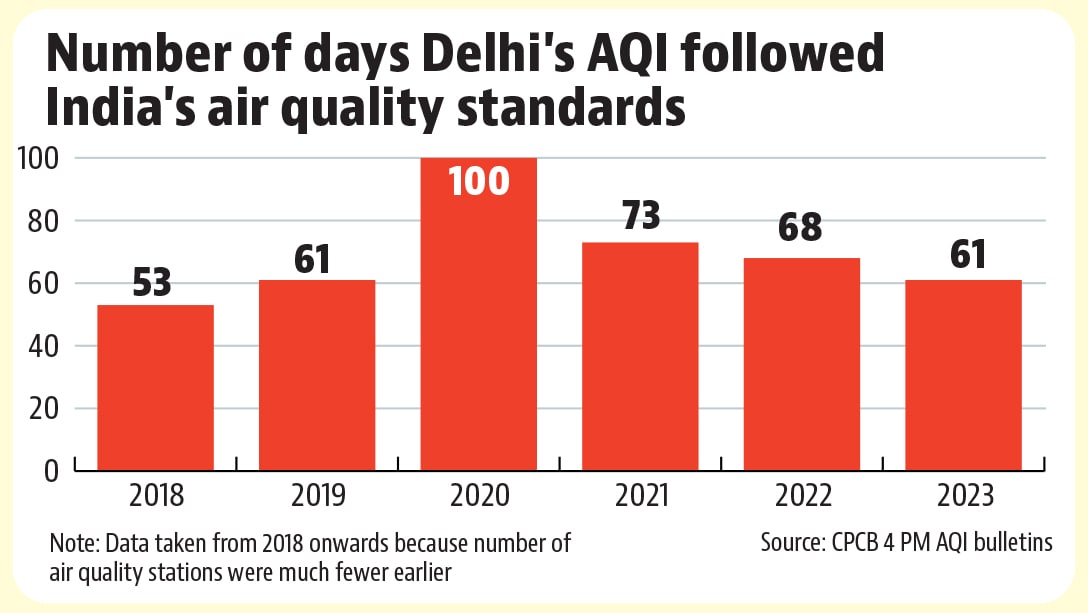
 Delhi’s air is worse than permissible limits for majority of the year...This is the most important part of the story. Delhi’s air quality is way below internationally acceptable norms of what is considered to be healthy air. For example, the World Health Organisation (WHO), recommends an annual average PM2.5 (particles of diameter 2.5 micrometers or less) concentration of 5 micrograms per cubic metre (µg/m3). Delhi’s annual PM2.5 concentration has averaged between 101 µg/m3 (in 2020) and 128 µg/m3 (in 2018) from 2018 to 2023. Even if one were to take the Indian standards for what is defined as clean air – 40 µg/m3 annual average of PM2.5 concentration or 60 µg/m3 on 98% of days– Delhi’s air has been polluted on 81% of the days. The usual practice of thinking about pollution only when it reaches really bad levels is tantamount to equating treatment to getting admitted in an ICU rather than seeking timely medical attention.
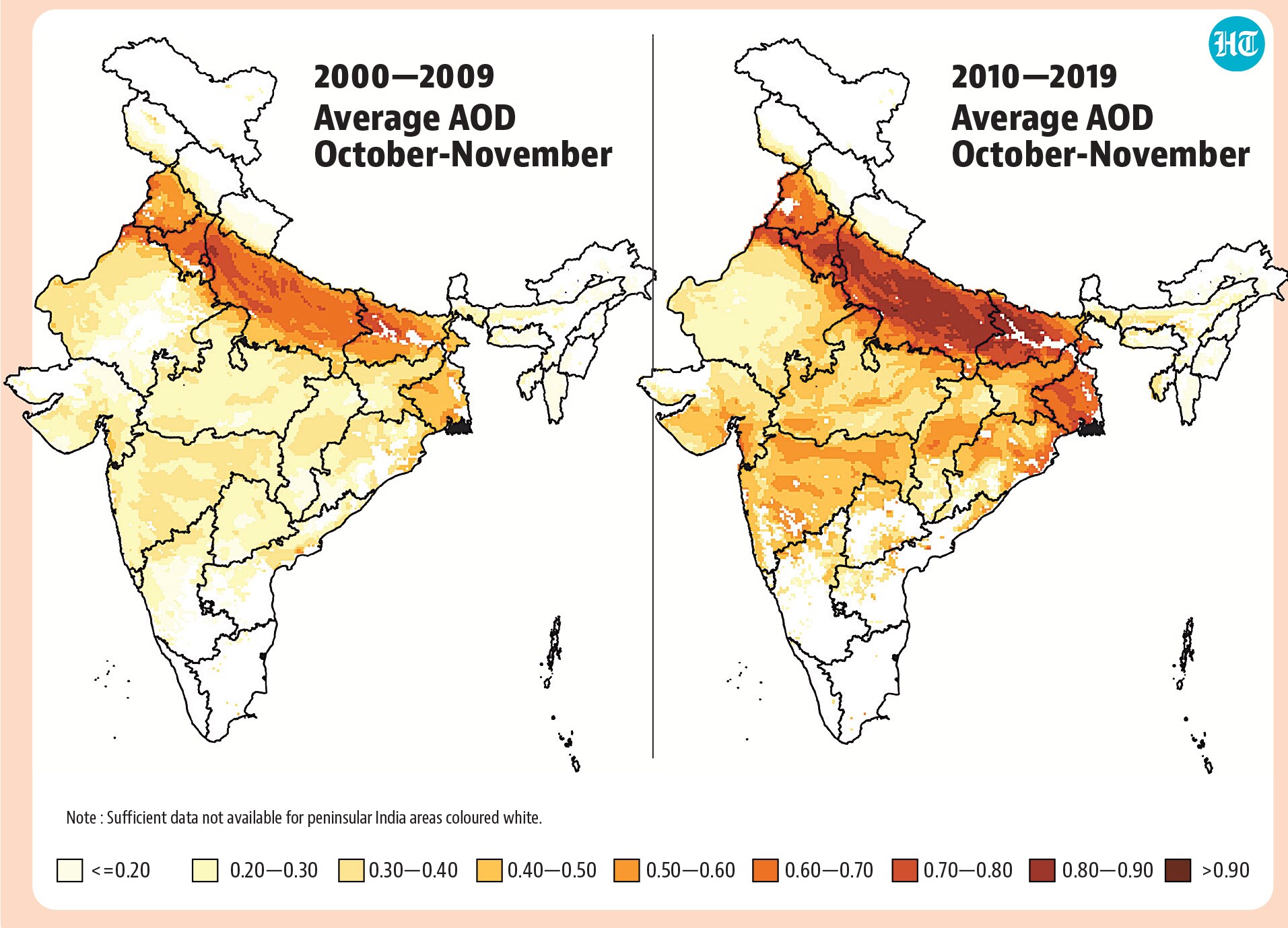
- ...but air pollution is not a problem restricted to Delhi.There is unequivocal data to support this claim. Air quality in large parts of the Indo-Gangetic plain, and not just Delhi, is pretty bad for a large part of the year and the problem becomes much worse during winter, when meteorological factors such as lower temperatures and wind generate tailwinds for pollution levels. There is also clear evidence that the problem has become much worse over time. Data from the MODIS instrument aboard NASA’s terra and aqua satellites shows that aerosol optical depth (a measure of particles suspended in the air, which is a proxy for air pollution) is one of the highest globally over the Indo-Gangetic plains and has become worse almost all over India between the 2000-2009 and 2010-2019 decades.
- The first clue to the problem is in rising urbanisation in this regionThe fact of urbanisation is hardly a surprise. However, its scale can be seen visually in the Global Human Settlement Layer (GHSL) data that uses satellite imagery to estimate built up area. Densely built-up places were few in the Indo-Gangetic plains in 1980 (the earliest year for which this data is available) and separated by sparsely built-up places. In the four decades since, existing urban centres have become bigger and the places separating them are also more built-up now. Rising urbanisation leads to a host of activities such as construction, travel and other kinds of emissions which directly increase pollution. The accompanying maps show only the Indo-Gangetic plains because it allows one to zoom in on the place where meteorological conditions and geographical features are favourable for dangerous air quality in winter. This does not mean other places are not getting more urban, which has a cascading impact on multiple factors that affect air quality (more on this later). When this urbanisation is unplanned or illegal – such as in the Aravalli range southwest of Delhi – it directly generates dust and dismantles natural protection against such dust travelling long distances. This was also pointed out in a series of stories by HT in January 2023.