E-Paper



Number Theory: Shaktikanta Das signs off from Mint Street
How will Das’s stint as the RBI governor be remembered ? Here are four charts which try and answer this question
Published on: Dec 11, 2024, 10:47:30 IST

 Prefer HTon Google
Share via


Copy link

The Reserve Bank of India will have a new governor after six years, with Sanjay Malhotra taking charge from Shaktikanta Das today. Malhotra, like his predecessor, comes to Mint Street after a stint in the top bureaucracy at North Block where he was serving as the Revenue Secretary. How will Das’s stint as the RBI governor be remembered ? Here are four charts which try and answer this question.
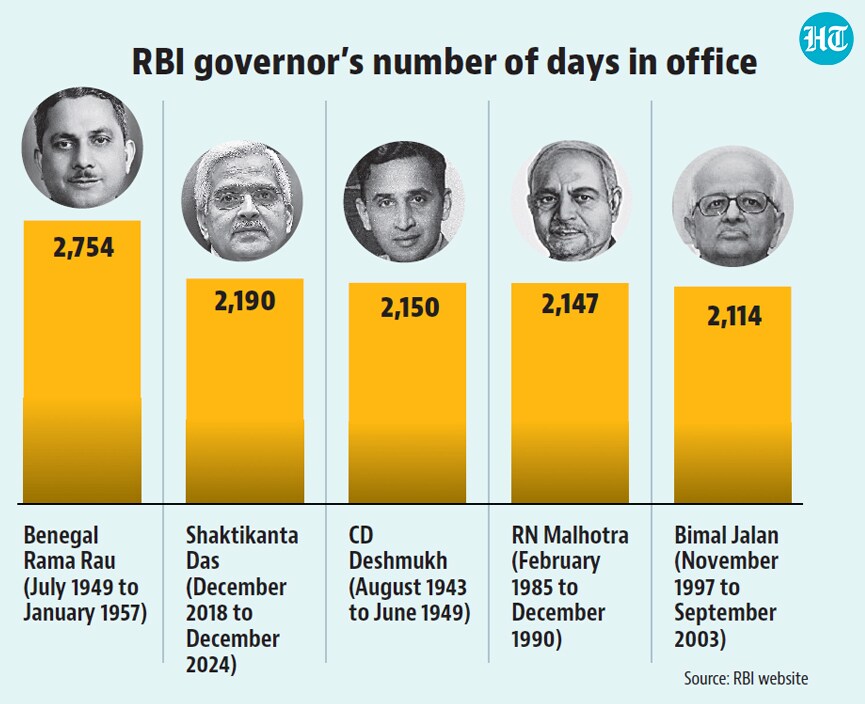
 Shaktikanta Das has had the second longest stint as RBI GovernorThe RBI has had 25 governors so far since 1935. This puts the average term of a governor at 43 months. Four of these 25 have not even had hundred days in office. Ten out of RBI’s 25 governors had a term of less than thousand days. With 2190 days in his term, Shaktikanta Das is now the second longest serving Governor of the RBI. The only person who has had a longer term in office than Das is Benegal Rama Rao, who served between July 1, 1949 and January 14, 1957. In the more recent past, Governors who come close to the length of Das’s term are Bimal Jalan (2114 days), Y V Reddy (1826 days) and D Subba Rao (1825 days). Das has had a longer term than the two of his immediate predecessors combined, both of whom served during the period of the Narendra Modi government and resigned on their own. See Chart 1: RBI governors by length of term
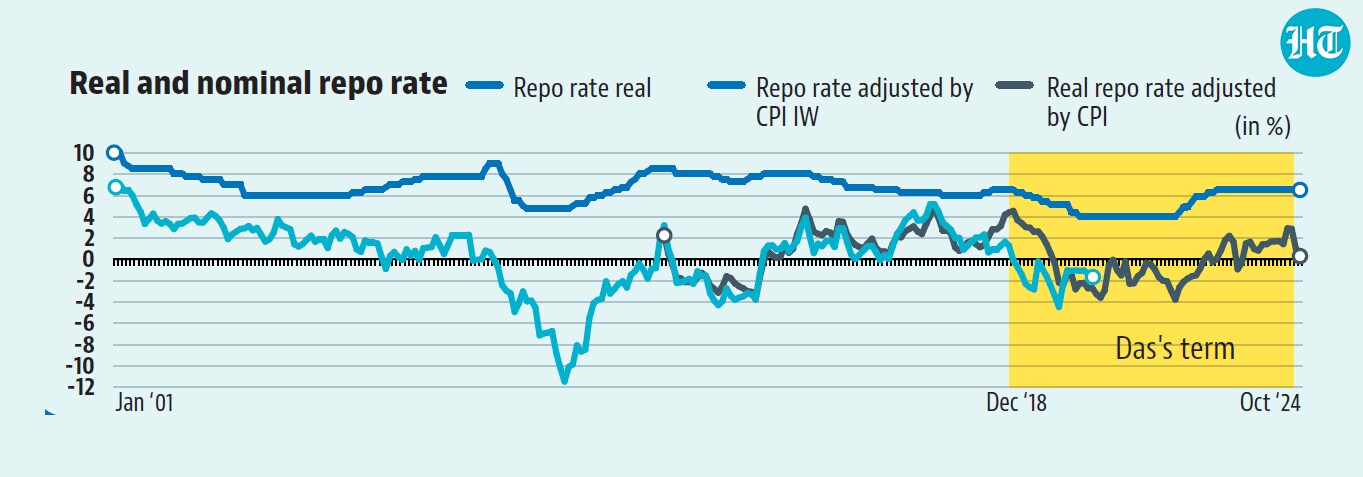
- Was Das the most hawkish RBI Governor?Das’ statements in the latter part of his term might have earned him this reputation; he has been adamant about inflation rate aligning to the 4% target rather than the broad range of 2%-6% in RBI’s inflation targeting mandate. It is worth remembering that it was Das himself who refused to raise interest rates in the early phase of the pandemic despite inflation rate staying above RBI’s target. “We have not been a prisoner of any rulebook,” Das said in his statement after the October 2021 Monetary Policy Committee (MPC) meeting in the backdrop of the RBI pushing monetary easing despite high inflation during the peak of the pandemic. In fact, monetary support was the cornerstone of India’s post-pandemic policy support unlike many large economies which took the fiscal route. RBI’s current hawkish phase only came after the economy came closer to its potential growth rate phase. These anecdotes aside, how harsh were interest rates under Das’s leadership at the RBI? A comparison of nominal and real policy rates shows that real rate was negative for 39 of the 72 months under Governor Das. While real rates did climb up in the recent past, they have been much higher in the past. See Chart 2: Real and nominal repo rate
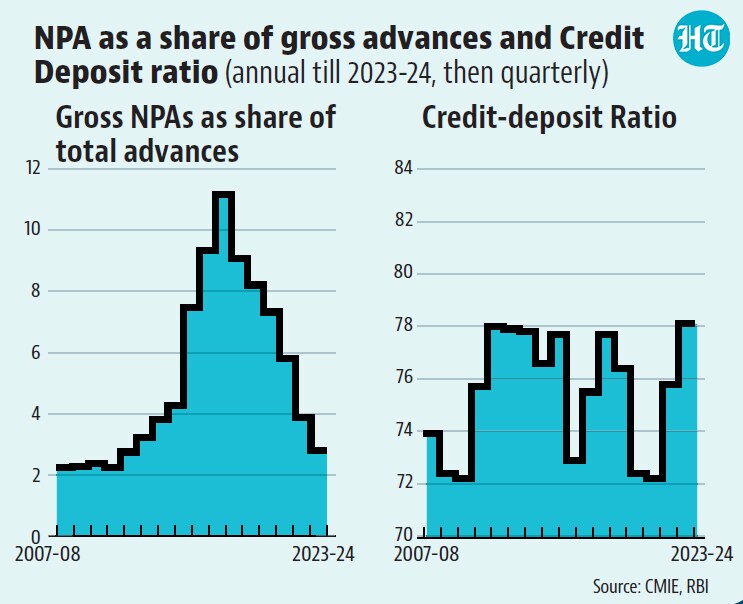
- Das saw a qualitative change in banking sector’s primary contradictionDas’s last two predecessors, Raghuram Rajan and Urjit Patel, spent most of their time in RBI trying to clear the toxic overhang of bad loans from the banking system. Non-Performing Assets (NPAs) were already on a falling trajectory when Das assumed office and are at their lowest levels today. Rather than resting on his laurels, Das chose to pursue the financial sector stability challenge on different fronts. While a lot of his regulatory focus was on securing non-bank credit, he also repeatedly flagged the rise in credit-deposit ratio (CDR) in his recent statements. While the CDR is far from reaching historically unprecedented levels, Das’s overall regulatory behaviour suggests that it is as important to closely monitor demand and supply of retail loans and deposits in the economy as it is to, big ticket lending which led to the twin balance sheet crisis in the last decade. See Chart 3: NPA as a share of gross advances and Credit Deposit ratio (annual till 2023-24 then quarterly)
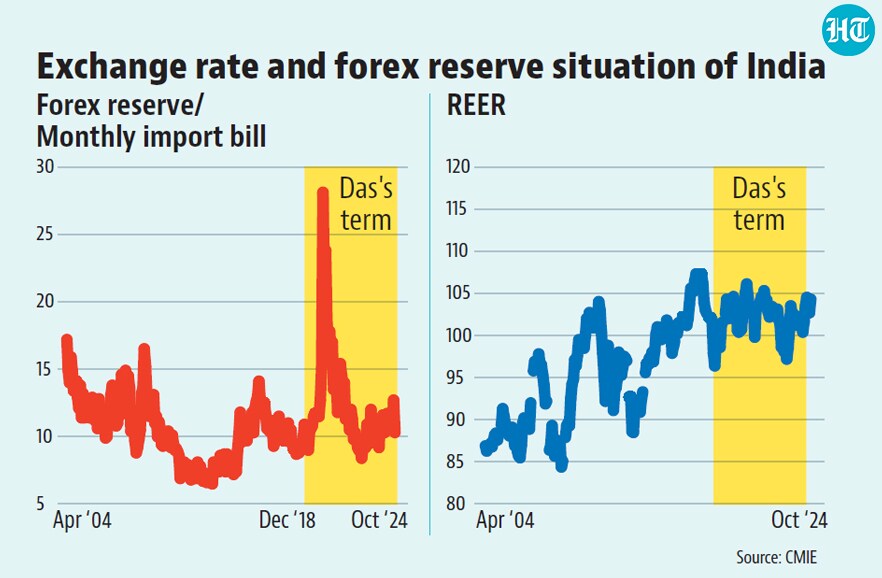
- On exchange rates and forex reserves, Das has had a steady handFor someone following the nominal numbers, this might appear counter-intuitive. The USD-INR exchange rate went from 72.04 on 12 December 2018, when Das took over, to 84.85 on 10 December 2024, his last day in office. Similarly, India’s for-ex reserves have increased from $393.4 billion to $ 658.1 billion between December 2018 and November 2024. However, things appear much more normal when one looks at real effective exchange rate — it takes into account inflation and trade relations across countries — and forex reserves as a multiple of the monthly import bill. See Chart 4: REER and forex reserves as a multiple of monthly imports