E-Paper



Number Theory: What do the 2024 results mean for the RJD in Bihar?
This is first of a two-part series which looks at RJD’s political predicament in Bihar. The second part will look at past election results in Bihar.

 Prefer HTon Google


Bihar and Uttar Pradesh have been the epicentre of what is referred to as Mandal politics in India. These are also states which were pretty much swept by the Bhartiya Janata Party (BJP)-led National Democratic Alliance (NDA) in 2014 and 2019 elections. The BJP ceded a lot of ground to the Samajwadi Party (SP)-Congress alliance in 2024 in Uttar Pradesh, and the NDA tally came down from 64 to 36 between 2019 and 2024. However, the 2024 results did not bring a similar revival for the Rashtriya Janata Dal (RJD) led alliance in Bihar. To be sure, the RJD managed to win four parliamentary constituencies (PCs) this time, compared to zero in 2019. But the National Democratic Alliance (NDA) comprising the BJP and the Janata Dal (United), or JD(U), managed to win 30 out of the 40 PCs in the state.

What do the 2024 results mean for the RJD in Bihar? This question is especially relevant because Bihar will have its assembly polls next year. This two-part data series will try to answer this question in detail. The first part will analyse the results of the 2024 elections from the RJD’s perspective. The second part will look at historical data to analyse the RJD’s current challenges in Bihar.
What can the RJD do to convert its popular support in Bihar, which is far from insignificant, into more seats in Bihar? Answering this question requires going back in Bihar’s political history, which is what the second part of this series will do.
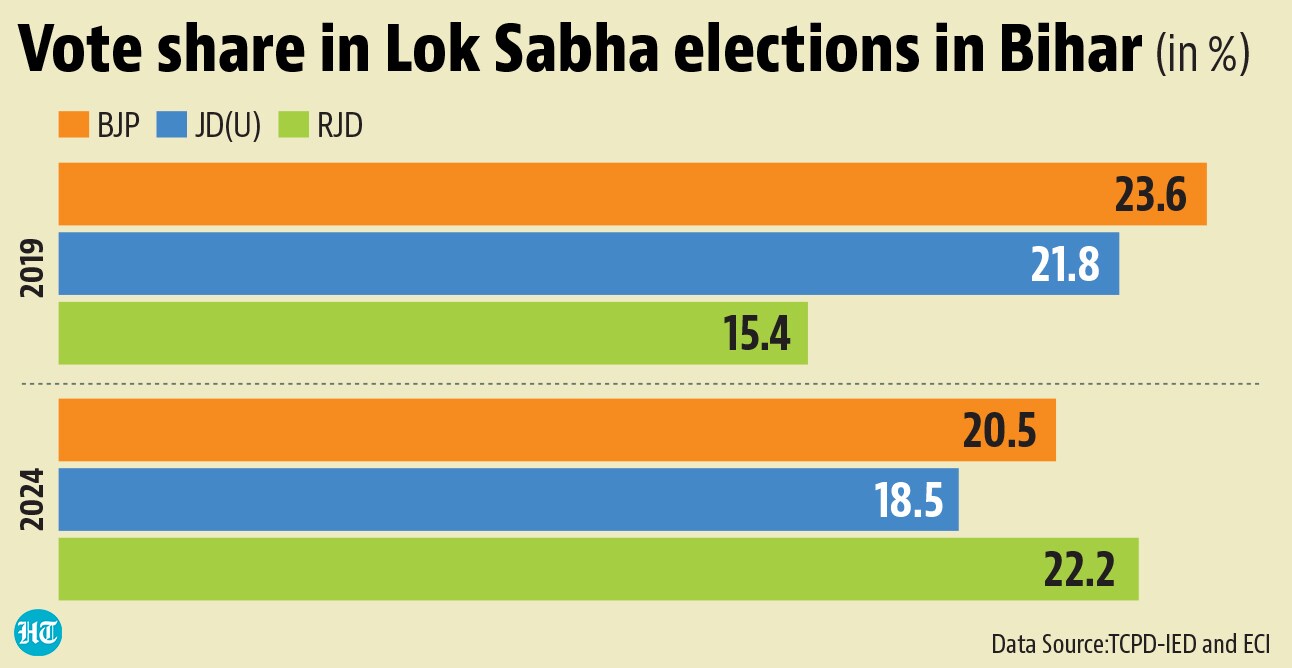
 RJD is the party with the largest vote share in Bihar in these electionsThe RJD’s vote share of 22.2% in the 2024 Lok Sabha elections is the largest among all parties in the state. This, when taken on face value, puts the RJD as the party with the largest popular support in the state. This was not the case in the 2019 Lok Sabha elections, when both the BJP and the JD(U) finished ahead of the RJD in terms of vote share. The RJD also had the highest vote share among all parties in the 2020 elections assembly elections. Do back-to-back highest vote share performances mean that the RJD is on a revival path in Bihar?
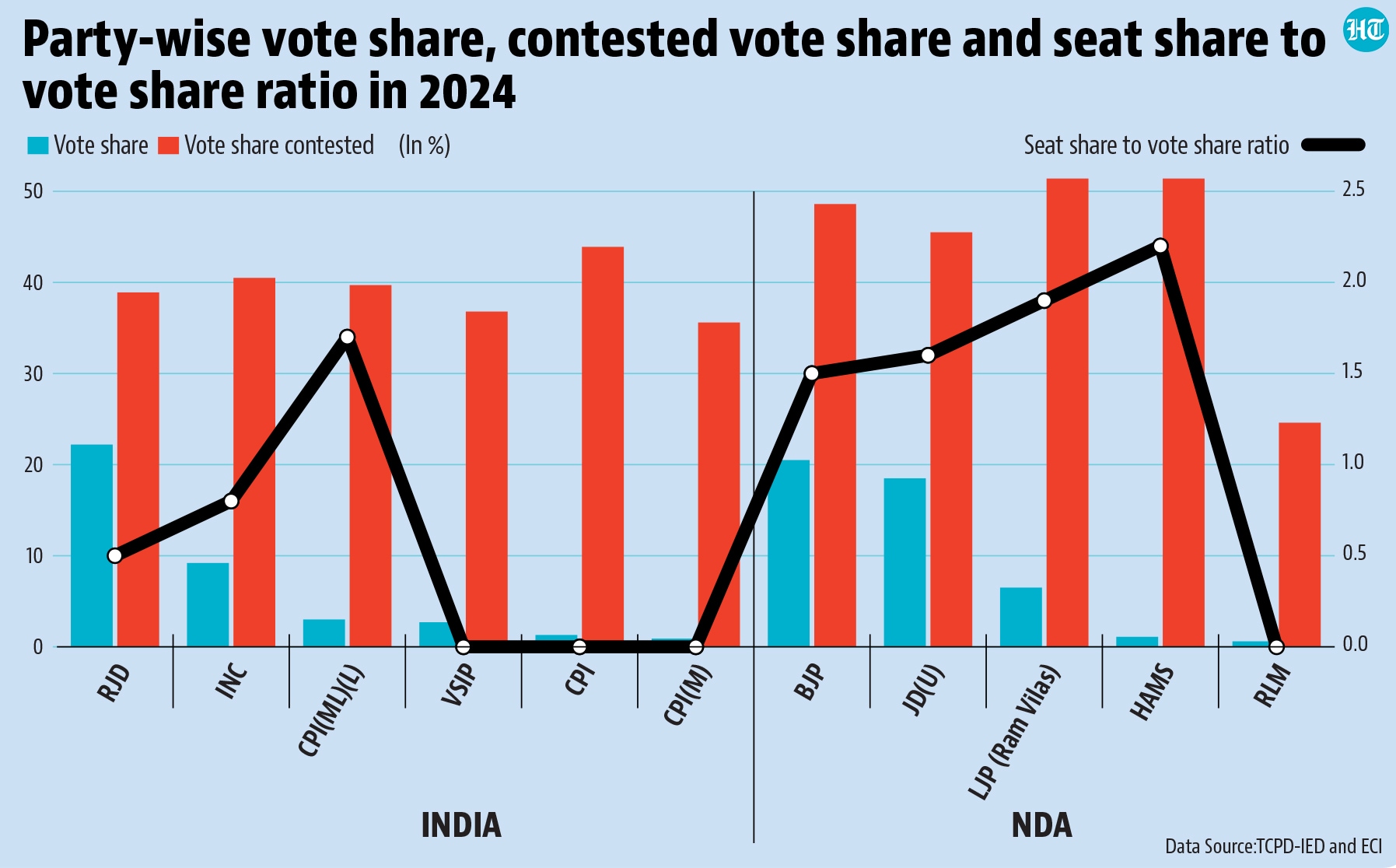
- Contested vote share numbers tell us a different storyWhile vote shares are the best measure of a party’s popular support in a first-past-the-post (FPTP) system, they have to be treated with caution when alliances come into play. This is because if a party decides to enter into an alliance, or have a wider alliance than another party, it will contest more seats and therefore enjoy a natural advantage in terms of overall vote share. This is exactly what seems to have happened with the RJD in the 2024 elections. The party contested 23 PCs, which is the highest among the 11 parties which were a part of the NDA or INDIA blocks. The BJP and the JD(U), other two major parties in the state, contested 17 and 16 seats this time. If one were to compare the contested vote share of parties in the 2024 elections – they adjust a party’s popular support for the number of PCs contested – the RJD drops to seventh rank among the 11 parties that were a part of either the NDA or the INDIA alliance. The RJD is ranked higher ahead of only the Vikassheel Insan Party (VSIP), the Communist Party of India (Marxist) and the Rashtriya Lok Manch (RLM), none of which could win a seat in the state. As is to be expected, contested vote shares have a near perfect correlation with seat share to vote share ratios of parties in Bihar, which measures a party’s ability to convert votes into seats in an FPTP system.
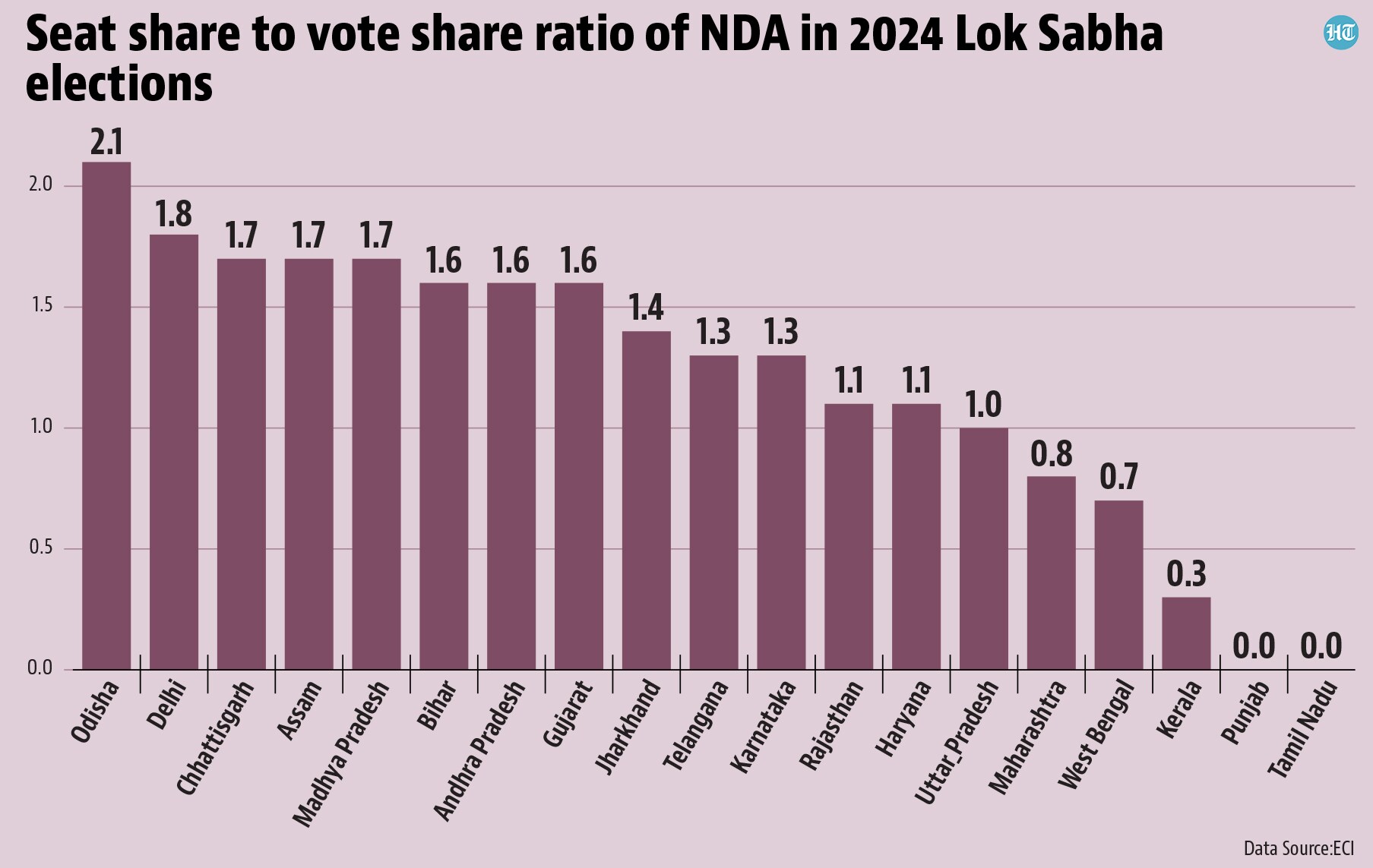
- Bihar was among the better performances of the NDA in converting votes into seatsA simple comparison of seat share to vote share ratio of the NDA in states/Union territories with at least seven parliamentary constituencies (PCs) makes this clear. These states account for 509 out of the 543 PCs in the country and 274 out of the 293 which the NDA has won in these elections. The NDA had a seat share and vote share of 75% and 47.2% in Bihar in these elections. This puts its seat share to vote share ratio at 1.59. This is the sixth highest among these states which shows that Bihar was among the better performances of the NDA in terms of exploiting the FPTP system. Seen another way, this also shows that the RJD-led Opposition alliance had a strategic disadvantage vis-a-vis the NDA in Bihar.