E-Paper



Number Theory: What do we know about salaried jobs in India?
An adjustment of salaried workers with their share in the workforce shows that men’s share in salaried jobs is 1.11 times their share in the workforce.
Published on: Jul 25, 2024, 09:02:14 IST

 Prefer HTon Google
Share via


Copy link

Employment generation is the biggest talking point in Union Budget 2024-25. The budget speech talks about earmarking ₹2 lakh crore rupees over the next five years to achieve this task. The major focus of these policies will be on generating salaried jobs in the formal sector. Will these policies achieve the desired objective? It will be premature to answer this question either way right now. However, what is worth looking at in detail is the status of already existing salaried jobs in the Indian economy. Here are five charts that answer this question in detail by looking at the periodic labour force survey (PLFS) data.

What do we know about salaried jobs in India?
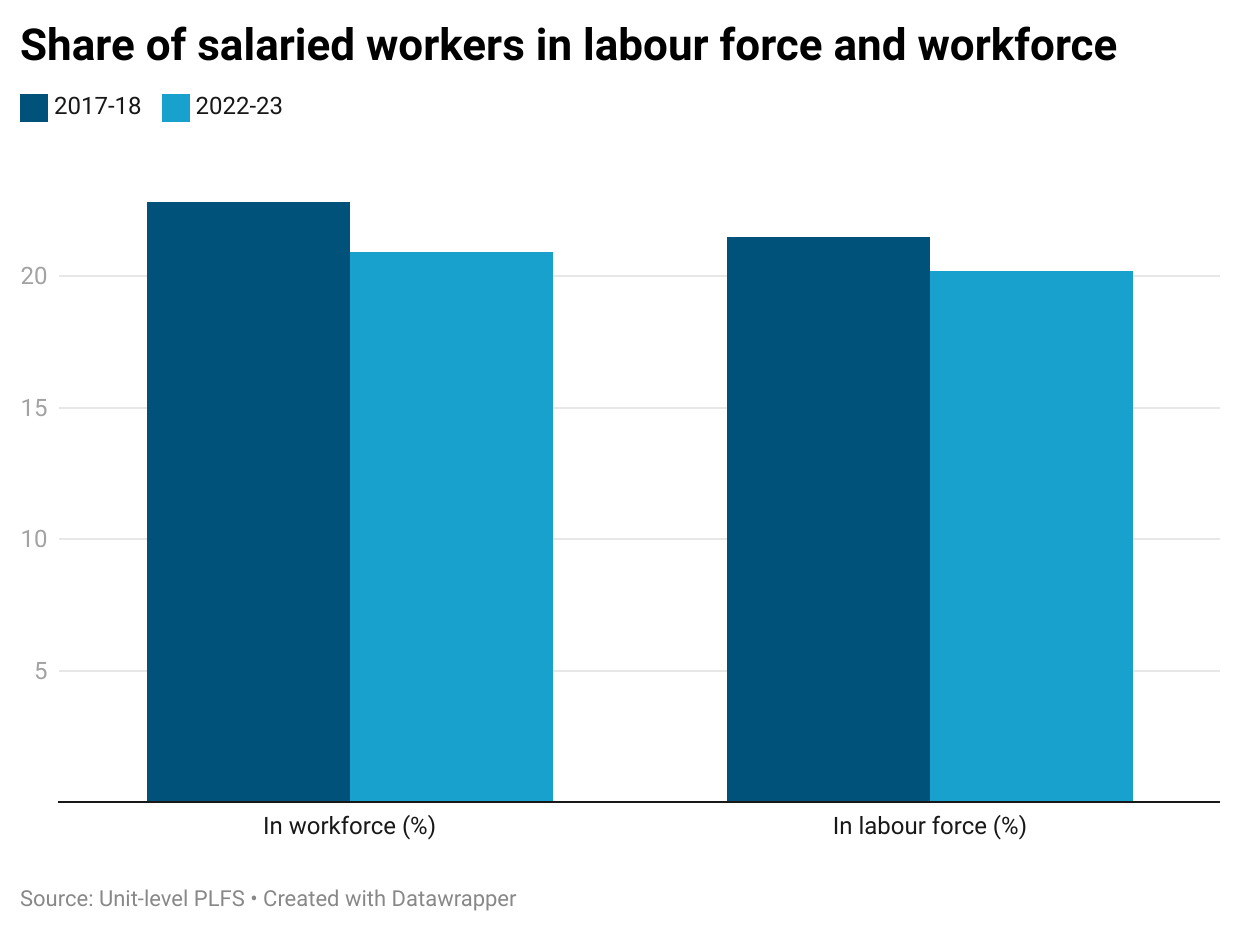
 How many salaried jobs are there in India?The 2022-23 PLFS puts the share of salaried jobs at 20.9% of India’s workforce. When seen as a share of the total labour force, the share is 20.2%. Given India’s estimated labour force of 585 million (using PLFS ratios with July 1, 2022 population estimates of the National Commission on Population), the estimated number of salaried jobs comes to about 118 million. How has this number changed under the Modi government? PLFS data only starts from 2017-18 and it shows that the share of salaried jobs in the economy has remained largely constant.
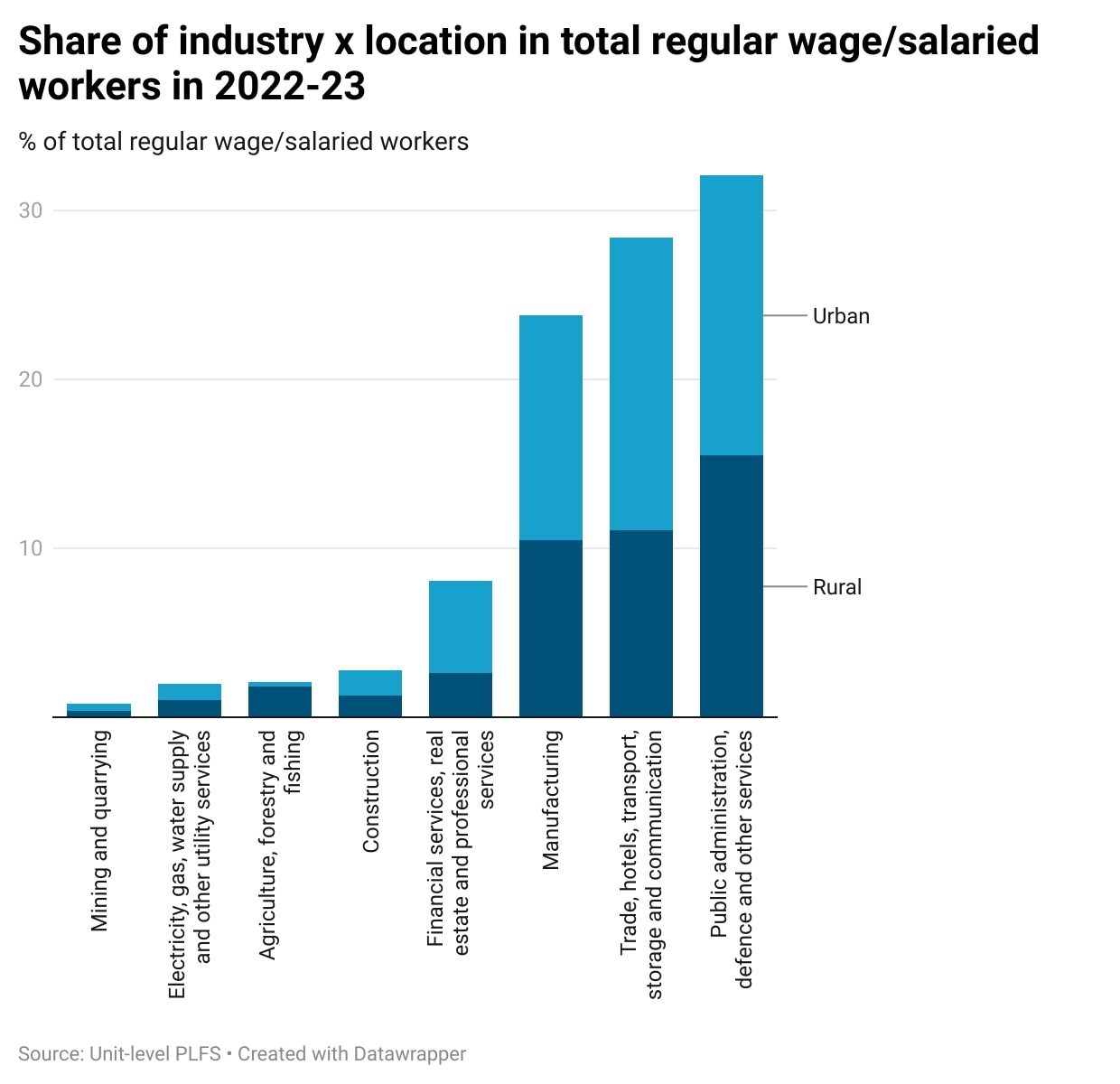
- Where are India’s salaried jobs located?One can answer this question from a geographical or sector-wise perspective. The data shows that urban areas have a disproportionate share in the total number of salaried jobs. While they account for just 24% of the workforce, their share in salaried jobs is 56%. To be sure, the PLFS also counts paid apprentices and those receiving “piecemeal” wages as regular wage or salaried (no distinction), as long as there is no daily or periodic renewal of the work contract (it does not need to be a written one). In terms of major sectors, just three , namely, public administration, defence, and other services; trade, hotels, transport, storage, and communication; and manufacturing, account for 84% of total salaried jobs. This is, again, a disproportionate distribution, as these sectors account for just 38% of total workers in the country. Is the urban skew in salaried jobs a reflection of agricultural employment in rural areas? Not really. Even if one were to exclude agricultural employment, the relative share of urban areas in salaried jobs would still be 1.35 compared to just 0.75 for rural areas.
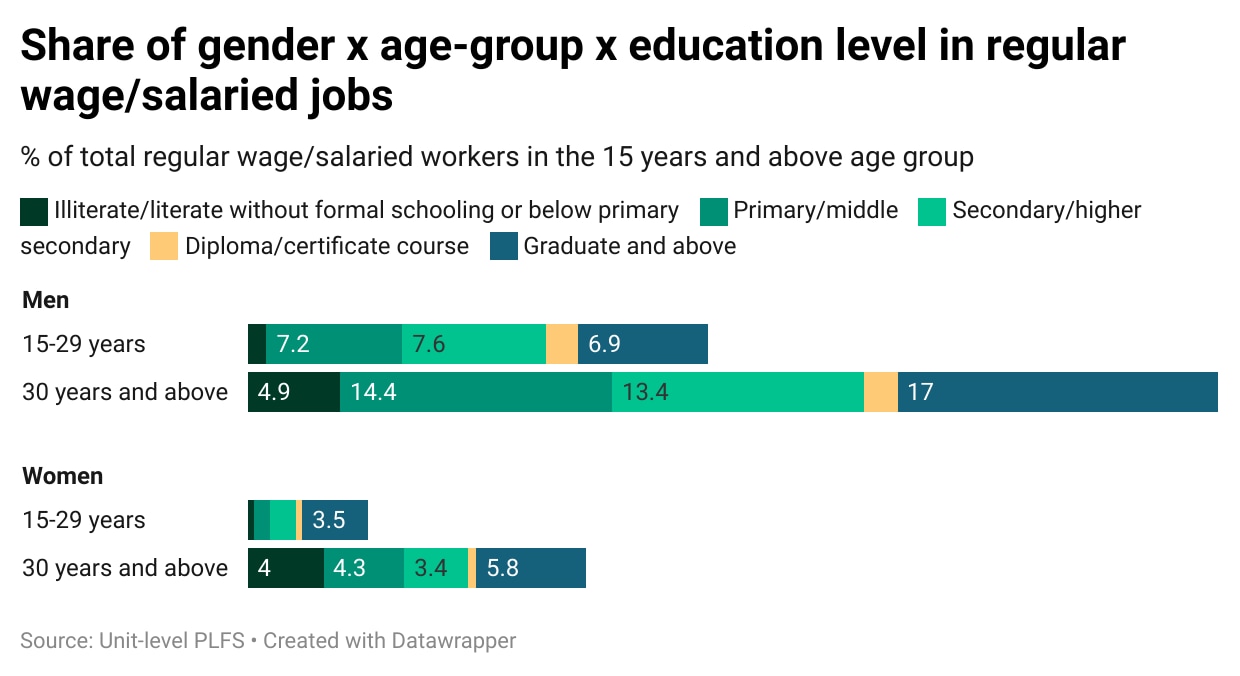
- Who has India’s salaried jobs?One can try and answer this question by age, gender and educational qualification. Unit level data from the PLFS shows that 76% of salaried jobs are with men, only one-third of them are with people who at least have a graduate degree and 31% of them are with workers who are less than 30 years old. To be sure, relative share of these indicators are more useful in understanding the interpersonal distribution of salaried jobs. This is because the workforce does not have an equal representation on the basis of gender, education and age. An adjustment of salaried workers with their share in the workforce shows that men’s share in salaried jobs is 1.11 times their share in the workforce. This number is 0.76 for women, 1.22 for the 15-29 years age group, 0.93 for the 30 years and above age group, and 2.75 for those with a graduate or higher degree. At least one of these numbers – that of young being over-represented in salaried jobs – needs to be read with caution because it is likely a reflection of the younger workers choosing unemployment rather than working in agriculture.
- Not all salaried jobs are well payingThis is the most important thing to keep in kind. Less than 10% of salaried jobs in the PLFS data shows a monthly income of ₹50,000 or more. More than two-third of them actually have an income of less than ₹20,000 per month. Similarly, a lot of salaried jobs do not have social security provisions. Only 44% of the salaried jobs in the PLFS have some form of social security provision, which the PLFS defines as provisions where the employer makes a contribution, such as EPF or paid maternity leaves.