E-Paper



Number Theory: Will welfare be a crucial plank in J&K elections?
What made Jammu & Kashmir unique among Indian states was the fact that it was the only Muslim-majority state in India.
Published on: Sep 25, 2024, 08:13:40 IST

 Prefer HTon Google
Share via


Copy link

The Union territory (UT) of Jammu & Kashmir is in the midst of its first assembly elections. Given the erstwhile state’s – it became a UT in 2019 – turbulent political history, the ongoing elections are largely seen as a debate on larger political issues such as the abrogation of Article 370 and the restoration of statehood for Jammu & Kashmir. Without prejudice to any of these issues, there is another question to be asked about the elections. How much of a plank would welfare be in Jammu & Kashmir? Here is what an HT analysis of official statistics shows.
Will welfare be a crucial plank in J&K elections?
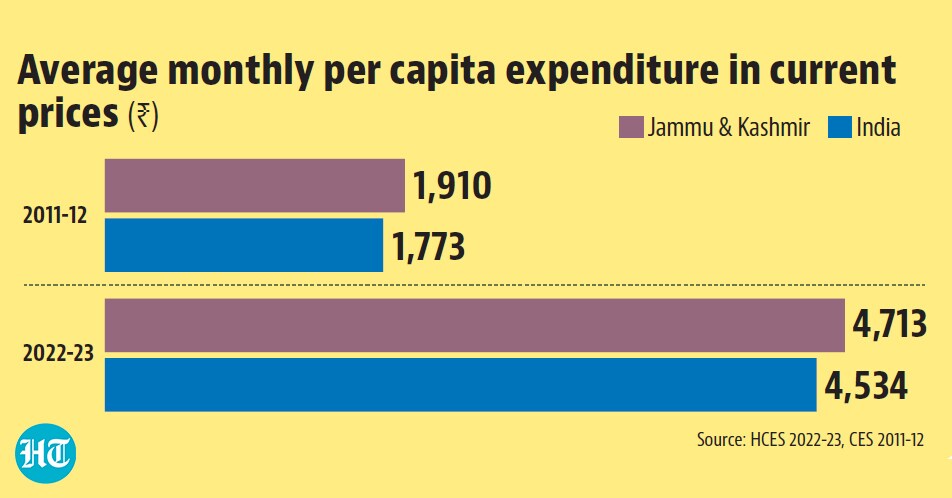
 Jammu & Kashmir’s consumption spending is slightly above the all-India averageData from the 2022-23 Household Consumption Expenditure Survey (HCES) shows that the average person from Jammu & Kashmir spends slightly more than the average Indian. Jammu & Kashmir’s average monthly per capita expenditure (MPCE) was ₹4,713 compared to the all-India figure of ₹4,534. To be sure, a comparison of 2022-23 HCES data with the 2011-12 numbers shows that Jammu & Kashmir’s lead over all-India MPCE has fallen in the last decade from 7.8% to 3.9% between the 2011-12 and 2022-23 consumption surveys.
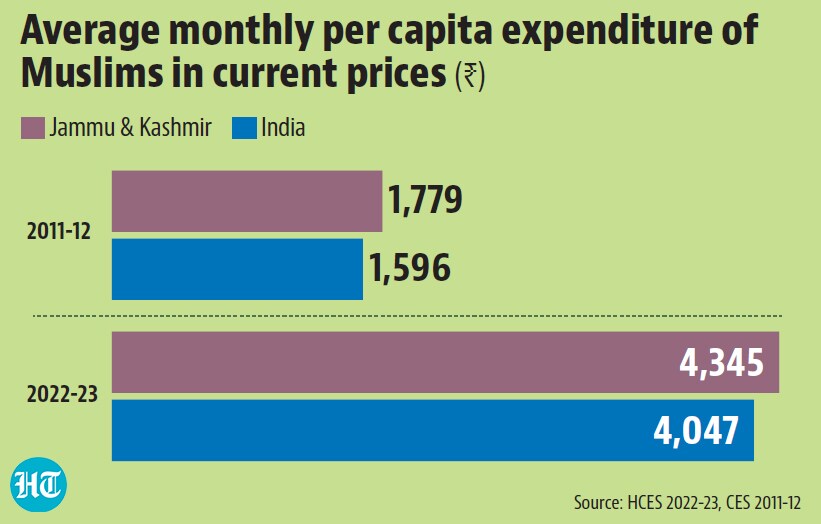
- Muslims in Jammu & Kashmir have a much bigger advantage over their counterparts in the rest of the countryWhat made Jammu & Kashmir unique among Indian states was the fact that it was the only Muslim-majority state in India. According to the 2011 census, the share of Muslim population in Jammu & Kashmir (after excluding the two Ladakh districts) was 69%. How do Jammu & Kashmir’s Muslims compare with the rest of Muslims in the country when it comes to consumption spending? Data shows that Jammu & Kashmir’s MPCE advantage was larger vis-à-vis the rest of the country when it came to just Muslims rather than the entire population. The average MPCE of Muslims in Jammu & Kashmir in 2022-23 was ₹4,345 which was 7.4% more than the average MPCE for Muslims at the national level. To be sure, Jammu & Kashmir has seen a loss of its lead in average MPCE for both Muslims and the overall population between 2011-12 and 2022-23.
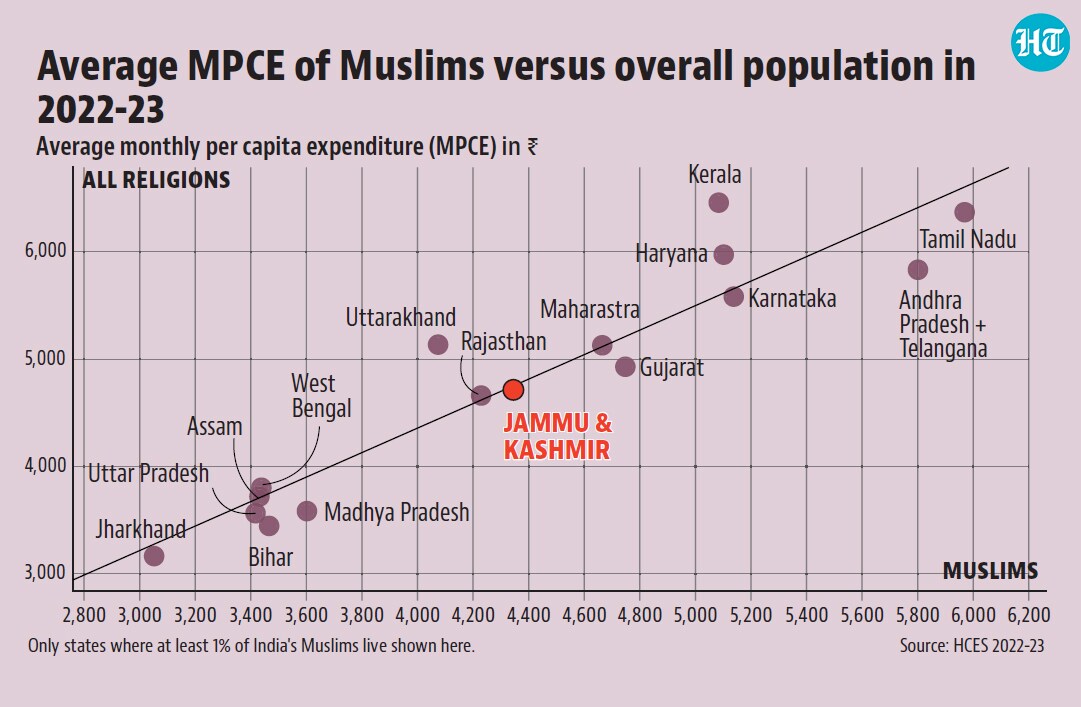
- Jammu & Kashmir’s Muslims are not the richest in the country when it comes to consumption spendingWhile the average Muslim in Jammu & Kashmir is more well-to-do than the average Indian Muslim, there are many states where Muslims are better than their counterparts in Jammu & Kashmir. This could be a result of the overall economic ranking of the UT among different states and UTs. A comparison of average MPCE for Muslims and the entire population across states where at least one percent of India’s Muslims live shows that economic fortunes of Muslims are pretty closely tied with that of the entire population, with MPCE for the two categories showing a strong positive correlation.
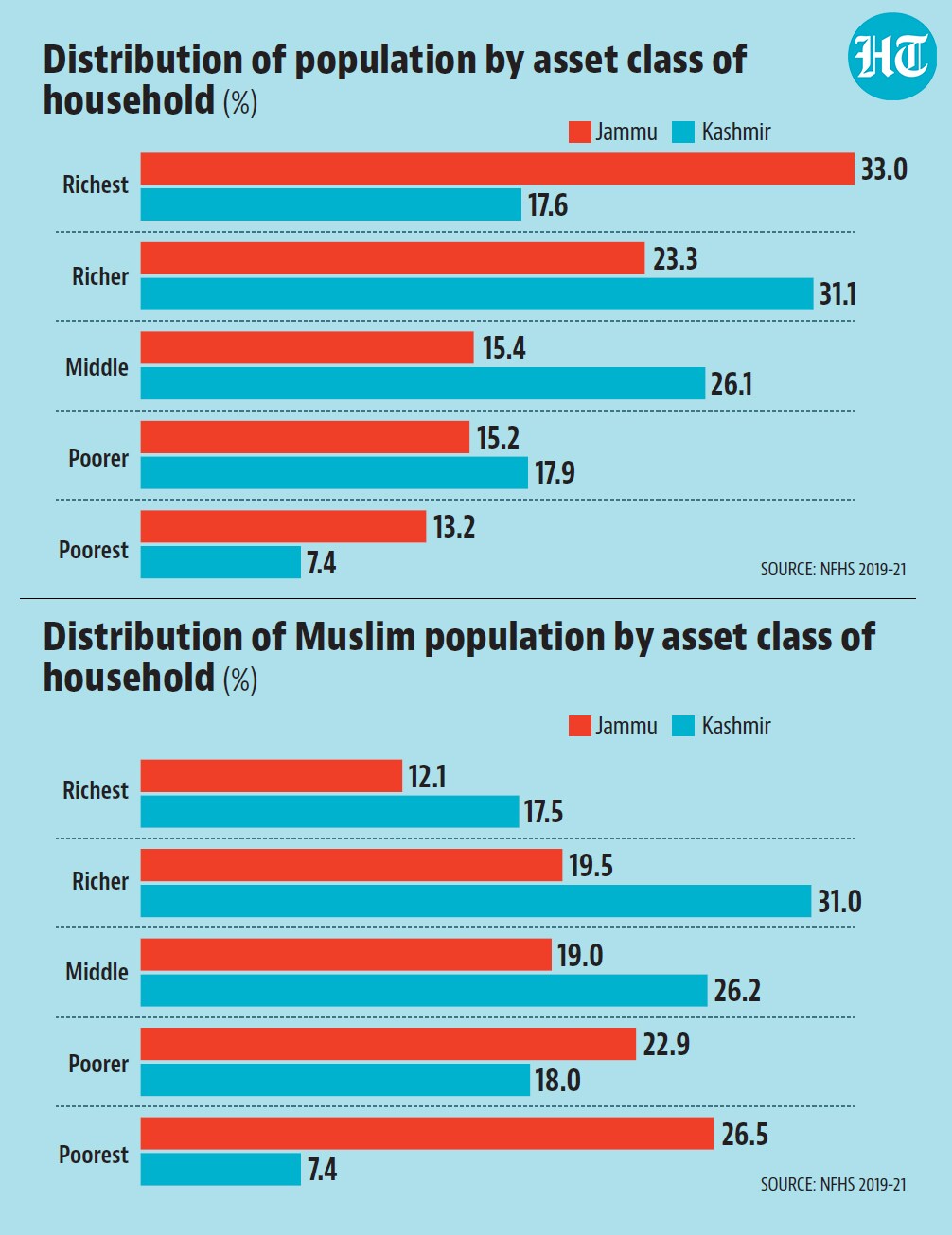
- But neither Jammu & Kashmir, nor its Muslims are an economically homogeneous groupThis can be seen from the classification of households into national wealth quintiles – bottom to top 20% -- by the National Family Health Survey (NFHS) conducted in 2019-21. This part of the analysis uses NFHS data instead of NSSO data because the latter is not representative at the district level. The 2019-21 NFHS – the latest available -- shows that 33% of the population in the Jammu region is among the top 20% richest households in the country. This share is just 17.6% for the Kashmir region. The Jammu region also has a higher concentration of the population classified among the poorest 20% in the country. 13% of the region is in the poorest 20% group compared to just 7% in Kashmir. As is obvious, this is because Jammu has a smaller proportion of its population in the middle classes. The trends seen for the overall population are somewhat reversed when looking at the economic condition of Muslims in the two regions. Muslims in Jammu are more likely to belong to the poorest quintiles than the Muslims in the Kashmir region. However, even the regions are not economically homogeneous. For example, while 12% of Muslims in the Jammu region are among the richest 20% households in the country, this share is 67% for Muslims living in the Jammu district, higher than even the 36% figure for Srinagar. To be sure, only a minuscule 0.6% of the UT’s Muslims live in Jammu district compared to 14% in Srinagar, according to NFHS. These numbers suggest that it would be unwise to completely write off bread and butter issues in the ongoing Jammu & Kashmir elections.