
 E-Paper



Red retreat: Is LDF on its way out in Kerala? | Number Theory
The writing on the wall, from the results, suggests that the Communist Party of India (Marxist) or CPI(M) led LDF has its back against the wall
Updated on: Dec 19, 2025, 08:38:00 IST

 Prefer HTon Google
Share via


Copy link

Results for Kerala’s local body polls were declared over the weekend. These polls come months before the 2026 assembly elections and have historically been a bellwether for the assembly polls. The writing on the wall, from the results, suggests that the Communist Party of India (Marxist) or CPI(M) led Left Democratic Front (LDF) has its back against the wall. Here’s a detailed explanation of the argument.
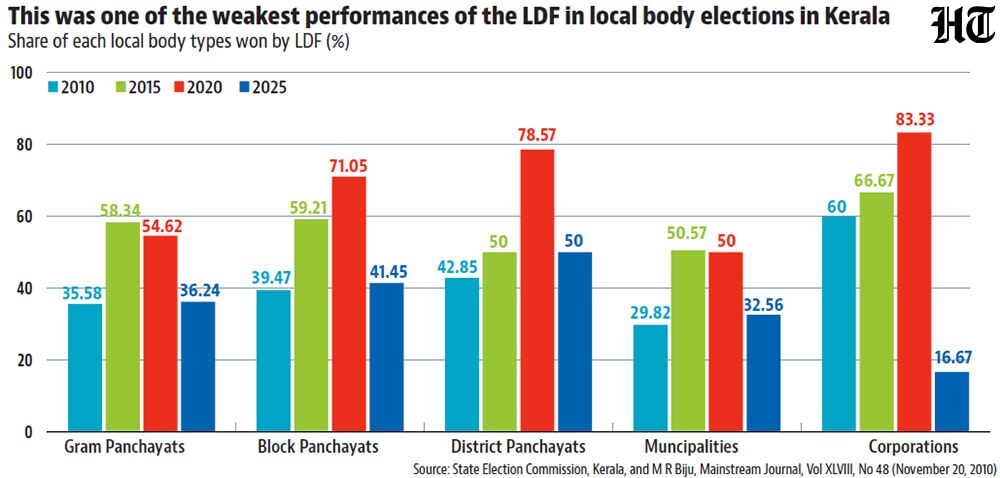
 2025 is the LDF’s worst showing in local body polls in two decadesThis is important to put the results in context. When compared with 2010, 2015 and 2020, the LDF’s 2025 performance marks its lowest seat share across all tiers of local bodies. The LDF swept the 2005 polls after which it went on to achieve of its largest ever victories in the state in the 2006 assembly election. It also went on to win the Assembly elections in 2016 and 2021 after strong performances in the preceding local body polls, it lost the 2011 assembly election, albeit by a narrower margin than its loss in the 2010 local body elections suggested.
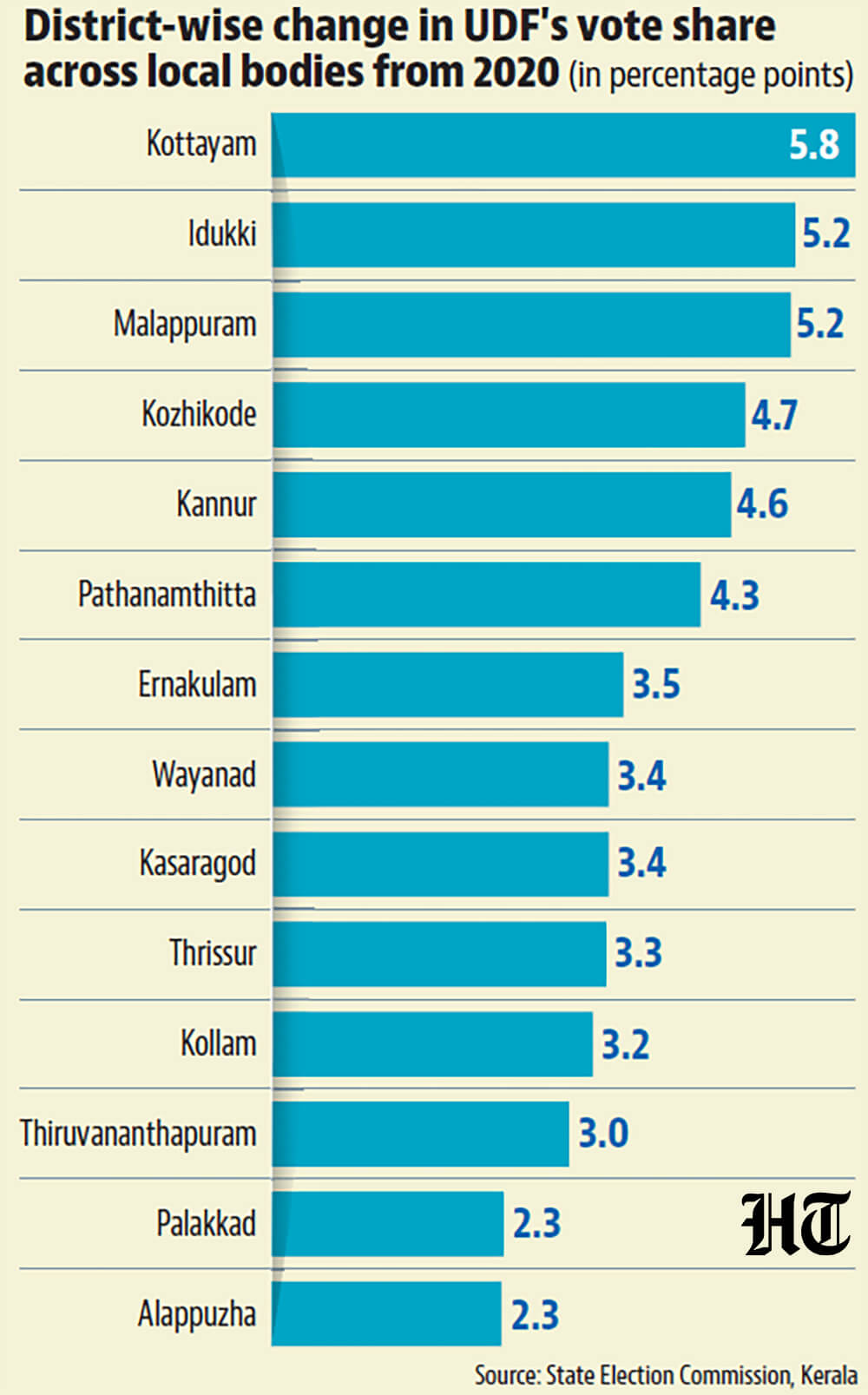
- For the UDF, the comeback was statewide, not just in comfort zonesAfter two weak local body cycles and unprecedented failure to oust an incumbent government in 2021—the first in Kerala since 1977—the Congress-led United Democratic Front sharply improved its prospects in the state, winning majorities in 53.6% of gram panchayats, 52% of blocks, 50% of district panchayats, 62% percent of municipalities and 66.7% of corporations, up from 34.1%, 25.0%, 21.4%, 47.7% and 16.7% in 2020. Its gram panchayat gains were especially strong in Kottayam (20 to 44), Thrissur (15 to 34) and Ernakulam (47 to 66), while the UDF also expanded in districts long associated with Left dominance such as Kannur (14 to 21) and Kozhikode (25 to 39). The alliance secured a vote share of 41.2% in the local bodies overall, up from 37.2% in 2020.
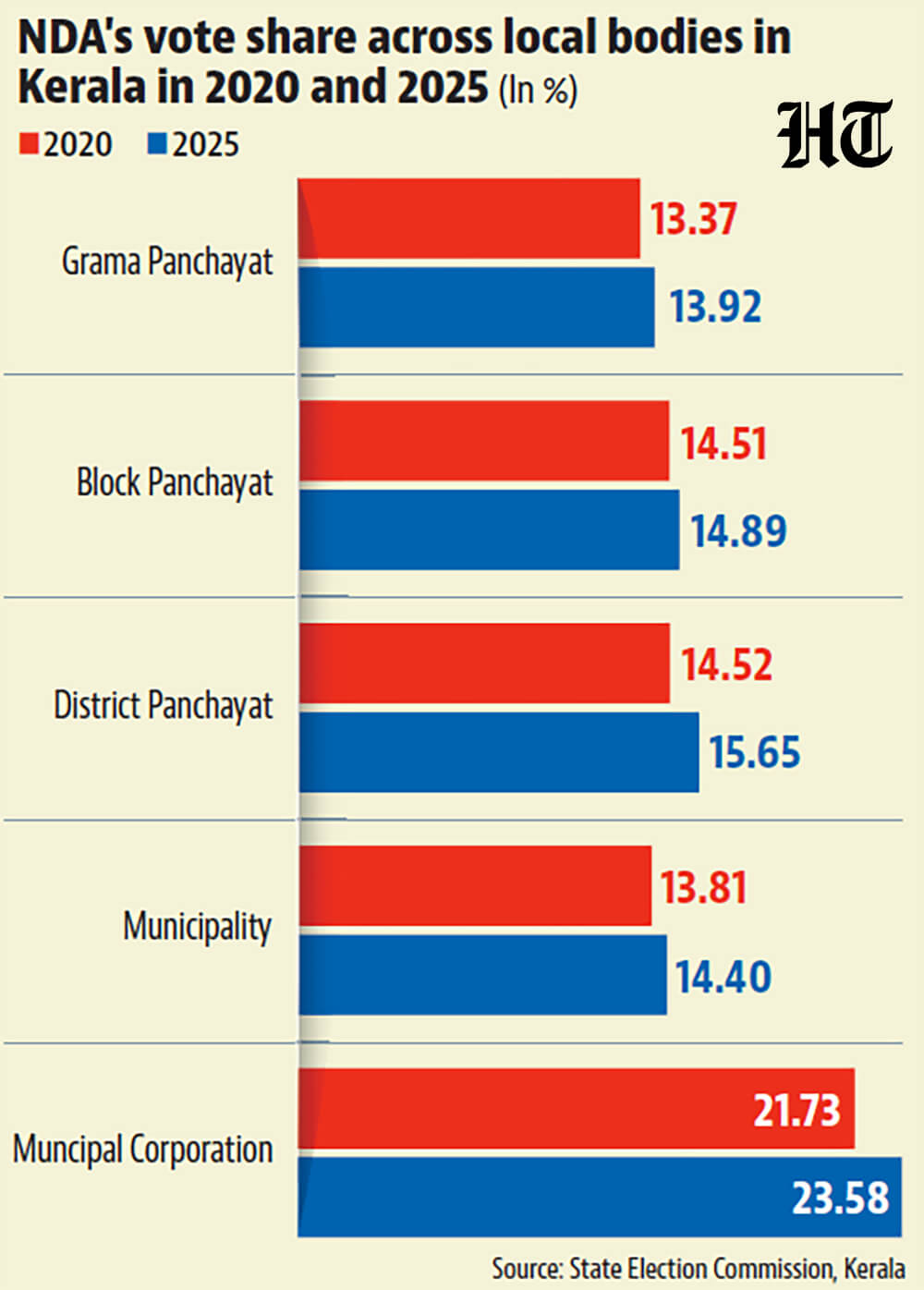
- NDA made some gains, mainly at the Left’s expense and in big citiesThe BJP-led National Democratic Alliance’s expansion in Kerala remained modest in aggregate terms, but the pattern of its gains was politically telling. The NDA’s share of gram panchayats rose to 2.8%, up from 2.0% in 2020, while its footprint in municipalities held steady at 2.3%. The real inflection point came at the top of the urban pyramid. For the first time, the NDA secured a majority in a corporation. District-level data suggest that the NDA’s expansion came largely at the LDF’s expense, at least electorally. The clearest example is Thiruvananthapuram, where the BJP not only won the corporation but also made gains in several urban and semi-urban wards where the Left’s margins were comfortable in 2020. In contrast, its gains in gram panchayats were scattered and thin, reflecting limited increase in rural penetration. To be sure, NDA’s vote share only saw marginal gains from 14.3% in 2020 local body elections to 15.1% in 2025, with most of its votes coming from urban areas.
- An assembly loss could add to CPI(M)’s larger challengeA likely loss in Kerala would leave the CPI(M) without any state government in India for the first time since 1977. Kerala has been the last bastion of communism after the CPI(M) lost West Bengal and Tripura in 2011 and 2018 respectively. Even in Kerala, the CPI(M)’s success post 2011 has been bittersweet because the 2016 and 2021 victories did not translate into commensurate performance in Lok Sabha elections. One of the probable causes of the CPI(M)’s resilience in the state was the appeal of various populist measures announced by the government . The recent panchayat setbacks suggest that these may no longer suffice.


Unlock a world of Benefits with HT! From insightful newsletters to real-time news alerts and a personalized news feed – it's all here, just a click away! -Login Now!


