E-Paper



This oil jolt is unlike the previous ones | Number Theory
Between the energy market outlook and the politics around the conflict, the current oil shock could end up being the most painful the world has seen. Here's how

 Prefer HTon Google


The International Energy Agency (IEA) released its monthly Oil Market Report on Thursday. The opening line of the report states the gravity of the current energy crisis in unequivocal terms: “The war in the Middle East is creating the largest supply disruption in the history of the global oil market.”
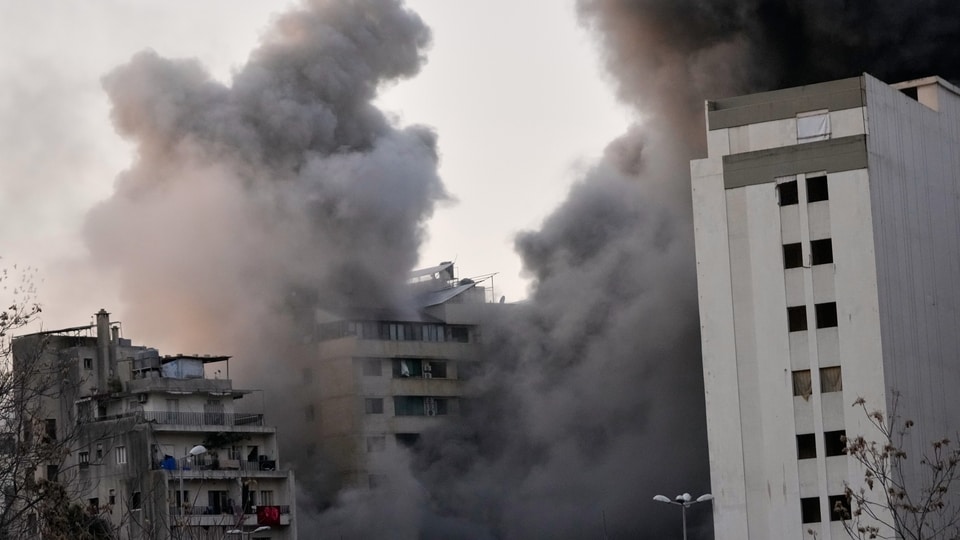
Statements from the political leadership of Iran and US – the two countries which matter the most as far as ending the conflict is concerned – do not serve up any optimism on the current disruption. Bloomberg reported US President Donald Trump saying “stopping Iran is greater interest to me than the price of oil” and “US makes a lot of money when oil prices go up”, while Iran’s military spokesperson has threatened that price of crude oil will reach $200 per barrel.
Between the energy market outlook and the politics around the conflict, the current oil shock could end up being the most painful the world has seen. Here is how.
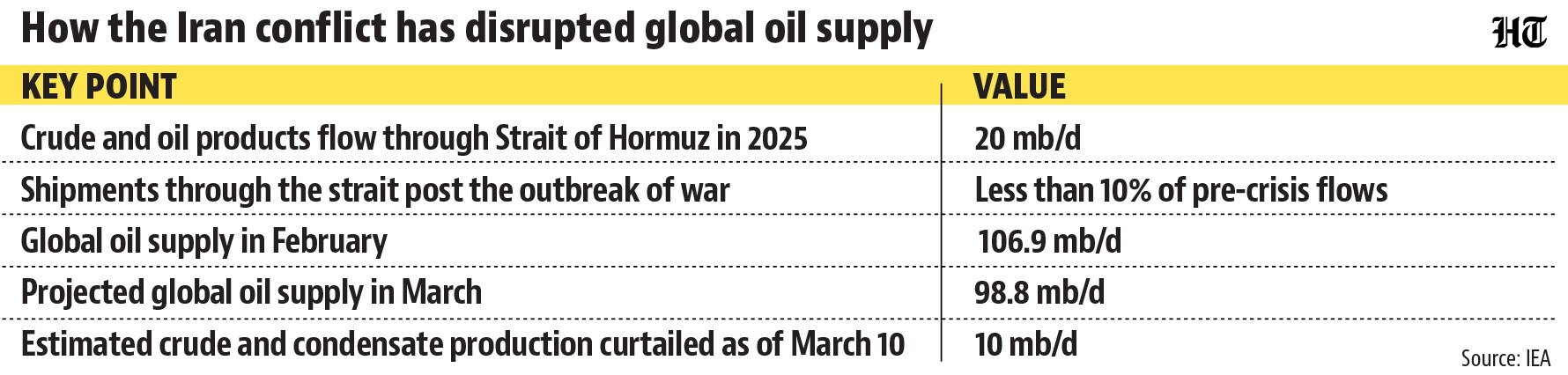
 IEA estimates the global oil supply shock on account of the war in March in the ballpark of 10%“With crude and oil product flows through the Strait of Hormuz plunging from around 20 million barrels per day (mb/d) before the war to a trickle currently, limited capacity available to bypass the crucial waterway, and storage filling up, Gulf countries have cut total oil production by at least 10 mb/d. In the absence of a rapid resumption of shipping flows, supply losses are set to increase”, the IEA report says. “Global supply in March is projected to fall by 8 mb/d to 98.8 mb/d,” it adds. IEA’s estimates are on the side of optimism because it assumes that “options to bypass the Strait (of Hormuz) are fully utilised from early March and seaborne flows gradually normalise from late March”. In fact, the report itself admits this. “With no signs of a de-escalation in hostilities or a clear timeline for a recovery in flows through the Strait at the time of writing, we note that the March forecast and beyond carry a high level of uncertainty”, it says.
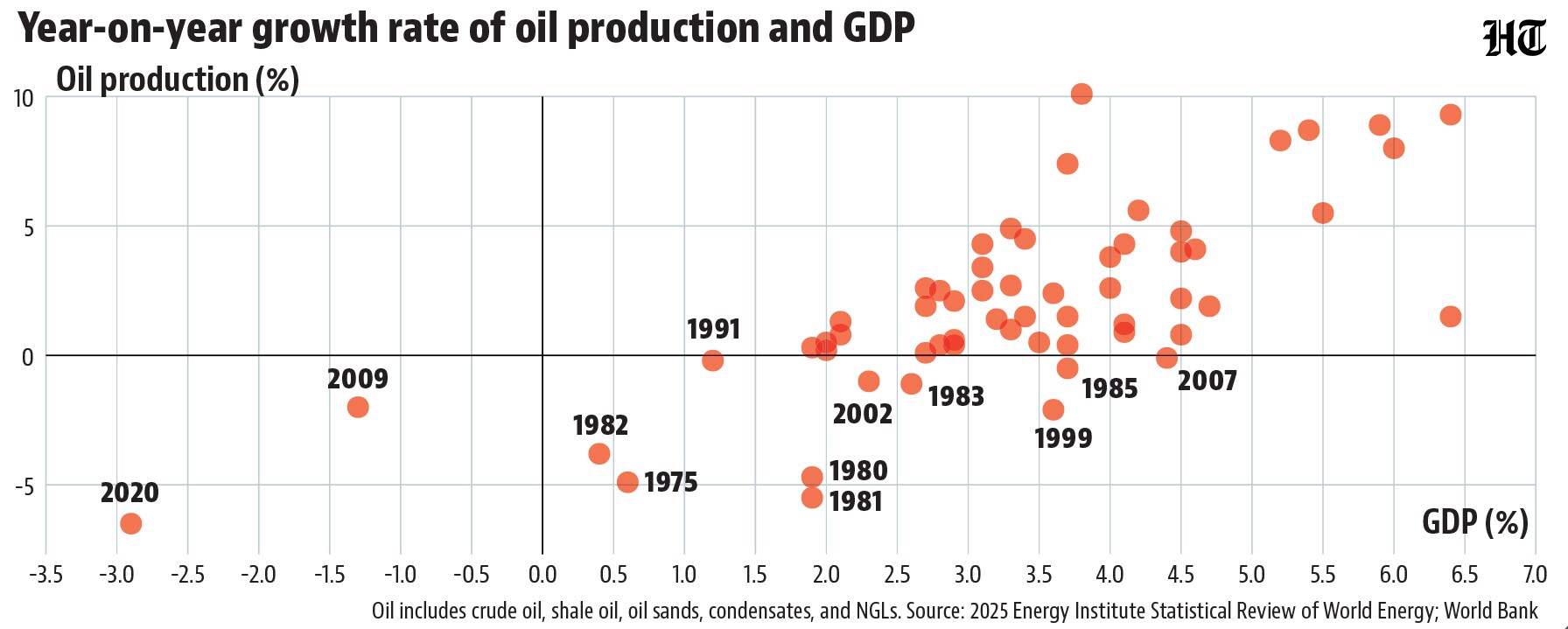
- It is early days, but a comparison with past oil shocks is instructive hereIf the war is prolonged and the Strait of Hormuz remains closed, the world will face nothing short of an economic apocalypse. A Bloomberg Economics estimate says that one month of closure of the Strait will drive Brent crude toward $105, peak price would approach $164 with a three-month closure, after which prices will start coming down due to demand destruction. How big have past oil shocks been in terms of supply shock? Long-term data on oil production from The Energy Institute – a global orgnaisation of energy sector professionals – shows that the worst the world faced in terms of fall in production of oil (excluding the pandemic year) was 1981 – the end of the Iranian revolution and the beginning of the Iran-Iraq war – when there was an annual contraction of 5.5%. Oil production has contracted in only 12 out of past 59 years for which this data is available. Global GDP growth fell sharply in 1980, 1981 and 1982.
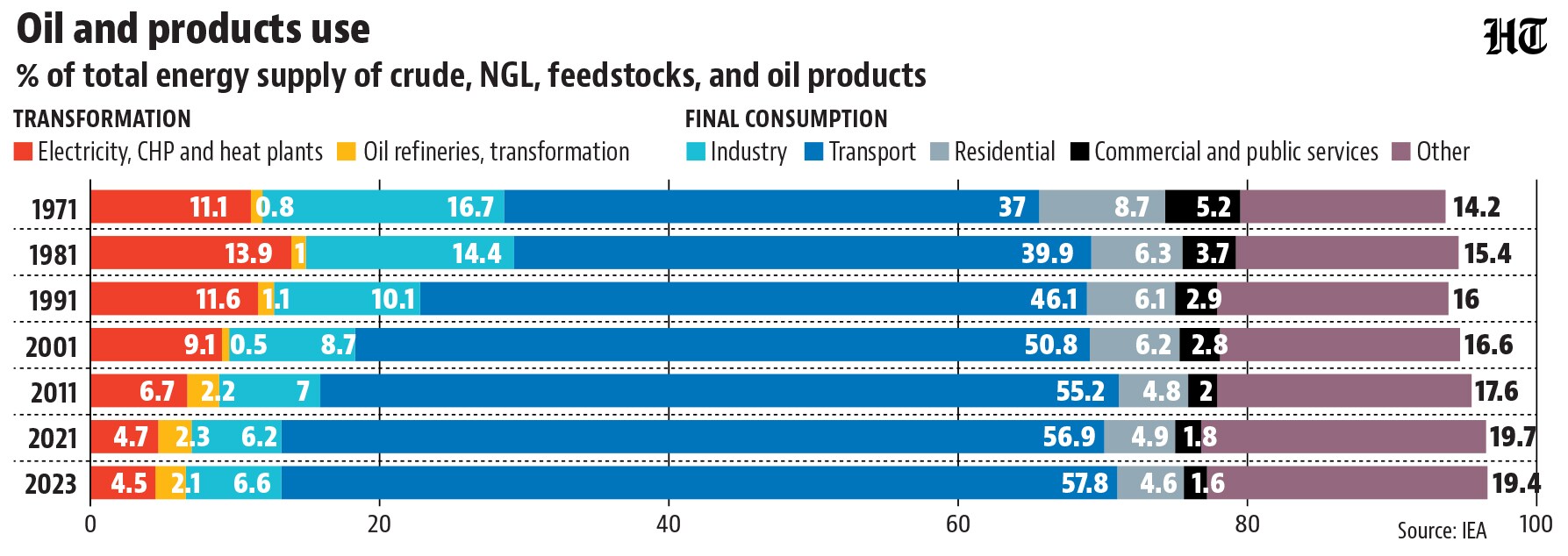
- Global oil demand has evolved in a way which makes it difficult to substituteThe Economist’s leader on the current crisis articulates it well. “The world depends less on oil than it did in 1973, when an Arab embargo caused crude prices to quadruple, or 1979-80, when the Iranian revolution and the Iran-Iraq war hit supply. Then, it was still common to burn oil to produce electricity. Today it is used less widely, mainly to power transport and make petrochemicals. Yet this evolution is double-edged. Today’s oil demand is stubborn, so prices have to rise more for a given disruption of supply”, it says. An HT analysis of data from the IEA corroborates the line of reasoning. In 1971, transport used 37% of total petroleum supplies. This number increased to 58% by 2023.
- To summarise, three points can be made. The immediate impact of the oil shock on account of the war is the biggest ever. History teaches us that even smaller supply shocks, if prolonged, have inflicted severe economic pain. And, barring a wholesale shift to renewables away from ICE-driven transport – which Trump killed before he launched the war – the world might find it very difficult to bring down its oil consumption without inflicting economic pain.