
 E-Paper



Number Theory: Unraveling the tax story during 10 yrs of NDA govt
Finance minister Nirmala Sitharaman will present the first budget of the newly elected National Democratic Alliance (NDA) government on July 23

 Prefer HTon Google


Finance minister Nirmala Sitharaman will present the first budget of the newly elected National Democratic Alliance (NDA) government on July 23. While there is an element of continuity to the government in the sense of Prime Minister Narendra Modi continuing to lead the government and BJP being the largest party in the alliance, there is also a difference, because unlike in 2014 and 2019 the BJP does not have a Lok Sabha majority of its own this time. Will this changed reality show in the budget?
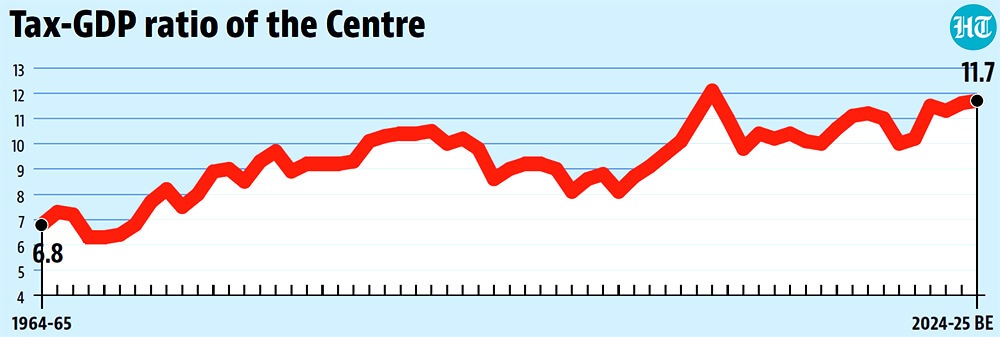
 Centre’s tax-GDP ratio has been steadily rising in the past few years and could soon surpass its all-time high value of 2007-08This is among the most credible fiscal achievements of the current government. The centre’s gross tax revenue (GTR) as a share of nominal GDP has increased for four consecutive years beginning 2020-21 to reach 11.6% in 2023-24. If one were to use the budget estimates for nominal GDP and GTR for 2024-25 from the interim budget presented in February this year, the tax-GDP ratio for 2024-25 is expected to be 11.7%. According to the Centre for Monitoring Indian Economy’s (CMIE) database, this is the second highest value of this number in India’s entire history. The highest ever tax-GDP ratio for India was 12.1% in 2007-08, just before the financial crisis derailed what was an unprecedented boom in the Indian economy. The consistent, albeit incremental, increase in the centre’s tax-GDP ratio suggests that the 2007-08 benchmark could be breached going forward.
The two most important things in a budget are taxes and government spending. This two-part pre-budget series will look at both. The first part will look at the larger tax story under the past two Modi -led governments and the second part will look at the political economy of government’s spending during this period. Here are four charts which give us a summary of the tax story in the last ten years.
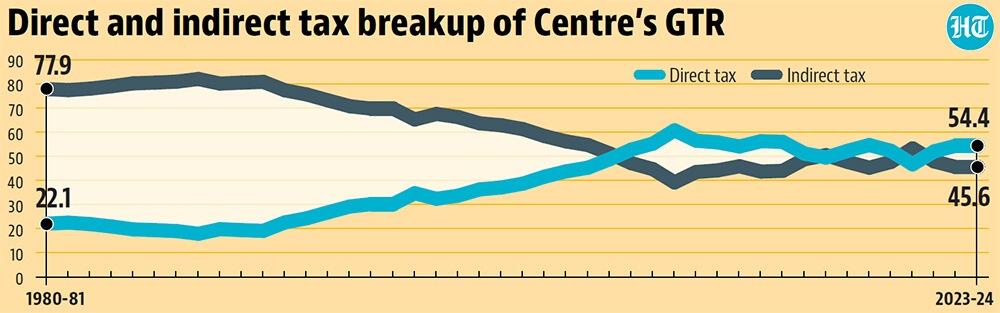
- And the increase in tax-GDP ratio has come with a progressive turn in the tax burdenThis is another important aspect of the fiscal story. A government’s tax revenues can increase through both the direct and indirect tax route. Because direct taxes are progressive in nature – tax rates rise with higher incomes unlike in the case of indirect taxes where everybody, rich or poor, pays the same rate – a direct tax driven rise in tax-GDP ratio will entail a progressive turn in tax burden. This is exactly what has been happening as far as India’s post-pandemic tax story is concerned. A break-up of centre’s GTR shows that this is unlike what was the case in the first few years of the Modi government when it assumed office in 2014. To be sure, a long-term look at this trend shows that the share of direct tax has been higher in the past.
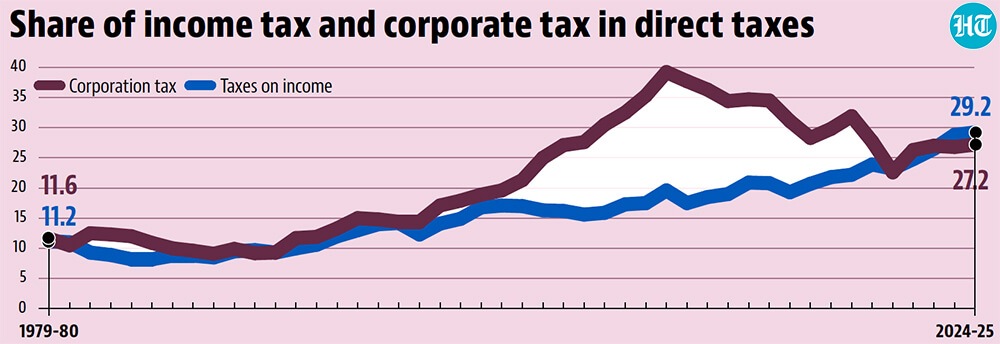
- But there is a twist in the direct tax storyThis is what a break-up of the direct tax data shows. Among the two most important components of the direct tax basket, share of income tax in GTR has historically always been lower than that of corporate tax. However, this has changed in the last couple of years. While part of the reason could be rapid growth in white collar salaries and perhaps even associated capital gains tax incomes, the reduction in corporate tax rates in 2019 must also have played a role.
- And share of revenue transferred to states continues to much lower than finance commission’s 41% markTax revenue transferred to states, as a share of center’s GTR was 32.1% in the 2023-24 Revised Estimates and is expected to be 31.8% in the 2024-25 Budget Estimates. These numbers are much lower than the 41% devolution share mandated by the 15th Finance Commission and show that a large part of the centre’s revenue is being kept outside the divisible pool. To be sure, there is research which shows that the overall transfer from centre to states has increased rather than decreased under the Modi government because of spending on things such as centrally sponsored schemes etc.
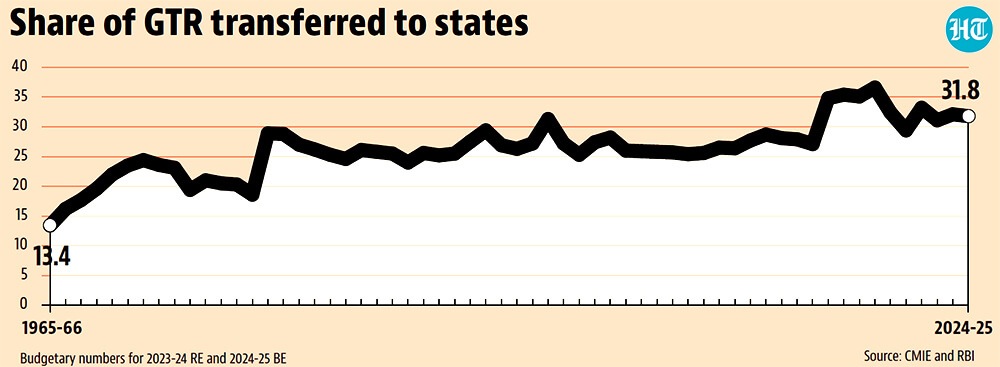
As is obvious, the first two charts in this story suggest a credible fiscal performance by the government, but the last two underline where political logic might put pressure on the government to provide relief to individual tax payers, especially in the relatively lower income brackets, and perhaps even share a greater amount of the tax proceeds with the states. To be sure, these are pulls and pressures which might continue over the term of the current government rather than the budget being presented next week.
This is the first of a two-part pre-budget series. The second part will look at government’s spending.


