E-Paper



Who are India's governors? | Number Theory
.

 Prefer HTon Google


Who gets to be a governor in India, and what have they done before reaching that position? Are some professions more common among governors than others? Do certain social or religious groups get appointed more often, and does this vary by political party? Are some states more frequently represented in these appointments? The second part of this series looks into these questions to understand the patterns behind gubernatorial selections -who they are, where they come from, and how political parties influence these choices.
This is the second in a three-part data journalism series based on HT’s Governors in India database. The first part covered the methodology and appointment patterns under various presidents and prime ministers. The third explores governors’ tenures across states, including transfers and shifts in appointment age.
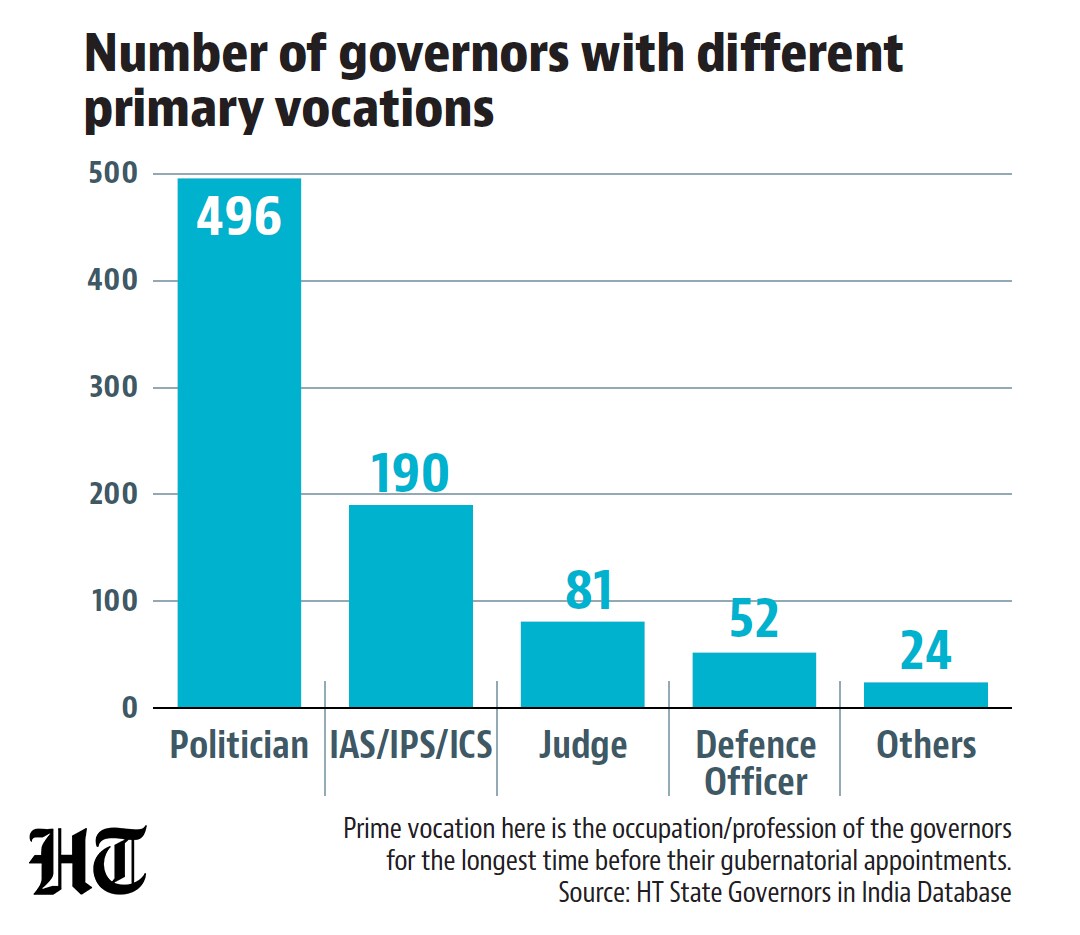
 Over half the governors have been politicians496 out of the 843 governors in India have been politicians, which means they have been associated with a political party. Bureaucrats, judges and armed forces personnel account for another 38% of all governors appointed so far. Persons who were either a bureaucrat, judge or armed forces officer but joined a political party before being appointed a governor have been counted as a politician in the dataset. In terms of previous offices held before becoming governor, 84 have been chief ministers, 162 have had been a part of the union council of ministers, one, a former Chief Justice of India, 22, former chiefs of army/navy/air force, 7, former Governor of RBI, 16, former Cabinet Secretaries, 24, former Home Secretaries, and 13, former Commissioner of Police in Delhi and a similar number of former Directors of Intelligence Bureau.
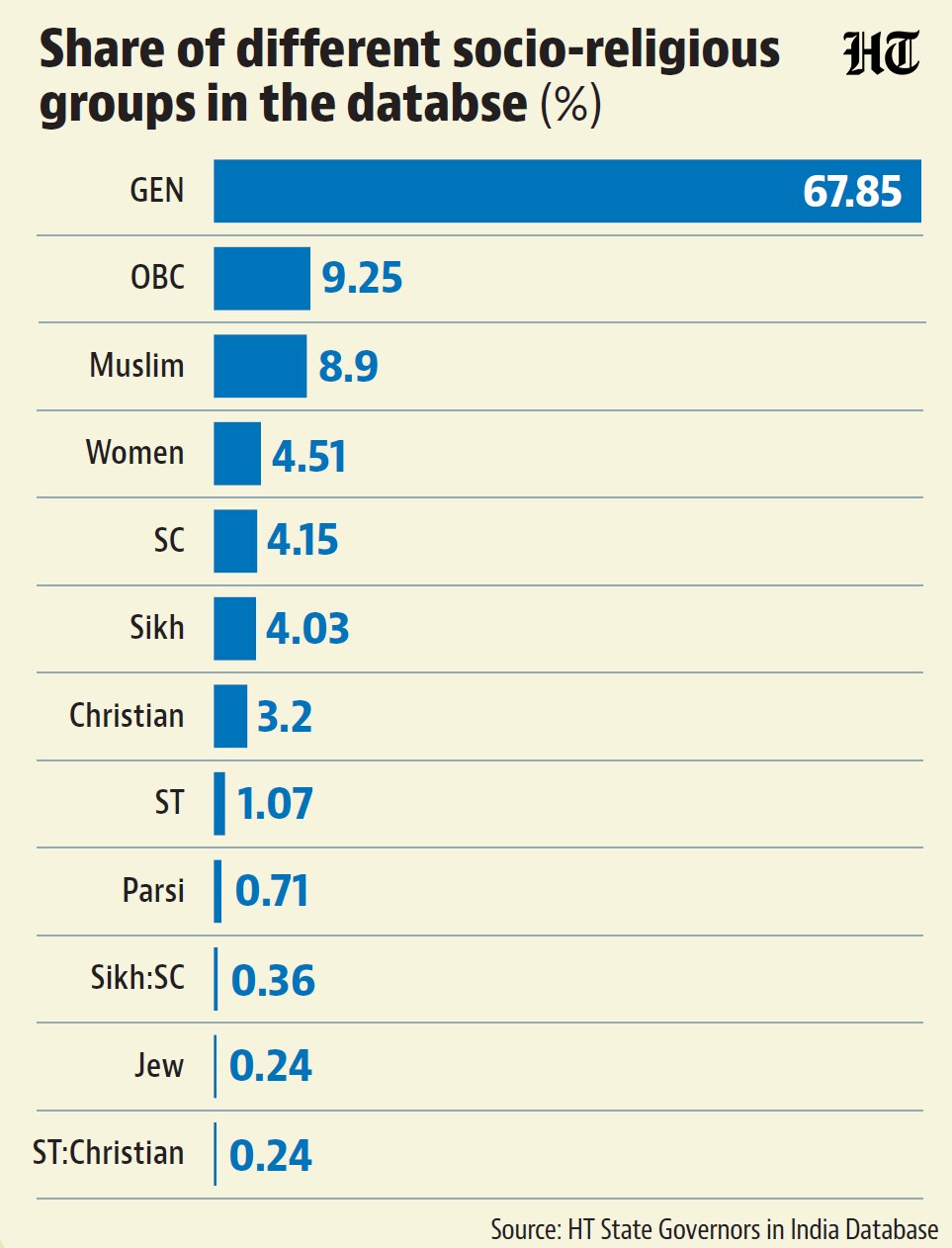
- Only 4.5% of governors have been women, 68% are Hindu upper casteOnly 38 of India’s 843 governors have been women. The share of women in the governor’s database is lower than their share in the council of ministers and almost similar to their share in the chief ministers database. When it comes to the religious and caste background of governors, they are overwhelmingly Hindu and rarely belong to either Other Backwards Classes (OBCs) or Scheduled Caste (SC) and Scheduled Tribe (ST) groups. What is remarkable about the social composition of governors is that even OBCs have not been able to increase their share over time. To be sure, the share of Hindu OBCs, SC, and ST governors is the highest in the 2017-2025 period compared to the preceding decades. But the share of the Sikh, Christian, and Muslim governors in this period is lower than in any preceding decade.
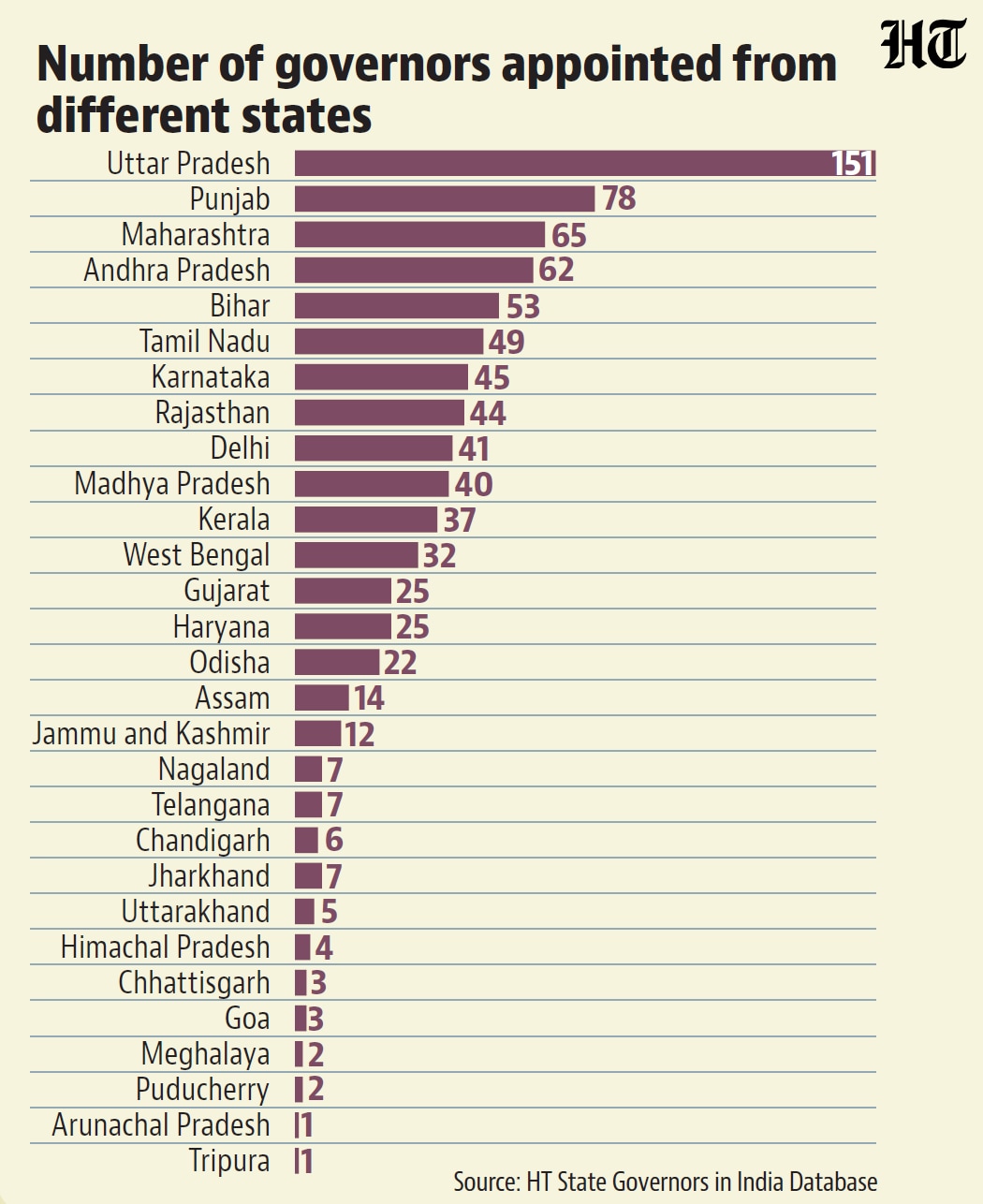
- Almost one-third of India’s governors have come from just three statesOf the total 843 governors appointed since independence, 151, around 18% of the total, have hailed from Uttar Pradesh alone. This makes it the single largest source of gubernatorial appointments. Punjab comes next with 78 governors, followed closely by Maharashtra with 65. These three states, along with Andhra Pradesh, Bihar, Tamil Nadu, Karnataka, Rajasthan, Delhi, and Madhya Pradesh, account for nearly three-fourths of all appointments made so far. In contrast, representation from several northeastern and smaller states has remained negligible. Only one governor each has come from Arunachal Pradesh and Tripura, while Puducherry and Meghalaya have contributed just two each. This highlights a sharp regional skew in the appointment patterns.
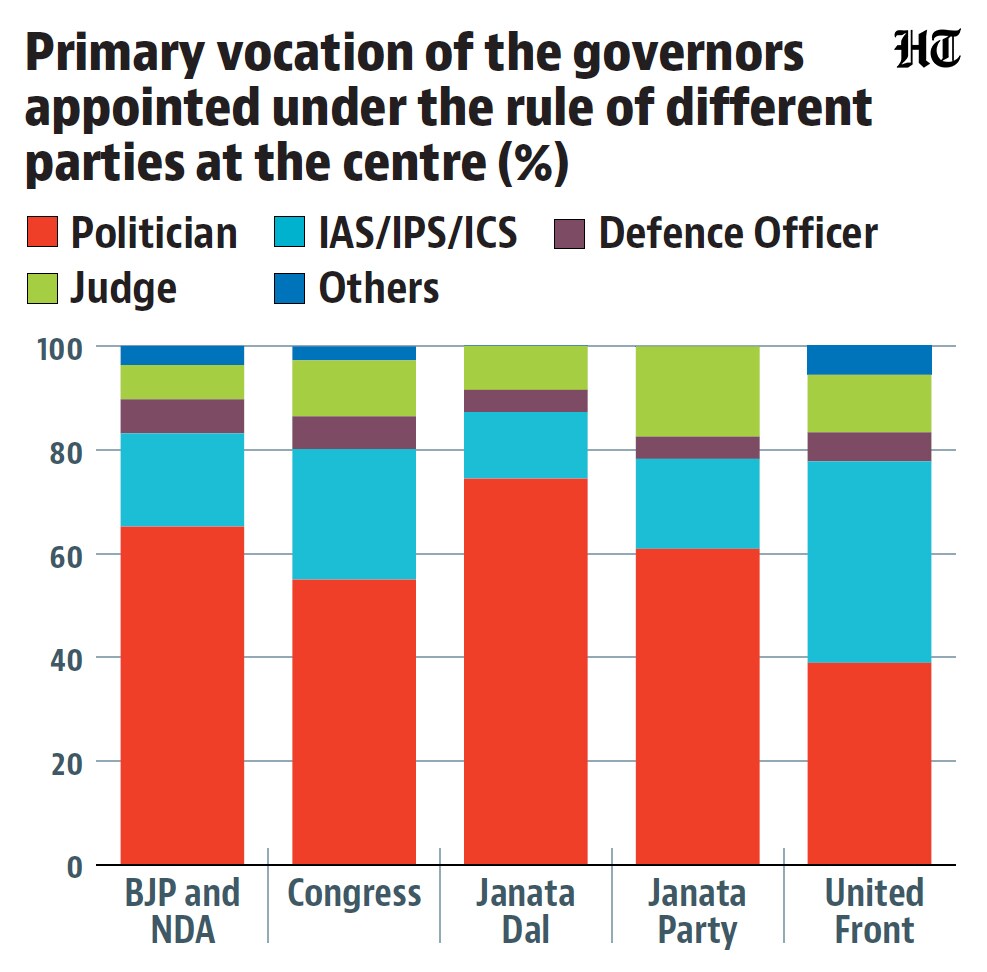
- Politicians dominate governor appointments under both BJP and CongressOf the 843 governors appointed since independence, 755 assumed office when either the Congress or the BJP was in power at the Centre. The Congress made 511 appointments, while the BJP made 244. Among the BJP appointees, 159 or 65.2% were politicians, while 18% came from bureaucratic or police backgrounds. Under the Congress, 281 appointees (55%) were politicians, followed by a significant share of 25% of former bureaucrats and police officers. The proportion of defence personnel remained nearly the same under both parties: 6.6% during the BJP’s rule and 6.3% under the Congress. These trends indicate that, while both parties have heavily relied on people from political backgrounds for gubernatorial appointments, the BJP has done so more markedly than the Congress.