
 E-Paper



Ambedkar varsity programme intended to teach English promotes cultural exchange
Started in 2017, the university’s Language Buddy Scheme is a programme based on peer mentoring model for students who need support to improve their English language skills.


Even as the country debates the feasibility of having a national language, an Ambedkar University initiative to improve English-speaking skill has turned out to become an interactive session promoting multilingualism and cultural exchange.
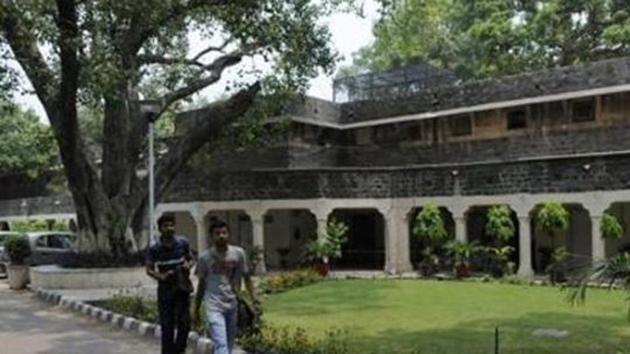
Started in 2017, the university’s Language Buddy Scheme is a programme based on peer mentoring model for students who need support to improve their English language skills. Through an English proficiency test, the programme identifies first year undergraduate students who need an extra credit course in English proficiency. These students are then assigned mentors which help them in learning the language through activities, workshops, and discussions.
Coordinator of the programme Monishita Hajra Pande, who teaches English at the varsity, said, “Peer learning is a two-way process. While the mentors bring their linguistic competence in English to the table, the mentee group also brings cultural knowledge to the table.”
For instance, during one of the classes, students from Jharkhand spoke about the local tribal communities in their village which were resisting industrialisation to protect their land. In another, Pande recalled, Telugu, Hindi and Maithili-speaking came together to collaborate on a poster-making session on access and equity in education.
“While the Andhra student spoke of how marginalisation was a barrier for her in accessing education, the one from Bihar shared how he faced two barriers. From his mother tongue Maithili, the student had to first learn Hindi and then English,” she said.
A Jagdishwar Rao, 19, a second year student of Sustainable Urbanism in the university who did the programme last year, said that it helped him learn other cultures along with English language.
“In these classes, students from Bihar, Gujarat, different southern states come together and communicate with each other. We are asked about festivals and traditions and this helps us in learning more about each other. Once a student from Jharkhand said they look at Raavan differently and even worship him. It gives you a fresh perspective.”
Based on the schedule of the mentors and mentees, one or two hour classes are organised once, sometimes twice a week. Arvind Raju, 20, an undergraduate student of Mathematics, is mentoring four students this year. “Mentees are given assignments like writing a movie summary or elaborating on different professions. These assignments lead to cultural exchanges. Students tell us about their food, festivals, and traditions and we too learn from it.”
“There is enough research to suggest that being multilingual has cognitive and social cultural advantages. Experiments like these in higher education promote multilingualism and celebrate diversity there by arguing for an inclusive language policy. Sustainable models of multilingual learning can also challenge monolingual mindsets,” Pande said.
The programme will be experimenting with open mics this year. “We will also try getting institutional support for language games like bananagrams, scrabble etc,” Pande said.


