
 E-Paper



SNAP 2017 exam analysis: Find out how you fared
Though the pattern of SNAP 2017was similar to that of last year, some candidates found it to be tougher than the 2016 paper


The Symbiosis Entrance Exam for MBA or SNAP 2017, conducted on December 17, 2017, was held in a computer based test format for the first time. Though its pattern was similar to that of last year, some candidates found it to be tougher than the 2016 paper.

Broad distribution of the test
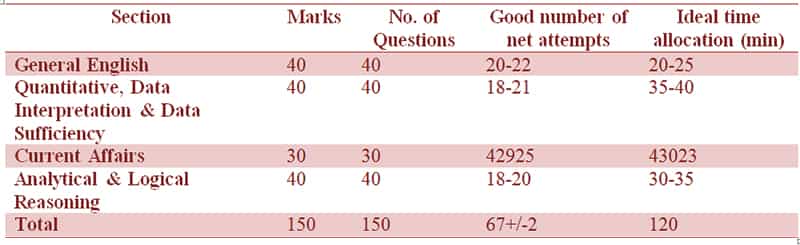
Since there was no sectional cut-off, it made the candidates’ work a lot easier, ie they could focus on maximising their scores instead of trying to improve their sectional performance in the tougher sections.
Let’s have a closer look at each of the sections:
General English
The distribution of the questions is as under:
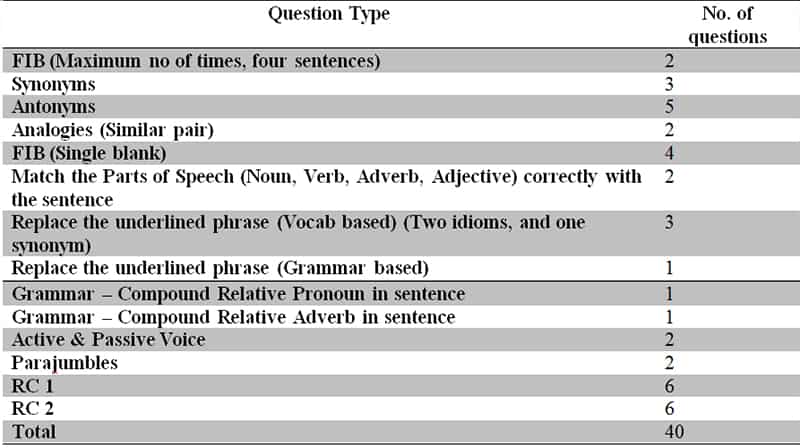
The reading and comprehension area had two passages with six questions each. The passages were lengthy with around 1,000 to 1,100 words.
Passage 1: It was a lengthy passage on “The right to be left alone” or “Privacy” taken from “The Indian Express”. The questions included title and tone of the passage and four ‘specific detail’ questions.
Passage 2: This was another lengthy passage on “The Founding Fathers of Australia: The Story of convicts shipped to the New World”. There were 5 ‘specific detail’ questions and one vocabulary based question.
About 20-22 can be considered to be a good number of attempts in this section.
Quantitative ability, data Interpretation and data sufficiency
The quantitative ability, data interpretation (DI) and data sufficiency (DS) section was lengthier and tricky. Last year’s section had more doable questions. Surprisingly, the weightage of pure maths was a little on the higher side.
There were only two DI sets which were not calculation intensive and should be on the easy to moderate level for most of the students. There were no DS questions this year as well.
One question was ambiguous (p^q =169) and two other questions did not have the correct answer options (1. Sale of two FM Radios, 2. DI question on the technicians and carpenters).
The broad distribution of the questions from various areas is as below:
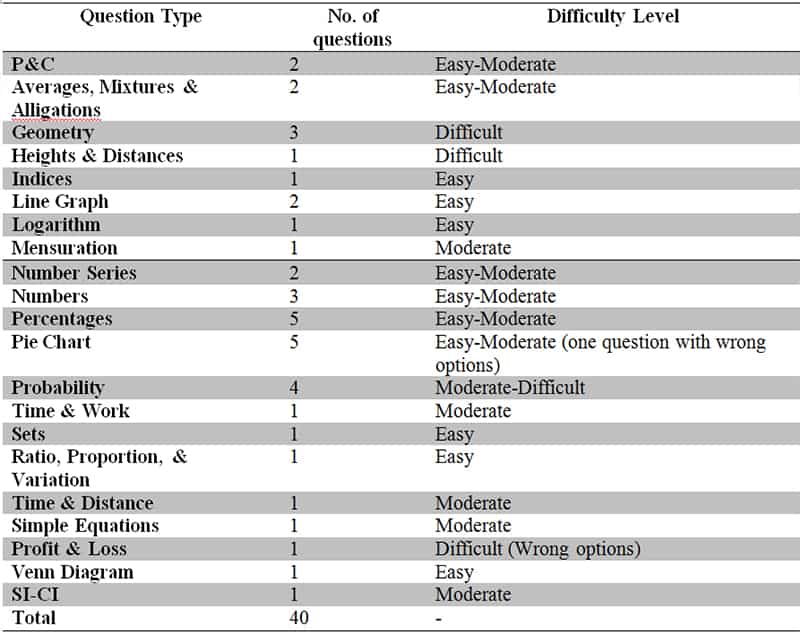
A good student could have attempted a net of 18 to 21 out of 40 questions in this section by spending around 35 to 40 minutes.
General awareness
The general awareness section had 30 questions.
The questions were asked from various categories as below.

Candidates found most of these questions were difficult. Around 7 to 9 attempts in the section in around 10 to15 minutes will be considered good.
Analytical and logical reasoning
The analytical and logical reasoning section had a reasonable number of easy and moderate questions.
Unlike last year, apart from the stand alone questions there were few set based ones too. Added to this, there were some tough ones to crack.
The level of the section could be pegged at moderate level of difficulty.
The question distribution in the section was as below:
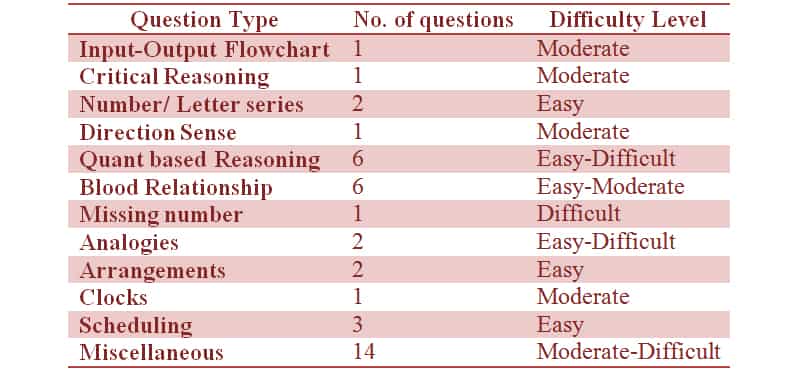
Around 18-20 attempts could be considered to be a good attempt in this section.
Cutoffs
An overall score of 66-68 or above should be a good score for Symbiosis Institute of Business Management (SIBM), 62-64 for Symbiosis Centre for Management and Human Resource Development (SCMHRD), and 53-55 for SIBM Bangalore and Symbiosis Institute of International Business (SIIB).
Please note that there are no sectional cut-offs for SNAP.
The author is the CAT course director for T.I.M.E.


