
 E-Paper



Town planners are high in demand
Planners are required to make plans of how residential areas, economic nodes, social and physical infrastructure and services are distributed equitably


Suptendu P Biswas is an architect, an urban designer and a planning professional involved in teaching and research. He also runs a consultancy in Delhi.
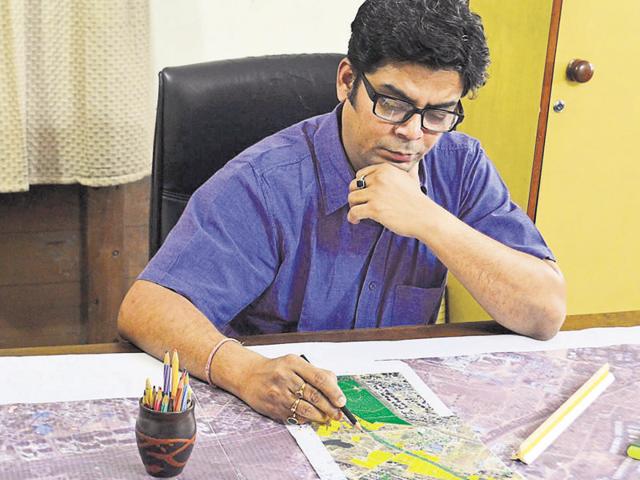
Growing up in a mofussil town near Kolkata with the river Ichhamati occupying the best years of his life, Biswas studied architecture from BE College in Shibpur (presently IIEST). After graduation, he came to Delhi to take up a job and got an opportunity to work on a few prestigious projects, including the Rajiv Gandhi Memorial at Sriperumbudur. “A postgraduate urban design course at School of Planning and Architecture (SPA), Delhi, was a wonderful learning experience that helped me closely observe Indian urbanism. Later, I completed a PhD from the department of physical planning at SPA, which has formed the basis of my recent book, Assorted City: Equity, Justice and Politics in Urban Services Delivery,” he says.
Biswas then started VSPB Associates with his architect wife. “We have recently finished a public place design in west Delhi next to a mall and Metro line. We are also working on a collaborative landmark project for the rejuvenation of a 2.2-km stretch of a derelict bundh and nullah in Gurgaon and converting it to a lively public place that will double up as a popular route for pedestrians and cyclists in future,” he says.
Read more: Career counselling: Textile industry offers good job opportunities
Town planning is today referred to as spatial planning to differentiate it from economic planning or policy planning. Anyone interested in spatial planning education has a couple of options. Do a four-year undergraduate programme (B Planning) and two-year post-graduate programmes (M Planning) with specialisation in urban, regional, transport and environmental planning and housing respectively. B Planning degree holders are eligible for admission to postgraduate programmes in all planning courses as well as those pertaining to architectural conservation, environmental planning, and urban design. For M Planning aspirants, a graduate degree in architecture and planning, and postgraduate degree in economics, geography and sociology are required. Initially, job opportunities for spatial planners were limited to the public sector, like Town and Country Planning Organisation, Delhi Development Authority or state-level organisations etc. With multinational firms and PPP model of development, job opportunities have opened up. Central government’s planning-driven schemes and initiatives like, JNNURM or AMRUT, Smart City Mission or mega-development projects like, Delhi-Mumbai Industrial Corridor, or, infrastructure-driven projects have all given a fillip to various planning activities and offered employment to planners and related professionals like urban designers and landscape architects, says Biswas.
Common sense is the most important aptitude required for a planner. How to analyse a situation and present suitable strategies in a simple and comprehensible manner to diverse groups including politicians, bureaucrats, financiers, slum-dwellers etc is expected from a planner. Also, software knowledge, visual and verbal communication skills are required, which a student is expected to hone up in course of study, he says.
All you need to know about a career in town planning
Ample opportunities: Today, there are a host of opportunities available in organisations such as the World Bank and UNDP and with NGOs, private sectors etc
I take home: Rs 15,000 per month
I love my job because: Career growth in this field is quick with ample opportunities to work on a number of specialised aspects or fields.
Expert gyan: Common sense is the most important aptitude required for a planner. Objectivity and analytical mind are two key assets


