E-Paper



Karnataka hijab controversy: UP deputy chief minister says no such complaint in state
We have been working on sabka saath, sabka vikas and will continue to do so in the future, says Uttar Pradesh deputy chief minister Dinesh Sharma

 Prefer HTon Google


Amid the Karnataka hijab controversy, UP (Uttar Pradesh) deputy chief minister Dinesh Sharma on Wednesday said there was no such complaint in his state where the government has been working on the motto of “Sabka Saath Sabka Vikas” and will continue to do so in the future.
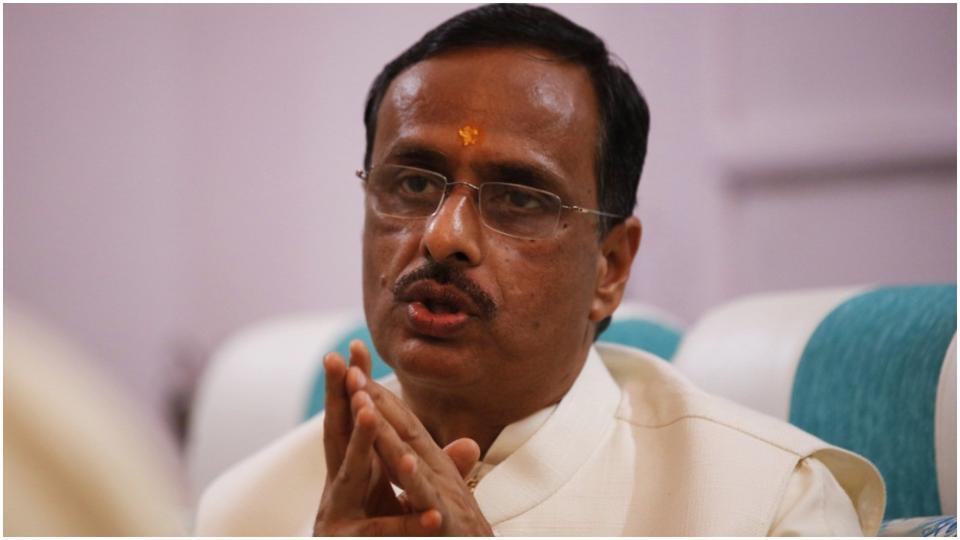
The Uttar Pradesh deputy chief minister Dinesh Sharma said this when asked to comment on the issue, a day before the first phase of polling in Uttar Pradesh on Thursday. The state will vote in seven phases between February 10 and March 7.
Uttar Pradesh deputy chief minister Dinesh Sharma, who is also the higher and secondary education minister in the state, said, “I am not making any comment on the issue. I am simply saying that Sabka Saath, Sabka Vikas (Everyone’s support, everyone’s development) is our slogan and we will work accordingly. As of now, we don’t have any such complaints. There will not be any second thoughts on it. Our slogan and motive will remain the same.”
The comment comes amid the ongoing Karnataka hijab controversy owing to which all educational institutions there have been shut for three days.
In a tweet, Congress general secretary Priyanka Gandhi Vadra on Wednesday said, “Whether it is a bikini, a ghoonghat, a pair of jeans or a hijab, it is a woman’s right to decide what she wants to wear. This right is GUARANTEED by the Indian constitution. Stop harassing women. #ladkihoonladsaktihoon.”
Ladki hoon lad sakti hoon is the Congress’s poll slogan for women empowerment in Uttar Pradesh.
She also said, “It is a woman’s right to decide what she wants to wear. The right has been guaranteed by the Indian Constitution.”
Her brother and Congress leader Rahul Gandhi earlier supported the protesting students amid the Karnataka hijab controversy.
“By letting students’ hijab come in the way of their education, we are robbing the future of the daughters of India. Ma Saraswati gives knowledge to all. She doesn’t differentiate,” Rahul Gandhi had tweeted earlier.
The controversy began when in January this year when six students were denied entry into classes by college authorities in Karnataka’s Udupi district, located 400 km from Bengaluru, for wearing hijab, the students and their parents claimed. The incident took place at the government pre-university college.
Uttar Pradesh, too, had its slice of controversy on hijab in the past. In November 2017, a Catholic school in Uttar Pradesh’s Barabanki district barred two Muslim students from wearing the headscarf inside the campus, saying it is against the uniform code of the institution, the family of the girls had alleged.
Prior to that, Lucknow’s St Joseph’s Inter College had to face a magisterial inquiry in 2015 after it allegedly sent a Class 9 student home for wearing the hijab, saying she had violated the school’s dress code.
Lucknow University student Sadaf Tasneem said, “Wearing hijab doesn’t violate Article 25 of the Indian Constitution. Those protesting against hijab are violating the religious freedom granted and guaranteed under Article 25 and Article 14 of the Indian Constitution. The segregation of girls on the basis of their religious customary practice is apartheid.”
“Schools are considered the temples of education and there is a tradition of going to the temples usually with a covered head. It is better that even those protesting against the hijab wearing saffron cloth should wear the cloth on the head like a hijab,” she said.
Monisa Jamal, housewife and mother of two graduates from Delhi University, said, “India is a democratic nation and no one is entitled to interfere in how a citizen dresses. I am a Muslim woman who doesn’t wear hijab, but I cannot criticise women who do wear them as India is a land of diversity and every single culture has some or the other way of dressing that makes them stand out. No one should stop a Muslim woman from wearing hijab, a Sikh from wearing a turban, a Hindu woman from practising the culture of “ghoonghat” and people of other cultures to follow their customs with freedom. It’s a basic constitutional right and act of human decency.”