E-Paper



Number Theory: El Niño may make 2023, 2024 back-to-back warmest years
Initial data for October and comparison with past temperatures suggest that 2023 is well on course to become the warmest ever year
Published on: Nov 1, 2023, 10:08:18 IST

 Prefer HTon Google
Share via


Copy link

September 2023 was the warmest ever in history, the fourth consecutive month to achieve this distinction. And thanks to the El Niño conditions prevailing right now, scientists believe that 2024 could very well break 2023’s record. Here are four charts which explain these trends in detail.

El Niño may make 2023, 2024 back-to-back warmest years
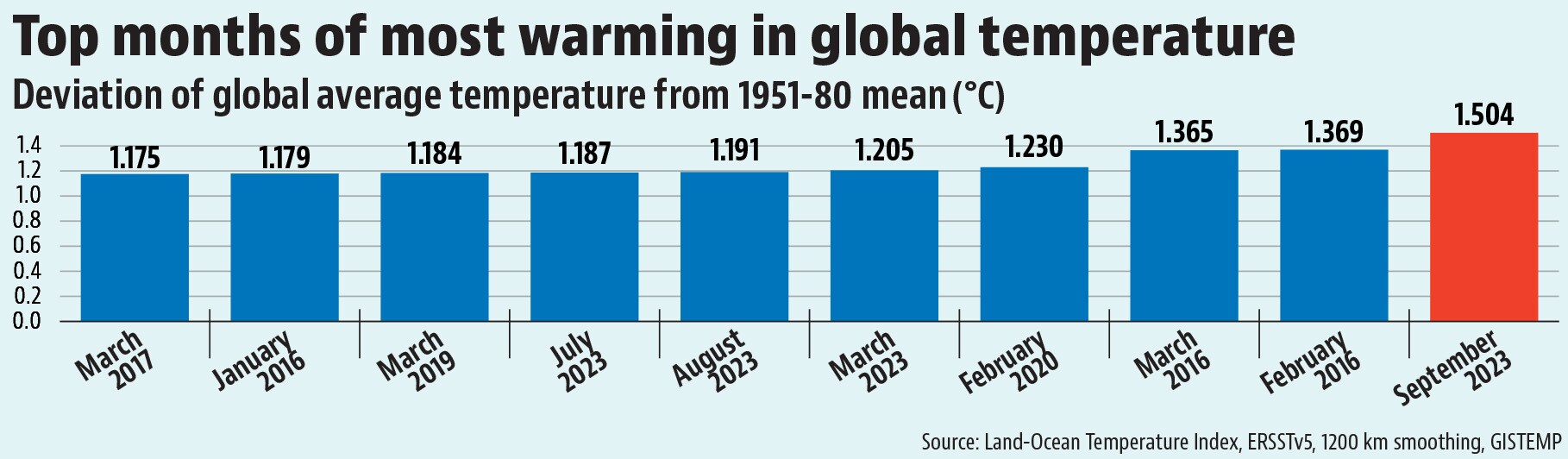
 September 2023 saw the largest ever deviation from normal temperatures for any monthThat September 2023 was the warmest ever should not surprise anyone. June, July and August were also the warmest ever this year according to NASA GISS Surface Temperature Analysis (GISTEMP). However, what made September remarkable was the extent of upward deviation it saw from what are considered normal temperatures. NASA considers the 1951-1980 average as the “normal” range for temperatures. September 2023 was 1.5 degrees C warmer than the normal value for the month. This is half a degree higher than September 2020 which was the warmest ever September before 2023. Also, a 1.5-degrees C deviation above normal is the highest upward deviation for any month’s temperature in the NASA database. By this metric, June, July, and August this year would be ranked 20th, seventh, and sixth in the NASA dataset. To be sure, July 2023 is still likely the warmest ever month in absolute terms because it is the warmest month of the year by global average temperature. While NASA does not publish absolute temperatures because of the errors inherent in measuring it consistently, an analysis published by Berkeley Earth, a US-based non-profit, suggests this is the case.
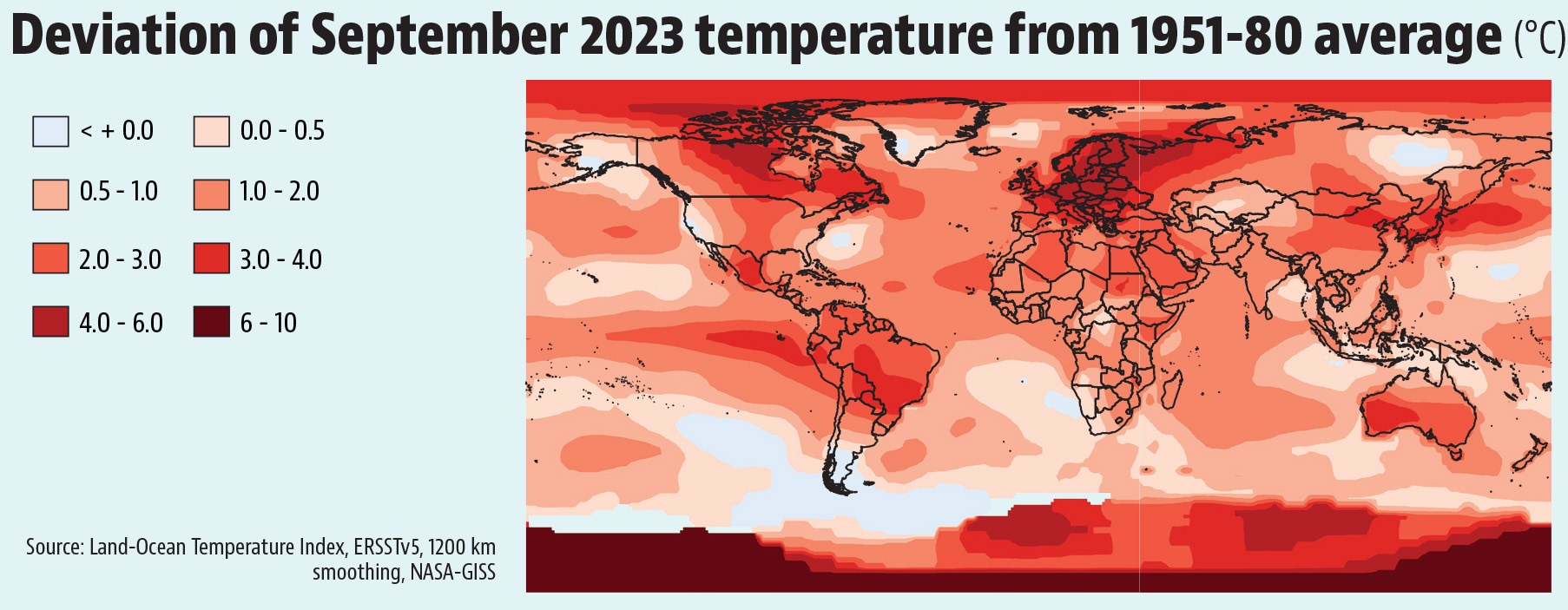
- Warming over the 1951-80 average was 2 degrees Celsius or more in 75 countriesGISTEMP’s gridded dataset allows one to calculate country averages for 151 countries. All of them were at least 0.3 degrees C warmer than normal in September, 110 of them were warmer by more than 1.5 degrees C (the global average), 75 of them were warmer by 2 degrees C or more, and 16 of them (across eastern and western Europe) were warmer by 4-4.3 degrees C. To be sure, the 4 degrees C warming in European countries might not have caused as much discomfort as the relatively less warming of around 3 degrees C in South American countries such as Paraguay, Bolivia, Brazil, Peru, and Ecuador. While the former were headed towards winter in September, the latter group of countries is south of the equator and experienced an unusually hot beginning of spring season. Parts of these countries experienced absolute temperatures 40 degrees C or higher, according to reports.
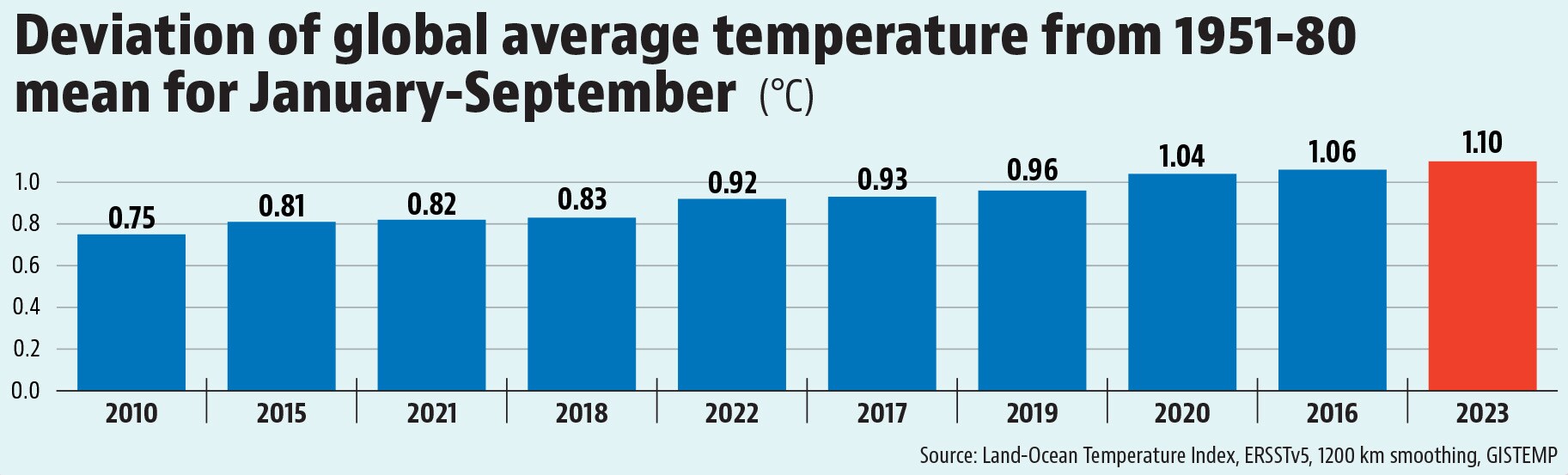
- October-December needs to be 'only' 0.8 degrees Celsius warmer than normal for 2023 to be the warmest year everWith September warming even more than previous months, 2023 is now the hottest ever year for the January-September period, with a deviation of 1.10 degrees C from normal. For the period up to August, 2023 was still behind 2016, the current warmest year ever, by 0.03 degrees C. What will it take for 2023 to beat 2016’s record by December? 2016 was 1.03 degrees warmer than normal overall. This means that the October-December period needs to be “only” 0.80 degrees warmer than normal on average for 2023 to become the warmest ever year. This is eminently plausible. Even January, the month with the least warming this year, was 0.86 degrees C warmer than normal. October also appears to be on track to be 0.80 degrees warmer than the 1951-1980 NASA normal. According to NCEP’s Climate Forecast System (CFS) – it uses a mix of observations and forecasts to generate global daily temperatures – the period up to October 28 is 0.92 degrees C warmer than the 1979-2000 average (the oldest data CFS has). Since the 1951-1980 period is cooler than the 1979-2000 period in all observed datasets, it is clear that October’s deviation will likely be more than 0.80 degrees from the 1951-1980 average.
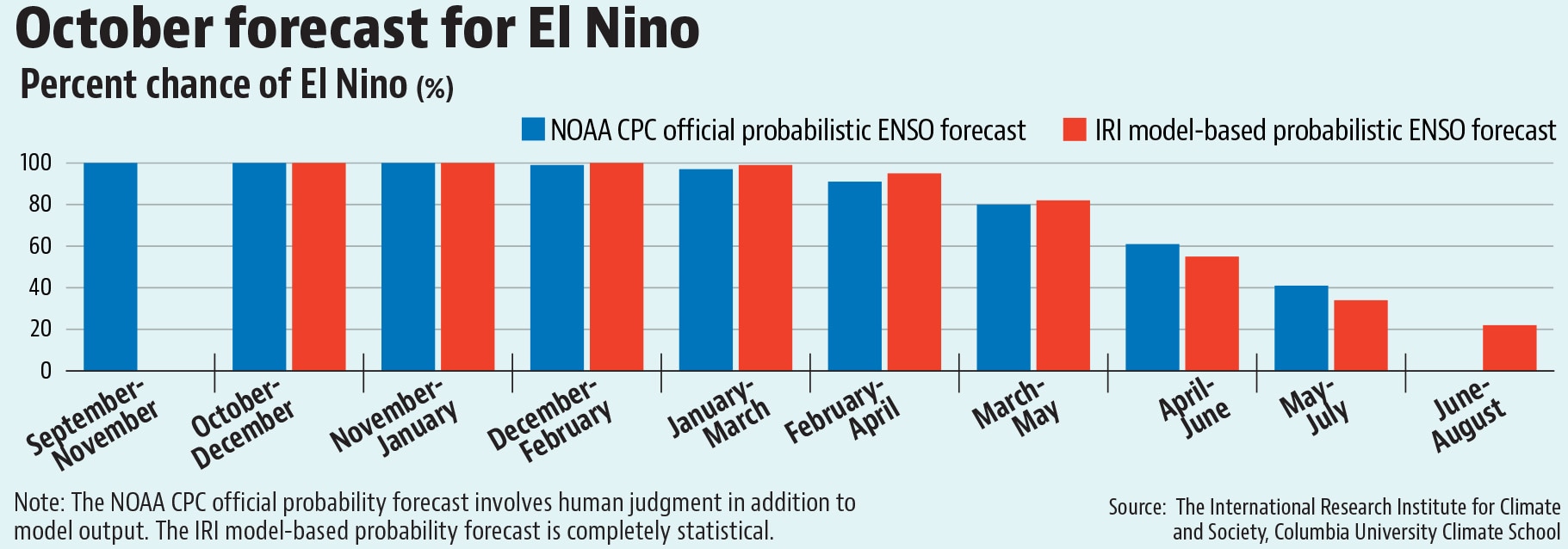
- And sea temperature forecasts suggest 2023’s record could be broken next year itselfAnother reason why scientists are almost certain that 2023 will be the hottest ever year is that all models predict El Niño up to October-December season as 100% probable or certain. El Niño is a periodic warming of the sea surface at the equatorial Pacific. This event has been adding heat on top of the long-term warming since June. To be sure, there is a lag of a few months between the development of El Niño and its impact on global temperatures. This means that an El Niño persisting even until December will affect temperatures early next year. The forecasts this month suggest that El Niño is certain up to the November-January season, over 90% probable up to February-April season, and over 50% probable up to the April-June season. This is why scientists have suggested that 2023’s record could be broken next year itself.