
 E-Paper



The battle to save South America’s skull-crushing big cat
From Brazil’s Pantanal to Iguazú Falls, governments and NGOs boost jaguar conservation as tourism helps protect the Americas’ apex predator


 Prefer HTon Google


The jeep is squelching through the marsh when the guide calls for a hush. A gentle beep emanates from his hand-held receiver, which he sweeps around him to pinpoint the signal. “Nine o’clock!” he whispers, and the car creeps off through the long, paludal grass. There, squatting by an island of wild cashew trees, is a pair of jaguars, mother and son, feasting on the carcass of a nine-banded armadillo. They briefly raise their heads, find the jeep uninteresting, and resume munching.
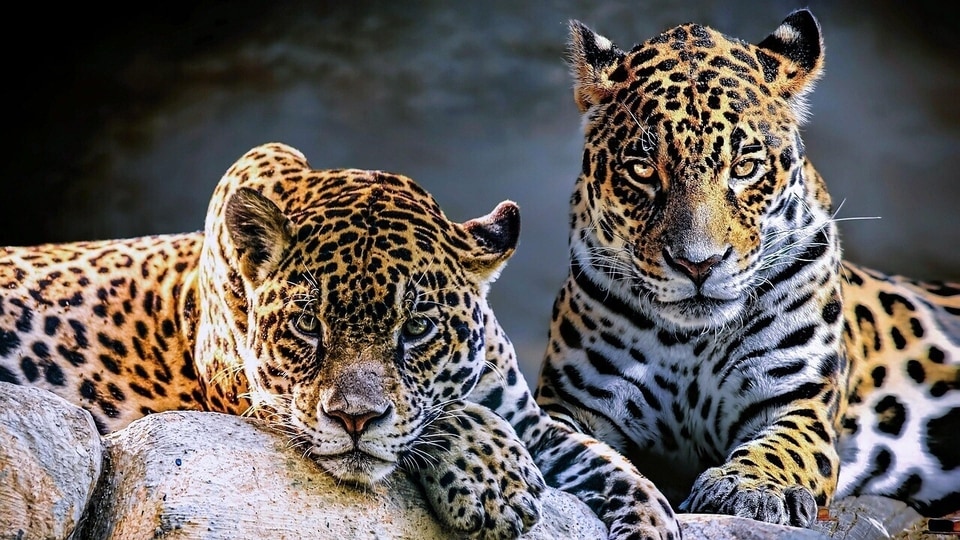
The scene, at the Caiman reserve in Brazil’s Pantanal, an area of tropical wetlands, offers hope. After years of indifference, governments and some landowners across the Americas are trying to preserve the region’s biggest cat. They face wildlife traffickers and farmers who torch tracts of pristine forest where the jaguars live. But they have an ally: the growing masses of tourists who want to see the wild beasts, and will pay great sums to do so.
Before the Americas were densely inhabited by humans, the hemisphere was the jaguars’ playground. Where leopards, their distant cousins, had to compete with tigers and lions in Asia and Africa, jaguars were the undisputed apex predator. Indigenous people considered them sacred and mostly left them alone. The abundance of prey in lush jungles helped them to grow large heads, muscly bodies and powerful legs. They developed the strongest bite of all cats. Unlike most felines, which asphyxiate their prey by latching on to the throat, jaguars kill by sinking their teeth through their victims’ skulls.
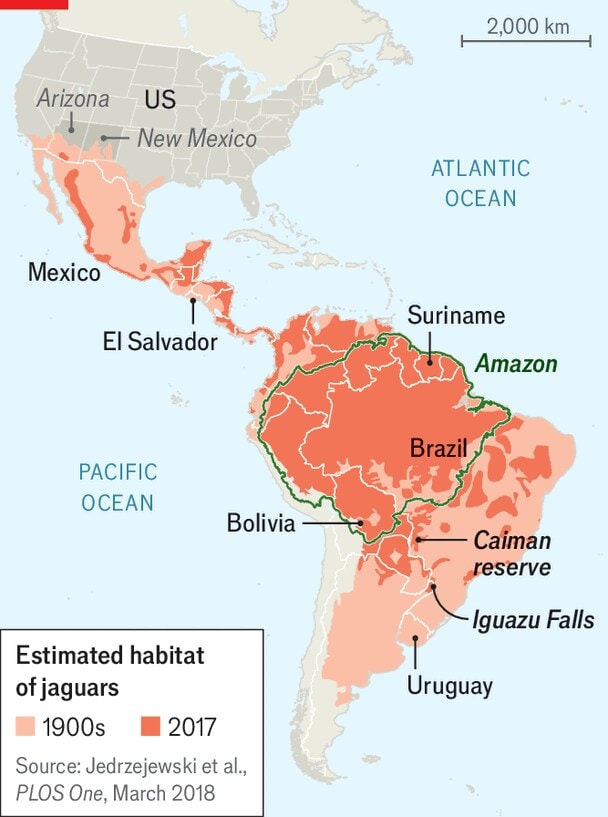
Deforestation has more than halved the jaguar’s original range (see map). What remains is disappearing fast. At around 9m square kilometres (3.5m square miles) it is a quarter smaller than it was in 2000. The cats are considered extinct in Uruguay, El Salvador and the United States, where they used to pad through the woods of New Mexico and Arizona. They are threatened in Bolivia and Suriname, where traffickers poach them for their fangs, which are used as a substitute for tiger in traditional Chinese medicine. About half of the world’s remaining jaguars are in Brazil, mostly deep in the Amazon. The rest are often isolated in patches of undisturbed forest that are surrounded by degraded land.
This fragmentation is a problem because of the jaguars’ “Game of Thrones lifestyle”, says Lucas Morgado, a biologist at Onçafari, the jaguar-research group at the Caiman reserve. Inbreeding is the norm. As a result, evolution has instilled male jaguars with an instinct to leave their family territory after adolescence to search for new land hundreds of kilometres away. Human expansion prevents jaguars from roaming, increasing genetic diseases and eventually prompting population collapse.
So international organisations and governments want to create corridors across Latin America to connect cats that live in fragmented territories. This effort started in 2018, when organisations such as the World Wide Fund for Nature and the UN Development Programme began looking for suitable land. Sixteen countries have signed up. In September they launched a regional plan, which involves adopting standardised methodologies to monitor jaguar populations and defuse conflict with landowners.
Yara Barros, who runs jaguar conservation in the national park that houses the Iguazú Falls—the vast system of waterfalls on the borders of Argentina, Brazil and Paraguay—says conflict can be mitigated. In 1990 the park held perhaps 800 jaguars. By 2005 there were only 40. Surrounding towns had expanded, building roads and razing forest. Landowners shot jaguars when they preyed on their cattle. Ms Barros’s organisation visited thousands of farms, as well as schools, to teach locals how to deal with jaguars. Her team put electric fences around farm land, helped make chicken coops secure, and advised ranchers not to leave cow carcasses lying around. Jaguar shootings plummeted. Today more than 100 roam the park.
Other efforts in Brazil show that coexistence is possible. The Mamirauá Institute, a charity, teamed up with the government to create two reserves that straddle 35,000 square kilometres of land in the Amazon. People living in villages inside the reserve still occasionally kill jaguars out of fear, for sport or even for food. Yet the jaguar population is stable, at around 1,000. “Conservation is not about not touching nature,” says Emiliano Ramalho of the institute. “It’s about protecting it so that even if you use natural resources, those resources will be able to replenish themselves.”
Tourism can help foot the bill. Cowboys in the Pantanal used to slaughter jaguars. But in the mid-2000s tourists began paying guides to take them out in boats to spot the elusive cats, who like frolicking in water. Wildlife charities taught locals how to collect data for scientists. “The sons of the cowboys started realising there was more value in keeping a jaguar alive than dead,” says Rogério Cunha de Paula, of the Chico Mendes Institute for Biodiversity Conservation in Brasília. In 2017 researchers found that jaguar tourism netted the area’s guesthouses almost $7m in annual revenues, while attacks on cattle cost just $120,000 every year.
Roberto Klabin, who owns the cattle ranch in which Caiman reserve sits, says jaguars take about 3% of his flock every year. The loss is tiny compared to the money the farm makes from ecotourism. The reserve tracks four of its 70 jaguars with GPS collars, which makes it easier to find the retiring creatures. Humans used to be jaguars’ biggest menace. Now benign curiosity may be their salvation.


