
 E-Paper



Dortmund legend remembers Klopp and the importance of being earnest
Football for Klopp means being aggressive in front and at the back, says Weidenfeller. “With the biggest teams, he would pull them to our level,” says Weidenfeller, lifting his arms above the conference room table and bringing them down.

 Prefer HTon Google


Midnight, somewhere in Asia. Roman Weidenfeller and his Borussia Dortmund teammates have got off a long flight and into their hotel when coach Juergen Klopp says, “we will go for a run now.”
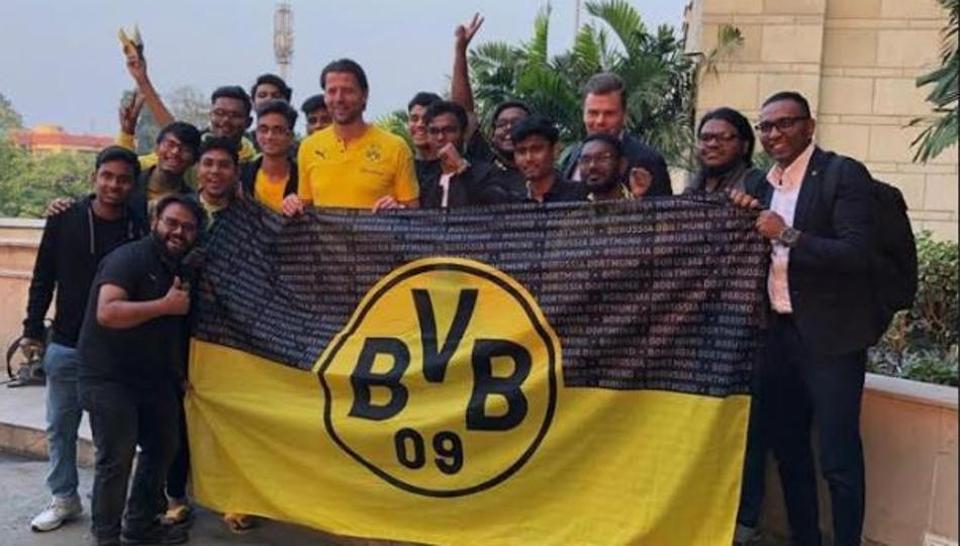
“We thought he was joking, but run we did,” says Weidenfeller, who played 349 games for Borussia Dortmund in a 16-season career, half of which --- 2008-15 --- overlapped with Klopp as coach.
“We would also go for runs at 6:30am; train three times a day,” Weidenfeller, a club ambassador, tells journalists at a city hotel abutting the Salt Lake stadium.
“The first time he put us through such a schedule, we were, f****d. Then we understood. Soon, with the results coming in, we were inspired to do more,” says Weidenfeller, a 2014 World Cup winning squad member.
Football for Klopp means being aggressive in front and at the back, says Weidenfeller. “With the biggest teams, he would pull them to our level,” says Weidenfeller, lifting his arms above the conference room table and bringing them down.
“And then we fight, and then we win. Of course, Barcelona is better than Borussia Dortmund but Klopp will say, no, no…bring Barcelona to our level and then we will play.”
Under Klopp, Dortmund were Bundesliga champions in 2010-11 and 2011-12, won the DFB Pokal (2011-12), the DFB Super Cup (2013) and were runners-up in the 2012-13 Champions League.
“The second time we won Bundesliga, we were 10 points behind Bayern at the winter break and everybody said, ‘this year we don’t have a chance.’ He said, ‘take it easy’. ‘We have done our job, we have our tactics and if we can play strong, we have a chance,” says Weidenfeller, 39.
Crucial to that campaign was an 86th minute penalty saved by Weidenfeller, off Bayern’s Arjen Robben. “I caught it directly. I was not a penalty killer and remember my father saying, ‘hey can you keep out one high-level penalty.’ And I did.” Weidenfeller played 32 of the 34 Bundesliga games in 2011-12 and was captain of the team the previous season when Sebastian Kehl was injured.
“He (Klopp) is like a machine on the pitch and in the dressing room. He is a very strong (tough) coach but is also very human. Everytime you talk to him, he meets you with open ears. With him, it was like a family,” says Weidenfeller.
Suresh Letchmanan, in Dortmund’s delegation here to explore chances of holding a legends’ game this year, says: “He remembers the smallest guy at the club.” Weidenfeller adds: “You can fight (argue) with him on the pitch. Next day you talk to him and he doesn’t bring up what happened the day earlier.”
Klopp joined Liverpool in 2015 and Weidenfeller says the move happened at the right time. “He builds things stone by stone (brick by brick) and makes a big club.
“When he came to us from Mainz, he was not that experienced. He learnt in Dortmund and is learning more at Liverpool. Now he is better at technique and tactics and prefers to keep the ball like (Pep) Guardiola.”
Borussia Dortmund haven’t scaled the heights Klopp took them to but the trend of recruiting and then polishing young players continues. “We have some experience there and that is an area we are interested in working in India,” says Letchmanan.
Erling Braut Haland is the latest in a list that has Lars Ricken, Mario Goetze, Marcel Schmelzer, Jadon Sancho, Christian Pulisic, Ilkay Guendogan, Pierre-Emerick Aubameyang and Ousmane Dembele.
Weidenfeller says Dembele’s move to Barcelona wasn’t well-timed. “Sometimes it gets complicated with managers (agents) who smell money…smell a situation where they can put a player from great club to world class club. Dembele hasn’t used his chance at Barcelona. Sometimes, it is better to stay two more years at Dortmund or a smaller club and then go to a bigger club.”
Having spent most of his international career as understudy to Jens Lehmann and Manuel Neuer, Weidenfeller knows what it is to be Marc Andre ter-Stegen. “Now, Neuer is the best but ter-Stegen is the future.”
Germany coach Joachim Loew telling Weidenfeller he deserved to play more helped him deal with getting five international caps. None of them came at the 2014 World Cup but the goalkeeper says winning it was the best moment of his career.
“Germany have always had good keepers. But I played for a big club and I hope, I did good,” he says.


