
 E-Paper



President Droupadi Murmu to Mark Akshaya Patra’s 5 Billionth Meal Milestone as Foundation Celebrates 25 Years
The Akshaya Patra Foundation celebrates 25 years of service and its 5 billionth meal milestone, to be honored by India's President on March 17.

 Prefer HTon Google


As The Akshaya Patra Foundation commemorates 25 years of service, it celebrates the historic milestone of serving its 5 billionth meal, to be honored by the President of India on March 17. In this interview, Madhu Pandit Dasa, Founder-Chairman of The Akshaya Patra Foundation, reflects on the journey from feeding 1,500 children in Bengaluru to reaching 2.35 million students daily across India. He discusses the critical role of technology, public-private partnerships, and the mission to ensure no child is deprived of education due to hunger
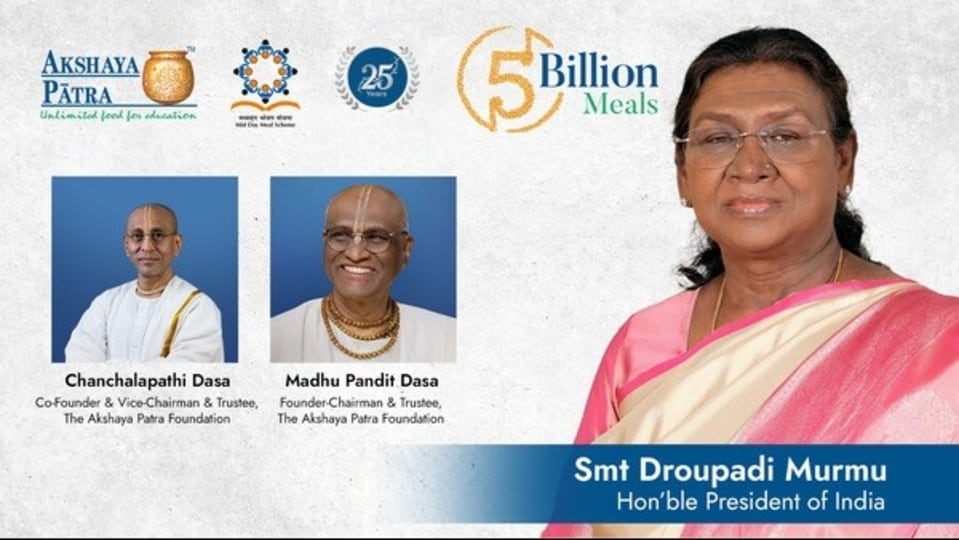
The upcoming milestone of the 5 billionth meal, to be served by Droupadi Murmu on March 17, is a significant moment for The Akshaya Patra Foundation. How would you describe the journey that led to this achievement?
On March 17, we will have the privilege of the Hon’ble President of India, Smt Droupadi Murmu Ji, gracing Akshaya Patra’s commemoration event of the 5 billion meals milestone and our 25 years of service to society. We are also grateful to the Hon’ble Minister of Education Shri Dharmendra Pradhan for kindly consenting to join us as the Guest of Honour for this special occasion.
Srila Prabhupada had given his followers the direction that no one within 10 miles of an ISKCON temple should go hungry, and he had faith in the power of collective effort. That faith has been vindicated every single day since we began feeding.
Twenty-five years ago, we started feeding from our kitchen in ISKCON Bangalore temple to 1,500 children in five schools, with no idea where we were going. What began in 2000 with a simple effort to serve a few thousand children has grown into one of the world’s largest school feeding programmes, reaching 2.35 million children across India every day.
This journey has been made possible through the support of the Government of India and the State Governments under the PM POSHAN initiative. Under the leadership of Hon’ble Prime Minister Shri Narendra Modi, this flagship program of the Government of India continues to highlight the importance of nutrition as a foundation for learning. Our journey has also been sustained by the unwavering support of donors, partners, volunteers and well-wishers who have believed in this mission for over 25 years. This is a collective achievement.
- Akshaya Patra recently crossed the milestone of serving billions of meals. What does this achievement represent for the organisation and the communities it serves?
The five billion milestone indicates the profound impact our program has had on the lives of children. It brings us great joy to see many of our past beneficiaries who were well-nourished and well-educated, playing a major role in improving the quality of life of their families. That is the compounding interest of a mid-day meal. It is not just about nutrition; it is about breaking an intergenerational cycle of poverty. This important milestone is an occasion to renew our commitment and ensure that no child in India has to choose between meals and education.
2. School meal programmes often have a direct impact on classroom attendance and learning. What changes have you observed in children’s participation in school through your work over the years?
When we began in Bengaluru in 2000, many of the schools we served had poor attendance. Within months of introducing the mid-day meal, teachers reported that children were not only attending more regularly but also arriving earlier because they knew a meal was waiting.
Over the years, I have met school heads and teachers across the country who told me that a majority of children in their schools were coming only for the meal. Once they come to school, the teacher can teach. And once the hunger is addressed, the mind is free to learn. You cannot ask a hungry child to focus on learning.
Over the years, we have seen enrolment go up. We have seen dropout rates reduce, particularly among girls. Our vision is simple: No child in India shall be deprived of education because of hunger. The data shows that alleviating classroom hunger is one of the most cost-effective educational interventions.
3. India is home to diverse food cultures and dietary habits. How does Akshaya Patra design menus that are both nutritionally balanced and locally acceptable?
India’s diversity is evident in its food choices. A child in Uttar Pradesh or Rajasthan would prefer roti-subji, while a child in Karnataka or Telangana would prefer rice with sambar or rasam. Every region has its own staple food, so our menu is also designed to suit the local palate.
At each of the 78 locations where we serve, menus are designed with local food habits in mind. We ensure the meals meet the prescribed caloric and protein requirements as per MDM guidelines, with the kitchen model allowing us to standardise the nutrition profile. The ingredients, spices and combinations are drawn from local preferences because a nutritious meal that children do not eat serves no one.
4. Large-scale social programmes depend heavily on logistics. What are some of the biggest operational challenges in delivering fresh meals to schools every day, and how does the foundation address them?
Logistics play an important role in feeding 2.35 million children across 16 states and 3 union territories every single school day as we have to ensure that hot meals are delivered on time to schools. Our kitchens can cook thousands of mid-day meals in just a few hours, leveraging technology and innovation. Our vehicles are custom-designed, stainless steel containers are insulated, and our routes are optimised to cover as many schools as possible within the delivery window. Akshaya Patra’s efficient systems and processes have become case studies at leading international institutions, including Harvard University, Stanford University, and London Business School.
5. Over the years, how have corporate partnerships and philanthropy contributed to strengthening Akshaya Patra’s mission?
Corporate partnerships and individual philanthropy have been very important for our growth. We operate through a public–private partnership model, where the government provides grants for meals and we mobilise the remaining resources through the generous support of corporate partners and individual donors. Every rupee that a corporate or individual contributes directly translates into a child being fed.
We raise funds for the establishment of kitchen infrastructure. Setting up a kitchen capable of preparing 50,000 meals is a significant capital investment. Many of our business partners have contributed from their CSR budgets to make this possible.
6. With growing awareness around child nutrition, are there any new programmes or initiatives the foundation is exploring to further improve children’s health outcomes?
While the mid-day meals play a critical role in supporting children’s learning and nutrition, many children arrive at school having had little or nothing to eat in the morning. With this in mind, we have started the Morning Nutrition Programme to complement the Mid-Day Meal Programme and provide a simple, nutritious start to children’s school day. The idea is to ensure that children begin their school day with the energy and nourishment they need to focus, learn and participate in the classroom. We are currently implementing the programme in six states and are exploring the possibility of expanding it across the states and union territories we serve, with the goal of reaching 3 million children by 2030.
7. Volunteers and community supporters often play an important role in social initiatives. How has community participation helped expand the reach and impact of Akshaya Patra?
The story of Akshaya Patra revolves around people from different walks of life coming together for a common cause: to ensure that no child is deprived of education because of hunger.
At the kitchen level, we have over 9,500 employees from local communities preparing and delivering mid-day meals to 2.35 million children every school day. At the school level, mid-day meal workers, many of them local women from the same communities as the children they serve, play a vital role in ensuring the meals reach students on time. Parents, community members and school management committees also actively support and encourage the programme. Additionally, we have volunteers and well-wishers who contribute their time and energy to spread awareness, strengthen the programme and mobilise support.
In our all-women kitchen in Barsana, Uttar Pradesh, local women manage operations end to end. The initiative not only serves nutritious meals to children but also empowers families economically by creating livelihood opportunities within the community.
Therefore, active community participation plays a major role in Akshaya Patra’s feeding mission.
8. In an increasingly technology-driven world, how are data and digital tools helping the organisation improve efficiency, transparency, and monitoring?
- Technology is the foundation of scaling up our operations. From the very beginning, when we designed our first kitchen in Bengaluru, we realised that only through technology could we consistently, safely and cost-effectively feed tens of thousands of children. In our kitchens, semi-automated systems improve consistency as we prepare thousands of meals in a few hours. In logistics, route optimisation ensures timely delivery across hundreds of schools. Looking ahead, we see significant potential in using data for predictive procurement, ensuring the right ingredients are available at the right time, and for real-time quality tracking across all our kitchens.
- As Akshaya Patra marks 25 years of service, what lessons has the organisation learned that could help shape the future of large-scale food security programmes?
The last twenty-five years have taught us several lessons and I would like to share a few with you.
First, causes rooted in selfless service tend to attract people who share the same spirit of commitment. At several points, when we faced resource constraints, support arrived in ways we had not anticipated. It reinforced our belief that work dedicated to the upliftment of others often inspires goodwill and support beyond the organisation itself.
The second is that scale requires robust systems. Good intentions alone cannot feed 2.35 million children every day. You need disciplined processes, the right technology, trained people and a culture of continuous improvement.
The third is that public-private partnerships are essential. The government brings policy, reach and funding. NGOs bring operational innovation and agility, and mobilise resources. In fact, the PM POSHAN scheme is a global case study of what government policy and civil society implementation can achieve.
The fourth and most important is that the Mid-Day Meal Programme is a strategic investment in human capital. Every child we nourish and educate today is a contributor to India’s future.
9. Finally, what message would you like to share with organisations and individuals who want to contribute to solving hunger and malnutrition in India?
For 25 years, we have seen that a simple, nutritious mid-day meal can change a child's trajectory. In our tradition, Annadaan, i.e., the sharing of food, is considered the highest form of giving. By ensuring that a child is nourished and able to learn, we are not just feeding a meal; we are helping shape a future.
We have already demonstrated that hunger and malnutrition can be addressed effectively when society comes together. When collective compassion turns into action, we can make this world more inclusive, equitable and sustainable. We welcome all socially sensitive minds and generous hands to join us in contributing to a hunger-free nation and world.
Note to readers: This article is part of HT's paid consumer connect initiative and is independently created by the brand. HT assumes no editorial responsibility for the content, including its accuracy, completeness, or any errors or omissions. Readers are advised to verify all information independently.
Want to get your story featured as above? click here!


