
Sign in

MCG okays pedestrian friendly redesign plan for Palam Vihar crossing

The redesign is essential considering increasing congestion and accidents on this stretch. An important element of the new design focuses is road safety.

Updated on: Oct 25, 2017, 23:00:05 IST
Hindustan Times | By , Gurgaon
Share
Share via
  • facebook
  • twitter
  • linkedin
Copy link
  • copy link

The Municipal Corporation of Gurugram (MCG) will redesign the Palam Vihar Junction on Old Delhi-Gurgaon Road to reduce congestion and give priority to pedestrians. It is the most important intersection on the Old Delhi-Gurgaon Road and handles major traffic going towards Udyog Vihar and other industrial areas.
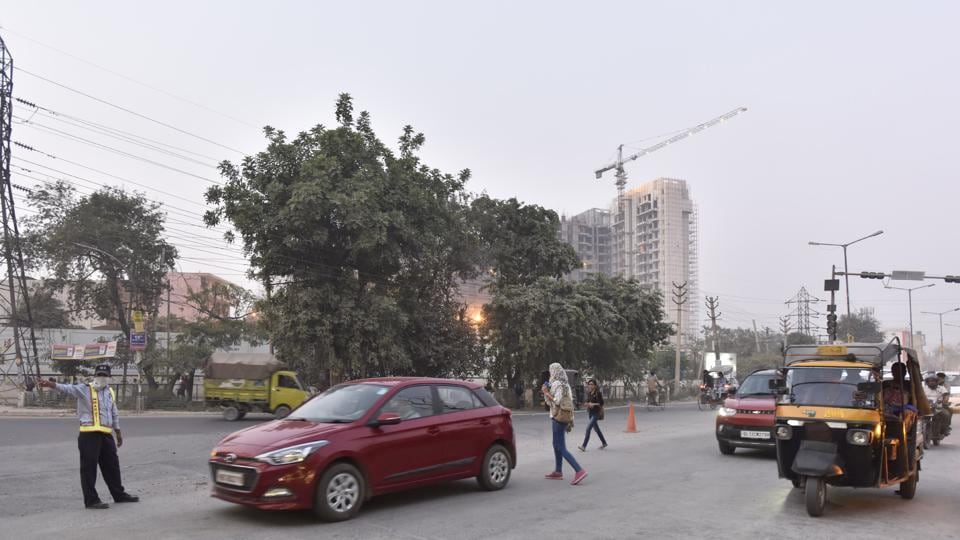
The new design focuses on two broad issues—improving pedestrian facilities because of their high volume and reducing the size of the intersection to make it safer and more manageable. (Sanjeev Verma/HT PHOTO)

The stretch was inspected on Tuesday by MCG sub-divisional officer Sanjay Bansal.

“The redesign plan by WRI India has been approved. The project will take time as funds are involved. Meanwhile, traffic police has started diverting traffic from the route to ensure smooth traffic,” MCG commissioner V Umashankar said.

The redesign is essential considering increasing congestion and accidents on this stretch. An important element of the new design focuses is road safety.

The new design focuses on two broad issues—improving pedestrian facilities because of their high volume and reducing the size of the intersection to make it safer and more manageable.

According to the volume count and traffic survey conducted by WRI India team during peak hours, about 8,000 pedestrians cross the intersection every day. The survey further states that the average share of traffic around the intersection comprises of 42% pedestrians, making them the largest road-user group. This was followed by cars occupying 30% space at the intersection.

Despite the high volume of pedestrian traffic, the road does not have any facilities to address their movement.

While there are footpaths connecting nearby villages of Mullahera and Dundahera to the office and industrial areas, pedestrians have no facility to cross the Jwala mill intersection, leading to jaywalking.

“The residents of my society find it difficult to commute on the stretch during peak hours. The long queues outside due to the CNG pump and commuters encroaching the road results in traffic congestion. We have written to the authorities several times but there has been no action,” Lt Col (retd) Sanjay Sehgal, a resident of Gurgaon One Apartments, said.

“Dug-up areas, garbage piles and parked vehicles, especially from the automobile repair shops, obstruct pedestrian movement. There are unused lanes for turning left that can easily be taken over for pedestrian use,” said Sarika Panda Bhatt, manager, Streets For All, WRI India.

The other suggested solutions include changing angles at turns and slip roads, reducing the size of the intersection, better lighting, new ramps, railing, road markings and better signage.

.

  • Leena Dhankhar
    ABOUT THE AUTHOR
    Leena Dhankhar

    Leena Dhankhar is Senior Editor and Bureau Chief, Gurugram, at Hindustan Times, where she has spent over 17 years chronicling the transformation of one of India's fastest-growing urban regions. From starting her career as a crime reporter to leading the Gurugram bureau, her journalism has been defined by investigative reporting, in-depth storytelling and an unwavering focus on public interest. Over nearly two decades, she has reported extensively across crime, politics, civic governance, elections, real estate, environment, courts, sports, education and entertainment, covering Gurugram, Faridabad, Nuh and Palwal. Her reporting has exposed several major scams and systemic failures, including insurance frauds, waste management irregularities, illegal arms manufacturing units in Nuh, illegal mining in the Aravallis, organised crime networks and governance lapses affecting millions of residents. Known for her investigative work and exclusive stories, Leena has reported on high-impact national issues, including the Nicaragua charter flight carrying Indian migrants that was turned back amid allegations of human trafficking, exposing the growing network of illegal immigration rackets. Her work has also focused on gang wars, prison administration, juvenile crime, women and child protection systems, the functioning of the Juvenile Justice Board and Child Welfare Committee, and environmental challenges such as pollution, waterlogging and deteriorating civic infrastructure. Beyond hard news, Leena has extensively documented Haryana's rich heritage, forests and wildlife, bringing attention to the state's historical landmarks, biodiversity, conservation efforts and ecological challenges through immersive reportage and feature writing. Her journalism has consistently gone beyond breaking news. She has documented Gurugram's rapid urbanisation through long-form narratives and enterprise reporting on issues ranging from pothole-ridden roads, flooding and waste management to the changing social fabric of India's Millennium City. She also writes widely read feature columns, including The Outsider, Changemaker, and Concern for Gurugram, profiling people, places and ideas shaping the city's identity. Leena is the author of Gurugram School Murder, published by Juggernaut Books, a deeply reported account of one of India's most high-profile school murder investigations. She is currently working on her second book, an investigative work exploring some of India's most significant scams and fraud investigations. Beyond print journalism, she has expanded her storytelling through public speaking and digital media. She is a TEDx speaker and has produced podcasts exploring Gurugram's transformation, civic challenges and untold stories. Her work reflects a commitment to narrative journalism that combines rigorous reporting with compelling storytelling. A law graduate with an MBA in Human Resources, Leena brings a multidisciplinary perspective to her reporting, particularly on governance, public policy and legal affairs. She has travelled extensively across India to pursue investigative assignments, often reporting from remote locations and conflict-prone areas in search of stories that matter.Read More