
 E-Paper



Muslim artisans from Uttar Pradesh craft Gurgaon’s effigies
A lot of multi-coloured effigies burnt in Gurgaon to mark the symbolic victory of good over evil are the creations of Muslim craftsmen, who migrated to the city in search of work from various parts of neighbouring Uttar Pradesh


A lot of multi-coloured effigies burnt in Gurgaon to mark the symbolic victory of good over evil are the creations of Muslim craftsmen, who migrated to the city in search of work from various parts of neighbouring Uttar Pradesh.
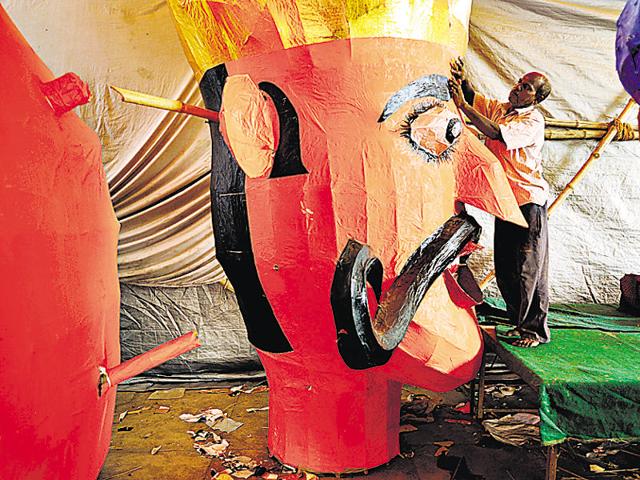
Aajam Ali, 50, an artisan from Ghaziabad, who was giving final touches to the handle-bar moustache, pouted pink lip, curly eyelashes and traditional ghagra-frock of a Ravana effigy at Sector 29, said that his family has been involved in the trade of making effigies for the Hindu festival over several decades.
“This is our family work. My grandfather and father always took pride in crafting Hindu idols. I have been helping my parents in this art since my childhood and that is how I developed an interest in it. I have made a 90-foot-tall Ravana which is the tallest in the city,” Ali said.
Mohammad Ali, 37, has been coming to Gurgaon for the last 25 years during the festive season. He is part of a 50-member group of Muslim artisans who have been making effigies of Ravana, Kumbhakarna and Meghnad in Gurgon for the last 45 years.
Speaking about effigies, many artisans said the labour they invested in creating these gigantic models gave them a feeling of brotherhood and communal harmony.
“We have been making effigies for Dussehra for generations now and I feel that it is our festival. We love all our Hindu brothers and sisters, their gods are ours as well. I have made a 45-feet Ravana here as per the requirement,” Mohammad Ali said.
Working at DLF Phase II area, these artisans made effigies that were burnt on Thursday. The group headed by Sabudin, 45, has acquired the skill from their forefathers.
Describing the process of crafting these effigies, Raziq, 50, an artist from Farukh Nagar in UP said, “We use bamboo to make the framework and cover it with colourful paper. Later, we paint features like curly eyelashes and pink lips.”
“We use thick glace paper and colours that do not fade to make effigies. The effigies I have made is 50-foot-tall,” another artisan Ali Hasan, 35, who hails from Moradabad, in UP said.
These artisans travel to the city seven or eight days before the festival to make the effigies. Though they do not earn much, they claim that they are happy with the work. “We get around `15,000-20,000 for our work,” Samil , 20, an artist from Loni, said.

Stay updated with all the Breaking News and Latest News from Mumbai. Click here for comprehensive coverage of top Cities including Bengaluru, Delhi, Hyderabad, and more across India along with Stay informed on the latest happenings in World News.


