
 E-Paper



Ease in lockdown poses challenge for the health department
Announcing a third extension of the nation-wide lockdown to contain the virus till May 31, the central government on Sunday had allowed states to demarcate their areas of infection and relaxations.


At a time when coronavirus disease (Covid-19) cases are rapidly increasing in the city, health officials worry that with the easing lockdown, exposure to the Sars-CoV-2 virus will increase if social distancing is not maintained. The opening of industries and more activity in high density areas pose a big challenge to contain the crisis even as they now look for setting up additional quarantine facilities.
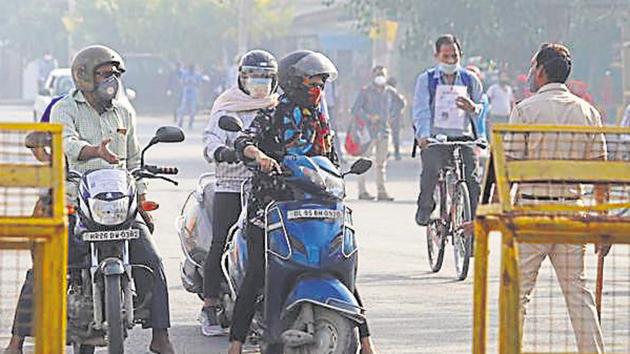
Announcing a third extension of the nation-wide lockdown to contain the virus till May 31, the central government on Sunday had allowed states to demarcate their areas of infection and relaxations. The Haryana government on Monday allowed industries, outside containment zones, to function with 100% staff.
“The chances of exposure are high as there has been an ease in the lockdown,” said Dr Jaswant Singh Punia, chief medical officer, Gurugram. “Since industries and factories are reopening, they should approach us for the surveillance of their employees. We can screen them and based on the symptoms, we can timely isolate them. This would reduce the risk of transmission. In this way, industrial operations wouldn’t be halted and timely symptomatic cases can be traced.”
Till Tuesday evening, Haryana recorded 36 fresh cases (Gurugram nine) taking the total to 964 (Gurugram 220). The total number of deaths due to the infection in the state is 14, while Gurugram suffered no deaths. In the last 20 days, the city has saw a surge with 150 cases.
Most cases are asymptomatic, according to health officials. According to Punia, emerging new cases are the primary contacts of Covid-19 patients and nearly 80% of them are asymptomatic. But cases coming from crowded urban settlements pose serious issues.
“We have reported cases where domestic helps, workers, security guards and drivers have contracted the virus. The target is to test them and quarantine the high risk contacts,” he said.
BREAKING TRANSMISSION CHAIN
In crowded areas like Sirhaul, Dundahera, Basai Enclave, breaking the chain of transmission is even more challenging where industrial workers and daily wage workers reside. Each of these areas has reported more than 10 cases in the last two weeks. Following the guidelines issued on May 16 by the union ministry of health and family welfare, high risk contacts found in congested areas have to be quarantined separately.
As per the guideline, a quarantine facility has to be identified where large number of high risk contacts can be accommodated. Shifting of high risk contacts, like elderly and those with co-morbid conditions is a crucial intervention to minimize the spread of disease in such persons, thereby limiting morbidity and mortality among them. A contingency plan has to be in place to move high risk population to alternative or temporary sites.
The health team wants to expand its existing capacity of 500-bed quarantine facility. Interestingly, the department has converted 400-bed quarantine facility in sector 9 as Covid Care Centre and is admitting asymptomatic Covid-19 patients.
Dr Jai Prakash, nodal officer for the quarantine facility, said, “Males who are asymptomatic Covid-19 positive are kept in sector 9 quarantine facility, while women are kept in the isolation ward of sector 10 Civil Hospital. Symptomatic patients and high-risk area admitted in 100-bed ESIC Hospital, sector 9, 120-bed Medeor in Manesar and other private hospitals of the city.” Six private hospitals have kept 100-bed, each, for Covid-19 cases.
High risk contacts of Covid-19 patients, who can easily spread the virus till their reports are declared, are being taken to 100-bed Bhora Kalan facility in Pataudi for quarantine, according to the nodal officer. There are at least 40 people under quarantine at the facility. Dr Punia, however, said, the administration along with health department has identified a few community centres to set up quarantine facility.
In DLF- Phase 1, the proposal is to convert community centre into qurantine facility but residents has opposed the move as community centre is in the middle of the residential area. RS Rathee, independent elected councillor ward no 34 recently took to social media to raise the issue citing residents’ objection in setting up the facility.
A member of rapid response privy to the matter said, “Quarantine has become an issue as people are not willing to stay away from their families for 14 days. Also, we are finding more places where the facility could be set. Everyone wants home like facility at the quarantine centre, which is not possible. Now, government has also issued guidelines for home isolation. It now depends how people manage social distancing on their own.”

Stay updated with all the Breaking News and Latest News from Mumbai. Click here for comprehensive coverage of top Cities including Bengaluru, Delhi, Hyderabad, and more across India along with Stay informed on the latest happenings in World News.


