
 E-Paper



India's hill towns are switching off their night skies
This article is authored by Minu Agarwal, professor, CEPT University, Ahmedabad.

 Prefer HTon Google


Hum tum kitne pass hain lekin, door hain chand-sitare (My dear we are so close, but the moon and stars so far away). So goes a popular song. Our everyday life unfolds all around us, often absorbing us completely, consuming us such that something like the silent night sky is not even a backdrop for us – it just disappears from our mind’s eye. But this summer, standing on a hillock deep in the Himalayas, the fading evening light seemed to dissolve the boundaries between earth and sky. The stars, the planets and the earth all seemed to come together as one breathtaking whole. Stars revealed themselves even before the night arrived, and Venus and Mercury chased the setting sun into the horizon. With no haze, and no glow of artificial lights on the horizon and the sky looked as it has for millennia. This was in sharp contrast to just four days earlier in the midst of a bustling city, where even the full moon overhead went unnoticed, lost in the wash of streetlight and digital signage. The difference between those two night skies is not geography. It is a consequence of the choices we make about where, when and how much we light our cities. This June, a group of students from CEPT University travelled from Ahmedabad to remote parts of Himanchal Pradesh and tackled this uncomfortable question along the way.
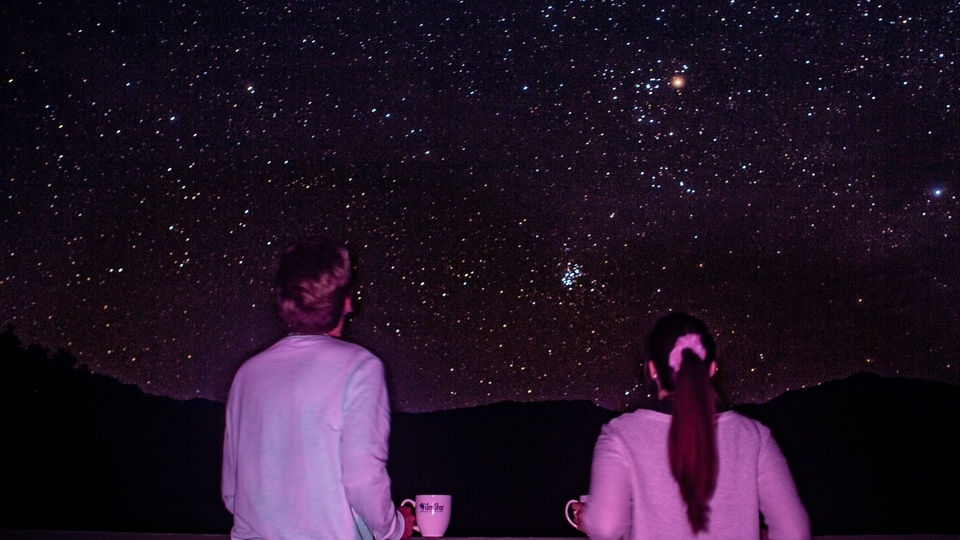
Light pollution is often treated as an abstraction: A hazy backdrop to more urgent environmental concerns. The data suggests otherwise. Nearly 70% of the world's mammals and about half of all insect species are nocturnal, adapted over millennia to darkness and lunar rhythms most city dwellers no longer notice. When artificial light erases that darkness, it does not just erase our view of the heavens above; on the ground, it also disrupts navigation, feeding, and breeding cycles for species that share our cities and towns, often invisibly.
In a hill town along the way, the student group surveyed 387 outdoor lighting fixtures across the highway, hotel districts, and market streets. Using GIS mapping tools they analysed whether the existing lighting fixtures threw light beyond what was needed. A mere 20 fixtures near the town's bus stand and parking area cast a visible glow across 72 square kilometres of the surrounding terrain and forest area. Simple, already-available shielded fixtures aimed at the ground instead of outward and upwards, could shrink that footprint to roughly eight square km — a nine-fold reduction.
The study also observed an issue of redundant lighting where individual businesses compensate for public lighting. In other words, each property tries solving, on its own, a problem that a centrally planned street lighting design would have solved with fewer lighting fixtures. The duplicated, poorly aimed light radiate outward into forest edges and night sky alike, at a cost that individual businesses are quietly absorbing. Add to that the cost paid by the environment and wild animals.
While cities struggling with light pollution shrug at it as a by-product of urbanisations, can hill towns afford to do the same? Preserving the night sky, the nightlife of the forests at the same time providing adequate lighting for wayfinding, security and aesthetics require a fine balance. Tourism planning must include a centralised policy to curb light pollution. Our study suggests the solutions are feasible and affordable. Local governance must adopt a stronger mandate for shielded fixtures in public lighting tenders and building by-laws, the way many cities already mandate energy-efficient lighting.
This also requires a larger shift in how we understand the role of darkness at night alongside what responsible tourism means. Tourism development is not only about making places more accessible, visible, and active; it is also about recognising what makes these places special in the first place. In a hill town, the night sky and the darkness that surrounds it are part of that special experience, and protecting them requires better lighting practices by authorities and businesses, along with greater awareness among visitors and the public at large. A shift in thinking is needed: darkness is not the absence of development but a valuable part of the environment that tourism can help preserve.
(The views expressed are personal)
This article is authored by Minu Agarwal, professor, CEPT University, Ahmedabad.


