E-Paper



Heart of tomorrow: The therapies shaping the cholesterol control battle
Statins have been the standard, but a new line of therapies is gaining prominence, bringing a different way to lower cholesterol, each with different mechanism.

 Prefer HTon Google


For as long as high cholesterol has been treatable, it has been treated the same way — a daily statin pill, taken for life, with the person on the medicine doing the remembering. That arrangement is beginning to change.
Cardiovascular disease kills roughly 3.2 million Indians a year — about one in four deaths in the country, and nearly half of all deaths between 40 and 69. High LDL (low density lipoprotein) cholesterol is one of the biggest modifiable causes. For most people who have it, it is either untreated or treated with the same medicine that has been prescribed for 30 years: statins.
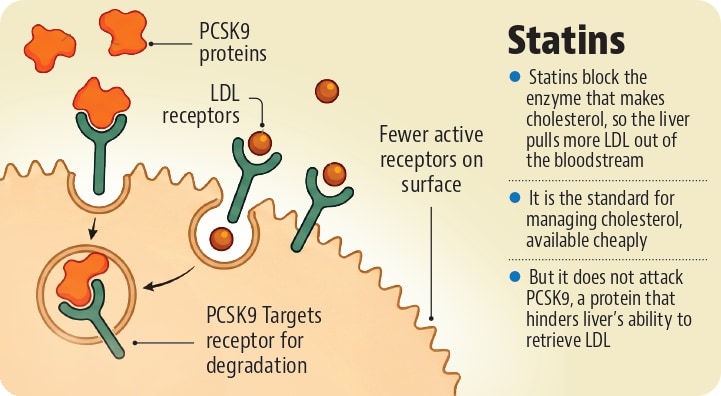
Today, these are the foundation of cardiac health, which hinges on the level of cholesterol in the blood. Cholesterol, in excess, sticks to the walls of arteries and hardens into plaque, narrowing the passage that keeps the heart supplied. Statins work by blocking an enzyme the liver uses to make cholesterol; with less being made, the liver pulls more LDL — the "bad" cholesterol that clogs arteries — out of the blood. Depending on the dose and the drug, they cut LDL by 30 to 50 per cent. In India, they are generic, widely available, and cheap. And they have, over 30 years, been shown to reduce heart attacks, strokes, and cardiovascular death. That last point matters: LDL reduction is the number every newer drug is measured by, but LDL is a proxy. What patients actually care about is the outcome. No other class of cholesterol drug has yet accumulated a comparable body of evidence for it.
Also read: Weight loss, muscle mass, heart risk: Study decodes strengths & weaknesses of 19 GLP-1 drugs
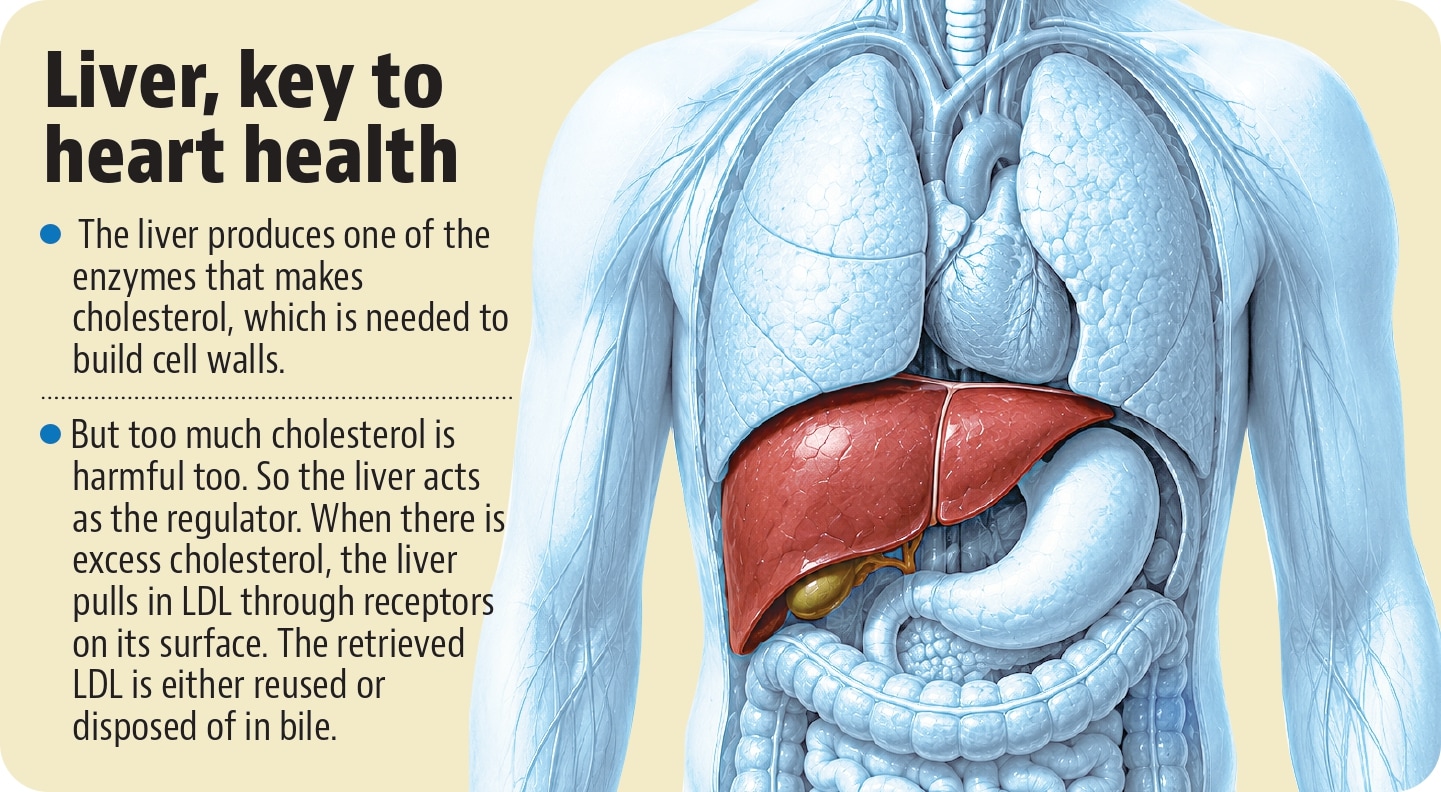
"Statins have been long-standing and eminently proven," said Dr Ashok Seth, chairman of Fortis Escorts Heart Institute. "We don't just talk about lowering LDL cholesterol but also preventing heart attacks. Statins alone even in the highest doses would lower bad cholesterol by around 35 to 40 per cent."
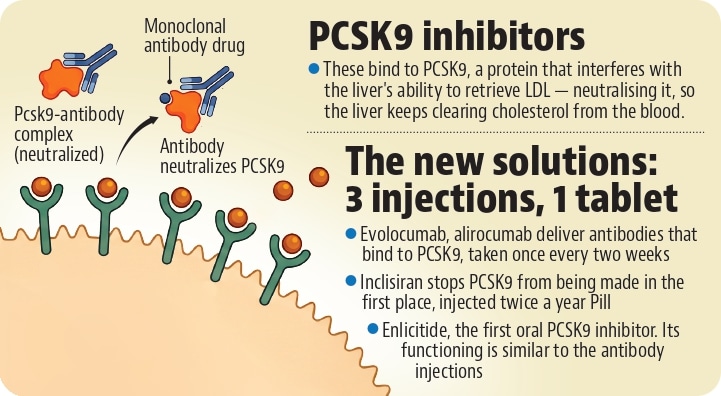
But a new line of therapies is gaining prominence, bringing a different way to lower cholesterol — each with a different mechanism. In the last decade, cardiology has learned to target a protein made in the liver called PCSK9. The liver has receptors on its surface that pull LDL out of the bloodstream and dispose of it. PCSK9 destroys those receptors. Block PCSK9, and the receptors survive longer, clear more LDL, and blood cholesterol falls sharply. Four drugs now do this, in different ways.
The first two are antibodies given as an injection under the skin every two weeks — evolocumab and alirocumab. They bind to PCSK9 and neutralise it. On top of a statin, they cut LDL by another 50-60%, and large outcomes trials have shown that in high-risk patients they reduce heart attacks and strokes.
In India, both are available, but they cost significantly more than statins. The injection has stayed a specialist choice for a narrow group — people whose LDL stays too high on the maximum statin they can tolerate, people who genuinely cannot tolerate statins, and people born with familial hypercholesterolaemia, a genetic condition that keeps cholesterol dangerously high from birth.
A third injection, inclisiran, does the same job differently. Instead of neutralising the PCSK9 protein once it has been made, it uses a technology called small interfering RNA to stop the liver from making PCSK9 in the first place. After loading doses, two injections a year have been shown to bring LDL down by around 50 per cent. But the outcomes trial testing whether that translates into fewer heart attacks is still running and reads out through the end of this year and next.
Inclisiran is available in India, but at a cost that keeps it, too, a specialist choice.
The fourth drug is the biggest newcomer, approved on July 16 by the US Food and Drug Administration: enlicitide. This is the first oral PCSK9 inhibitor, a once-daily 20 mg tablet.
The reason the earlier PCSK9 inhibitors required needles is that they are proteins, and proteins are broken down and digested in the stomach. Enlicitide is made using macrocyclic peptide chemistry — the peptide folded into a ring that survives digestion and reaches the bloodstream intact. In its main trial (CORALreef Lipids, 2,904 adults, published in the New England Journal of Medicine) it cut LDL by 56 per cent against placebo at 24 weeks; in a separate trial of patients with a genetic form of very high cholesterol, by 59 per cent. That is the same range as the injections. The trial testing whether it prevents heart attacks is still running.
In India, enlicitide is not yet available but a clearance is impending. The drugs regulator CDSCO gave approval on July 20 to run a Phase 3 trial locally.
In Indian consulting rooms, the alternatives to statins have a mixed reception. "If acceptance is 30%, we have 70% that say — such expensive injections, are you sure?" said Dr Seth. "They have to reach a sort of desperate zone for them to get pushed to taking the injections."
Those who have had multiple heart attacks accept it more easily, he said, than those who have never had one and are being offered it for primary prevention.
This is where the new oral PCSK9 pill matters — because, just like a statin, a patient will actually take the treatment. "The long-acting pill has to be the answer rather than the injections," Seth said.
Also read: The pill that nearly doubles pancreatic cancer survival — and is set to cost $475,000 a year
Gene therapies
Beyond the four drugs is a different kind of treatment altogether. Two experimental therapies now in early human trials do not lower cholesterol by giving the body a drug that works and then wears off. Instead, they change the DNA inside liver cells in a single infusion. Switch off a gene involved in cholesterol regulation, and the liver stops making the protein that gene codes for. Cholesterol stays low without any further treatment.
VERVE-102, made by Verve Therapeutics — a company Eli Lilly acquired last year — targets the PCSK9 gene: the same pathway as the drugs above, but by editing the DNA so the gene never expresses again. Early-phase results (Phase 1b) showed a 62 per cent LDL reduction sustained for at least 18 months after a single infusion.
A second candidate is CTX310, made by CRISPR Therapeutics. A study published in the New England Journal of Medicine in November 2025 said CTX310 uses CRISPR-Cas9 to switch off a different gene, ANGPTL3. In a 15-patient trial, LDL fell by 49% and triglycerides — a separate blood fat — by 55 per cent.
Both trials are small, and both were done in patients with genetic conditions that keep their cholesterol dangerously high no matter what drugs they take. Neither has been tested in the general population of people with high cholesterol. Phase 2 trials for both begin in 2026.
What should someone on statins do?
So — for the person currently on a statin, what is the best way forward?
For LDL reduction alone, every alternative named above beats statins. But the outcome that matters — fewer heart attacks, fewer strokes, fewer deaths — has been proved for the injections, has not yet been proved for the oral pill or for the gene edits, and will be answered by trials whose results begin to arrive at the end of this year. Indeed, these treatments lower cholesterol more aggressively than statins.
The patients for whom the newer therapies matter, clinicians say, are those with an extreme form of the problem. Dr Upendra Kaul, chairman of Batra Heart Centre, told HT about the case of a 40-year-old severely high-risk patient who was started on the injection alongside statins and saw his LDL fall from 210 to 30 in six weeks. That combination is not for everyone. It is for the patient for whom time and target matter more than cost. "What we want is to reduce the cholesterol to targets," Dr Kaul said. “Number two is to reach the target rapidly.”
For a patient who has had a stroke or a heart attack, that threshold of such intervention is under 50; for a young person who has already had an event, under 35 or even 30.