E-Paper



1st Indian-born female cheetah gives birth to five cubs in Kuno: Bhupender Yadav
Union environment minister Bhupender Yadav also said the development reinforces optimism about establishing a self-sustaining and genetically diverse cheetah population in India

 Prefer HTon Google


Mukhi, the first Indian-born female cheetah, gave birth to five cubs in Kuno National Park, Sheopur, Union minister for environment, forest and climate change Bhupender Yadav announced on Thursday.
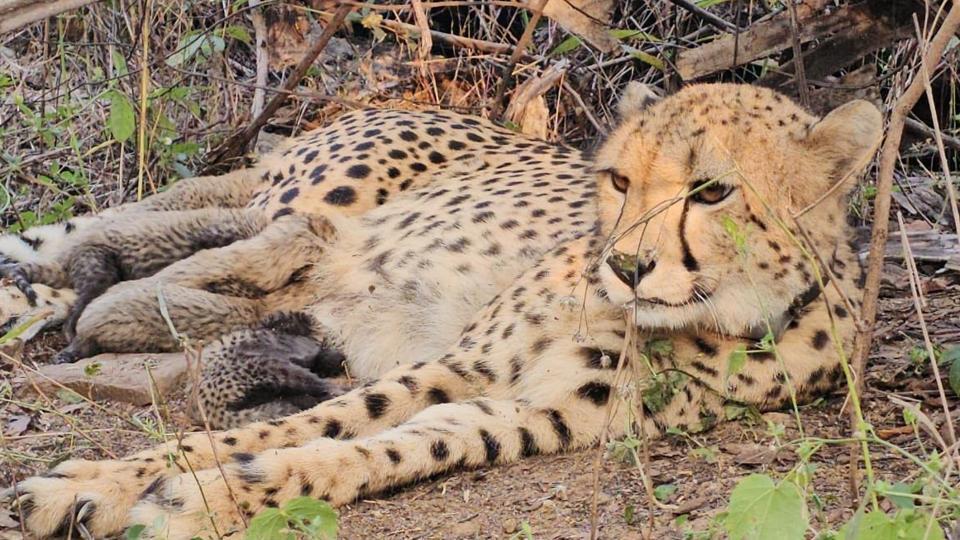
“In a delightful breakthrough for India’s cheetah reintroduction initiative, Mukhi — the first Indian-born female cheetah, aged 33 months — has given birth to five cubs. This is the first time in recent history that an Indian-born cheetah has reproduced, making it a landmark achievement for Project Cheetah”, Yadav shared the post on his official X account.
Yadav also said the development reinforces optimism about establishing a self-sustaining and genetically diverse cheetah population in India.
“This significant development reinforces optimism about establishing a self-sustaining and genetically diverse cheetah population in India, further advancing the nation’s conservation goals”, he said.
“Successful reproduction by an India-born cheetah is a strong indicator of the species’ adaptation, health, and long-term prospects in Indian habitats. The mother and cubs are doing fine”, he added.
Also Read: South African expert team reviews cheetah project in MP’s Kuno, Gandhi Sagar
Madhya Pradesh chief minister Dr Mohan Yadav called the achievement a ‘historic moment’ and a breakthrough for India’s cheetah reintroduction initiative.
“This is an unprecedented breakthrough for India’s cheetah reintroduction initiative. Mukhi, the first Indian-born female cheetah at 33 months of age, has now become the first India-born cheetah to reproduce making it a landmark achievement for Project Cheetah”, the CM wrote.
Cheetahs were reintroduced in the country on 17 September, 2022.
Mukhi is the only survivor from the first litter of Jwala born in India on April 20, 2023. She was just two months old when the forest team found her starved and dehydrated with her two siblings in June 2023. She survived but her siblings died.
Forest officials and experts called it a step towards successful reintroduction of cheetahs after six decades in India through inter-continental cheetah translocation project.
“Nurturing like a baby but keeping her wilderness alive, we learnt so many things in the cheetah project especially on how to take care of cubs. Mukhi was like a separate chapter for us in the cheetah project. Mukhi has adapted well to India temperature after seeing extreme heat in 2023, flood in 2024 and 2025. She has now learnt how to kill prey. This third generation will be more adaptable to the local climate,” said Uttam Kumar Sharma, field director Cheetah Project.
As of now, India has 32 cheetahs including 29 cheetahs in Kuno National Park and three in Gandhi Sagar Wildlife Sanctuary.
Out of total, 21 were born in India. India will get eight more cheetahs next month from Botswana, who will be kept in an enclosure at Kuno National Park.