
 E-Paper



7 minutes, 2 deaths: A story of wire theft that ended in a sewer
On March 22, four days after the incident, police found bloated and decomposed bodies of the two men. Their accomplice, Ateeque, has been arrested.


March 18. 5.53 pm, Max Muller Marg, Lodhi Estate, New Delhi
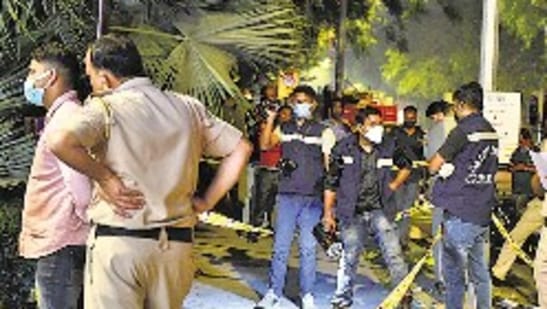
The road outside the India International Centre (IIC) was empty. It was an unusual sight because Max Muller Marg outside the IIC in the evenings is usually full of parked cars of the city’s rich and powerful. The members of the IIC include politicians, bureaucrats, judges, top police officers, and others from the city’s power elite.
But the IIC was closed that evening because of Holi. CCTV footage accessed by police later showed few passersby. They could possibly be evening walkers without a clue about the three men on the deserted road’s pavement, who were about to commit a crime.
But then, the faces of the three men were easy to miss or forget; the three could among the tens of thousands of migrant labour working in the national capital. The three opened the lid of a manhole on the pavement. Nobody on the road were bothered. Why would they? Migrant workers entering the city’s drains to clean them are a common sight in Delhi. Between March 29 and 30, for example, five men died after inhaling toxic gases in the sewer.
At 5.53pm, three men entered the sewer. They weren’t there to clean it. It was to be a quick heist inside the sewer but it ended in deaths. It was all over in seven minutes.
Copper wires
The copper cables used by the telephone company and the metro rail are a problem for the city’s police. Officials of the Delhi Metro Rail corporation have in the past said the theft of copper cables installed on the tracks is a perennial problem that leads to delays in the running of trains. In 2017, the DMRC starting using steel cables instead of the copper at some stretches.
The telephone connections run by Mahanagar Telephone Nigam Ltd are often down in the New Delhi area because the copper wires used by the telecom authority, too, are often stolen. In 2015, the telephone lines of one of the officer’s of India’s premier spy agency – the Intelligence Bureau – were down because the city’s cable thieves had stolen the telephone wires.
The copper wires fetch good money in the stolen goods market. About a kilo is sold for ₹100.
Police have in the past recovered stolen copper wires worth lakhs from thieves. Just on Wednesday, three men were arrested with copper cables stolen from Shastri Park metro station worth ₹20 lakh.
Inside a sewer at the Max Mueller Marg, there were copper wires belonging to the telephone company.
On the evening of March 18, when the three men – Khurshid (35), Sajjad (31) and Mohammed Ateeque (29) – entered the sewer, their plan was to steal copper wires, according to Delhi police probing the twin deaths outside the IIC.
At around 5pm, the three had left their rented room in south Delhi’s Kotla Mubarakpur, carried an iron rod with them, and reached Max Mueller Marg in an auto rickshaw.
Khurshid went into the drain first, Sajjad next, and Ateeque followed them. Going by police records, it may have been a first for Sajaad. Police did not find any criminal case against his name in their records.
But the other two had a history of thefts. But that evening, they weren’t lucky. Within seven minutes of entering the drain, Sajjad and Khurshid fell unconscious after inhaling toxic fumes. Ateeque survived. The police’s CCTV footage showed he came out at 6pm, peered inside the hole once, then closed the lid of the manhole and left the crime scene.
Four days later, the bloated and decomposed bodies of the two men were found by a police team. Police have arrested Ateeque for the deaths.
The two men and the Covid-19 lockdown
In Taran village of Araria district in Bihar, about 1,300km from the national capital, the families of the two dead men are yet to come to terms with news reports that Sajjad and Khurshid stole for a living. “They are my cousins. We live on rent in Bihar and earn about ₹250 by working as labourers,” said Mohammed Sadam, Sajjad’s cousin.
“Ateeque, who is from a neighbouring village, came to visit us and said that he would take Sajjad to Delhi. He promised Sajjad would be paid at least ₹500- ₹600 a day as a mason at construction sites. Khurshid, who had worked in Delhi before the lockdown, also agreed to travel to Delhi,” he added.
Tens of thousands of migrant workers such as Khurshid, who worked as labourers and masons in factories across Delhi, returned to their homes in the villages of Bihar and Uttar Pradesh in March 2020 when the government announced the nationwide lockdown to curb the spread of Covid-19. There is no government data on how many have returned.
Sadam said Sajjad agreed to leave his family back home because his wife was pregnant. The couple has three children. A month after he left forf Delhi with Ateeque and Khurshid, his wife, Nilima gave birth to their first child. The girl is now three months old.
Sadam said the Covid-19 lockdown led to many factories shutting down in the nearby Araria town, so villagers migrated to bigger cities such as Delhi and Mumbai. They share rooms and live together in slums. The three lived together.
“I worked in Delhi before the 2020 Covid-19 lockdown. I worked as a mason in east Delhi. You get ₹500-600 for a day’s work in Delhi, which is twice the amount we earn here. Sajjad’s father died so he was the sole bread earner. Also, there was a new mouth to feed (the new child), so he left. I do not know how he reached that manhole last week,” he said, adding that Sajjad must have been forced to steal that evening.
Police officers investigating the case said they are not certain if Sajjad was forced to work, but could confirm that Khurshid and Ateeque knew what they were doing that evening. They had done it in the past.
Khurshid was arrested in south Delhi’s Hauz Khas on April 4, 2017. A police officer patrolling the street has mentioned in the case files that he had caught Khurshid and two others with stolen copper wires. He was also jailed but got bail sometime later that year. Ateeque was last arrested on October 31, 2020, with a snatched cellphone and a stolen motorcycle.
Their cousin Sadam denied knowing the criminal past of the two men, but Delhi police said that Ateeque worked with a gang of copper wire thieves. Police have now arrested Ateeque gang member, Alauddin, who too has a history of thefts.
The closure
Between March 18 and 22, when the bodies of the two men were decomposing in the sewer outside the IIC, their family members frantically called Ateeque. They say they got no satisfactory answer.
Sajjad’s aunt then contacted another villager, Ashab, a migrant worker who works as a mason in Greater Noida on the outskirts of the capital.
“Sajjad’s aunt asked me to check with Ateeque. I called Ateeque, but he refused to give any answer. I travelled to Kotla Mubarakpur and questioned Ateeque. It was only after I threatened to call the police that he took me to the sewer where the two bodies were found,” Ashab said.
“Someone called the police control room when I saw the bodies,” he said. “Ateeque claimed it was an accident but the police arrested him,”
On March 24, Delhi police confirmed they solved the case of the twin deaths with the arrest of Ateeque. Amrutha Guguloth, deputy commissioner of police said in a statement that Ateeque had confessed to the crime. Not only had Ateeque closed the lid of the manhole before fleeing the spot but he also came to the spot later “to destruct evidence,” Guguloth said.
A second officer aware of the probe details said Ateeque had come to take back the rod, which he had used to open the manhole cover, because it had his fingerprints. Police have recovered the rod. It is now evidence along with the CCTV footage.
Even as Ateeque was taken to the Tughlaq Road police station and later lodged in Delhi’s Mandoli jail, the troubles were far from over.
How would they send the bodies from Delhi to Taran village in Araria in Bihar?
Taking a flight was an option, but even if they could afford it, the nearest airport Bagdogra in West Bengal is 120km from their village. An ambulance driver offered to drive the bodies from Delhi to Taran village, but demanded ₹32,000, finally settling for ₹22,000.
Ashab collected the money from several migrant workers from their village working in Delhi.
Sajjad’s aunt Khushboo said the money they now owe is equal to a villager’s 100 days of work at a factory in Araria. She doesn’t know how the family will repay the money to those who helped them. But this is not what is eating her up for the past few nights. She has a question.
“A day before Holi (March 18), Sajjad had called his wife and complained Ateeque wasn’t paying him. Ateeque had assured he would pay Sajjad’s salary the following day, so that Sajjad could come home for our festival (Shab E Bharat, also on March 18). But Ateeque took them to the sewer. Maybe the murder was premeditated,” she said.
In Bihar
Back home in Bihar, Jokhihat police have registered a criminal case. It was filed against Khushboo’s family members on the day the two men were buried. Khusbhoo’s nine family members have been charged of for assault and extortion. Ateeque’s cousin, Shahid, accused them of extortion and assault after learning that Ateeque had murdered the two men.
The complainant Shahid refused to comment on the case when contacted over the phone.
Khushboo said the family was paying for what happened to Ateeque in Delhi.
“Ateeque’s brother is the pradhan (village council chief) of the village. We went to him to ask for compensation but he used his clout in the village to file a case against us. No one knows about this in Delhi,” she said. “Our sons were murdered there and yet we are made to pay for it here in Bihar.”
 ABOUT THE AUTHORPrawesh Lama
Prawesh Lama, an Associate Editor at Hindustan Times with nearly two decades of frontline reporting experience across India’s conflict zones, border regions, and disaster-hit areas. He writes on internal security, insurgency, the Northeast, and Left-wing extremism and has reported from India’s hinterland and some of the most sensitive and strategically critical regions.Read More


