
 E-Paper



75% of all adults fully vaccinated against Covid-19
Of the country's total adult population of 939 million, as many as 707 million are fully vaccinated, as per data from the government’s Co-WIN portal.


More than 75% of India’s adult population has been fully vaccinated against Covid-19, the Union health ministry said on Sunday, as the country continues to expand its immunisation coverage in the face of growing challenges posed by the pandemic the world over.
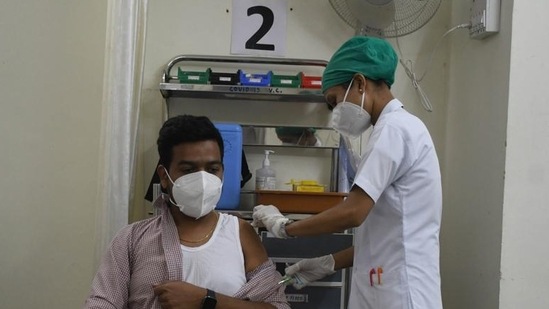

The significant feat in the country’s grand immunisation effort, one of the world’s largest, comes amid a resurgence of infections driven by the highly transmissible Omicron variant of Sars-Cov-2, with the country currently going through the third Covid wave. However, deaths in the third wave have remained mere fractions of the previous waves – a factor that experts credited, at least in part, to the success of the vaccination campaign.
Prime Minister Narendra Modi congratulated India’s citizens for the “momentous feat”, posting on Twitter: “75 per cent of all adults are fully vaccinated. Congratulations to our fellow citizens for this momentous feat. Proud of all those who are making our vaccination drive a success.”
“Co-operation of all; efforts of all, with this mantra India has met with the target of vaccinating 75% of its adult population with both the vaccine doses. We are continuously getting stronger in our fight against Covid-19. We have to adhere to all rules and ensure that we take the vaccine as soon as possible,” health minister Mansukh Mandaviya tweeted in Hindi on Sunday.
With the administration of around 2.8 million shots on Sunday, India’s cumulative Covid-19 vaccination coverage has touched around 1.66 billion doses, as per data from the government’s Co-WIN portal. These doses have been administered to 939 million people, of which around 894 are above the age of 18 years. In the latter part, 707 million people are fully vaccinated while another 187 million people have received only one shot of the vaccine.
When seen against India’s estimated population of 940 million adults, this translates to 95% of all adults in the country having received at least one dose of the vaccine (75.1% fully vaccinated, and 19.9% partially). Furthermore, 46 million adolescents between the age of 15 and 18 years – constituting around 62% of this population group – have received a single jab, while another 10 million shots have been administered as a third “precautionary dose” to those considered most vulnerable to the disease.
“It is a great achievement that the percentage of population that has already been vaccinated in the country is more than the population of several countries in the world. This has been managed within a year and that too powered by two made in India vaccines,” said VK Paul, member (health), Niti Aayog.
Experts also laud India’s efforts to ensure citizens are quickly vaccinated against the viral disease. “Yes, it is a great milestone indeed; and will help in the country’s fight ahead against Covid,” said Dr Anurag Agrawal, director, Centre for Scientific and Industrial Research-Institute of Genomics and Integrative Biology.
Dr Agarwal has also been emphasising on how Omicron variant of Sars-Cov-2 was not mild; although less severe than delta. “Omicron isn’t intrinsically mild, although significantly less severe than Delta. This is true for many viral diseases that we consider mild e.g. measles, which when first introduced to Native Americans without immunity, by Europeans who had immunity, led to devastating outbreaks. It is the high immunity that is making things better this time,” he added.
Dr Gagandeep Kang, senior vaccine expert and faculty, Christian Medical College, Vellore (Tamil Nadu), also said, “Widest possible protection comes from hybrid immunity which people get from a past infection plus vaccines. Therefore, a majority of country’s population getting fully vaccinated is good news.”
Former director of Centre for Disease Control, Atlanta, in the United States, Dr Tom Frieden, echoed the benefits of hybrid immunity. “Despite pandemic fatigue and rough weeks ahead as Omicron crests, we’re better defended against Covid than ever. Vaccines and prior infection steadily strengthened our immune defences. We now have a wall of immunity, though we have lost far, far too many people to get here,” he tweeted.
However, despite the progress, one of the concerns flagged by experts through the year of vaccinations has been India’s patchy pace of administration. At times (particularly through September and October last year), the country was administering an average that soared to more than 10 million doses a day, but at other times (through May last year), it would drop to around 2 million doses a day. In the past week, for instance, daily doses have remained at an average of around 5.5 million shots a day.
The government has stressed that its focus is remains two-fold: first, to look for those eligible beneficiaries who have not yet received even a single shot and administer that as soon as possible, and second, to identify those who are overdue their second dose.
Senior health ministry officials said that state governments have been asked to conduct special drives as part of the “har ghar dastak” campaign, especially among those who were appearing hesitant to get shots. “This has helped in reaching out to those who, for some reason, were not able to physically access the vaccination centre, such as specially abled, old and seriously ill persons. It also helped generate awareness among a section of vaccine hesitant population,” an official, who did not wish to be identified, said.
Experts also say that all eligible people must take the third dose as it will provide additional protection.
“Low incidence of severe disease with Omicron should not make us complacent for receiving third dose which gives us protection from infection and more so from severe disease. We all know that there is always a threat of new variants and it is expected that being fully vaccinated (with third dose) would protect us from them, too,” said Dr GC Khilani, former head, pulmonary medicine department, New Delhi’s All India Institute of Medical Sciences.


