
 E-Paper



AAIB report reveals Air India flight AI171's both engines shut down seconds after take-off on June 12
The AAIB found that in the Boeing 787-8 crash, which killed 270 people, the fuel cutoff switches moved from 'RUN' to 'CUTOFF' within a second of each other.

 Prefer HTon Google


India's Aircraft Accident Investigation Bureau or AAIB has released the preliminary report into the tragic crash of Air India flight AI171, a Boeing 787-8 aircraft, which crashed shortly after takeoff from Ahmedabad's Sardar Vallabhbhai Patel International Airport on June 12.
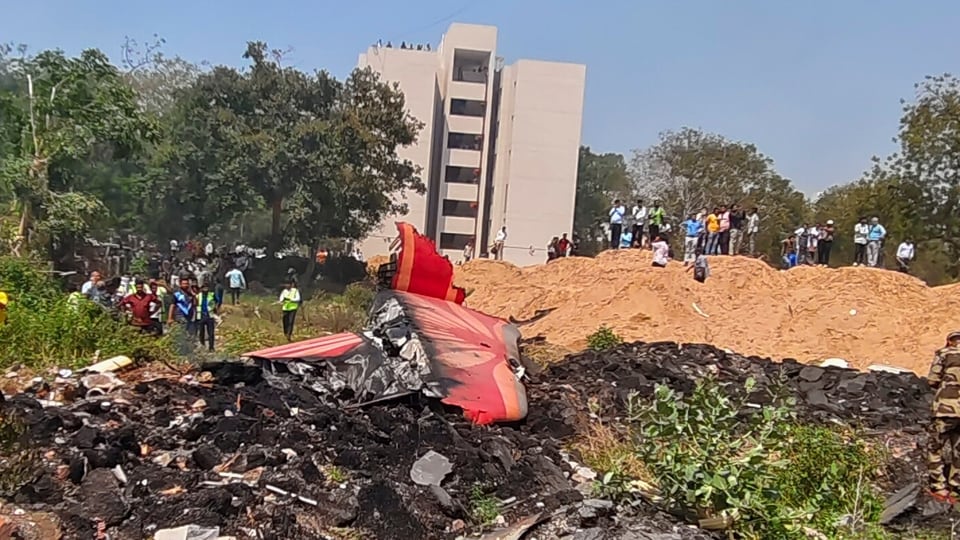
In the report, released shortly after midnight on Saturday, one of the findings shows both engines of the Air India Dreamliner shut down mid-air just seconds after take-off.
According to the AAIB's findings on the Boeing 787-8 crash — which claimed 260 lives, including 241 of the 242 people on board — the fuel cutoff switches that regulate fuel supply to the engines shifted from the 'RUN' to the 'CUTOFF' position almost simultaneously, within a second of each other.
Also Read | Ahmedabad Air India plane crash initial probe report shows fuel cutoff to both engines
Significantly, the cockpit voice recorder captures one pilot asking, “Why did you cut off?” to which the other responds, “I didn’t.”
“As per the EAFR (Enhanced Airborne Flight Recorder), the Engine 1 fuel cutoff switch transitioned from CUTOFF to RUN at about 08:08:52 UTC. The APU Inlet Door began opening at about 08:08:54 UTC, consistent with the APU Auto Start logic. Thereafter at 08:08:56 UTC the Engine 2 fuel cutoff switch also transitions from CUTOFF to RUN. When fuel control switches are moved from CUTOFF to RUN while the aircraft is inflight, each engines full authority dual engine control (FADEC) automatically manages a relight and thrust recovery sequence of ignition and fuel introduction,” the preliminary report said.
Also Read | ‘Mayday’ call, then silence: AAIB probe reveals moments before Air India crash in Ahmedabad
This uncommanded shutdown triggered the deployment of the Ram Air Turbine (RAT), and the aircraft began losing altitude almost immediately, unable to sustain powered flight.
According to the AAIB, the pilots re-engaged the fuel switches in an attempt to relight both engines. Engine 1 showed signs of recovering thrust, but Engine 2 failed to stabilise. The aircraft, which had briefly reached a speed of 180 knots, was already descending and failed to regain altitude. The final distress call – a "MAYDAY" – was transmitted at 08:09 UTC, just seconds before the aircraft crashed into residential buildings outside the airport perimeter.
Also Read | ‘Why did you cut off ?’: Cockpit recording reveals what Air India pilots said before Ahmedabad crash
The Air India aircraft slammed into several buildings, including the BJ Medical College hostel, sparking fires and causing serious structural damage to at least five structures.
Wreckage from the crash was strewn across more than 1,000 feet. Major parts of the plane — including the engines, landing gear, and vertical stabiliser — were found either embedded in buildings or scattered around the area.
The plane, registered as VT-ANB, had been in service since 2013 and had recently cleared routine maintenance checks. Investigators confirmed that all Airworthiness Directives were complied with, the fuel met quality standards, and there were no signs of any technical glitches in the engines or flight control systems leading up to the crash.
The pilot-in-command, 56-year-old captain Sumeet Sabharwal, with over 15,000 flying hours, and co-pilot Clive Kunder, 32, with over 3,400 hours, were both fully qualified and had no recent duty irregularities or medical issues reported.


