
 E-Paper



Aaliya Assadi’s fight for her right to wear hijab gave voice to others protesting ‘discrimination’
Karnataka’s coastal districts have been better known for its communally volatile climate where the majority versus minority agenda has defined its politics

 Prefer HTon Google


It all started in March last year when Aaliya Assadi was fighting for her right to wear hijab. Then in her first year at the Government Pre-University College, she and her parents had made several attempts to convince her school administration to end the “discrimination” “torture” and “harassment” meted out to students like her and those before her who were allegedly being targeted for wearing hijab.
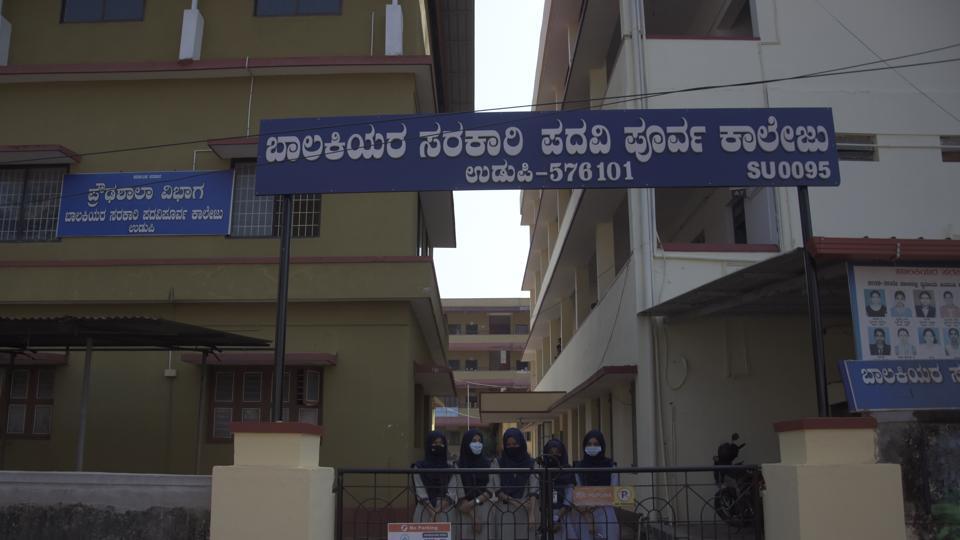
“Some have even endured discrimination at the hands of their own teachers, who have even tried to pull the hijab off their heads, sometimes injuring them,” she claimed.
“We didn’t protest all of a sudden. My parents have met the principal, DC (deputy commissioner), DDPI (deputy director of public instruction), gave them letters, begging for us to wear hijab. They were just not ready to listen,” said Assadi.
“Teachers had even asked our seniors if they bathe with their hijabs on,” said Almas AH, who has also been at the forefront of the protest in Udupi.
Following the controversy, two police personnel were placed before the entry into the main building of the college to prevent these students from entering classes while keeping them within the gates of the premises, forcing them to sit outside the very classrooms where their friends now continue without them.
One report indicates that some of these girls unknowingly attended a meeting of a right-wing group in October. Post this, members of the Campus Front of India (CFI), known to be associated with minority politics, met these girls who drafted this hijab controversy as a push back to assert their identity. The girls and the CFI have refused this claim.
“When the MLA (Raghupathi Bhat) came, he gave us open threats,” she alleged, adding, the “threats strengthened their resolve to fight the practice that denied them the right to practice their faith.”
Bhat, the school principal, and teachers have kept their distance from the media and are relying on the hearing by the Karnataka High Court and its verdict, expected on Tuesday.
The rise of clashes between majority and minority communities in Karnataka, including moral policing, hate crime, targeting minorities, anti-conversion laws, anti-cattle slaughter and several other controversies have been attributed to the Basavaraj Bommai-led BJP government and the chief minister’s strategy to “appease” the right wing to save his own seat as well as continue as the face of the 2023 assembly elections.
“We are denied the right to speak in Urdu, Beary or even do a salaam to our friends inside the college,” Shifa, a protesting student said.
Karnataka’s coastal districts have been better known for its communally volatile climate where the majority versus minority agenda has defined its politics. Unlike the caste-based politics in other parts of Karnataka, the coast has been the biggest laboratory for communal politics over the decades.
About 40km away, the fire has spread to neighbouring Kundapura where the visuals of the school teachers shutting the gates on Muslim girls have become a sign of continued oppression.
“It was them (Muslim girls) who instigated it. Firstly, corona impacted our education and then they came to college with hijab. We accept that everyone should have the same uniform. But if they are allowed to wear the hijab, then we will wear saffron shawls,” Suprasad Shetty, a 21-year-old student from Bandarkar’s Arts & Sciences college said.“If their community is important for them,ours is also important for us,” he said.
It is no secret that several organisations from either side have now sunk their teeth into the controversy, using these students as pawns in a larger political battle.
One student who did wear a saffron shawl to oppose the hijab indicated that orders came from the top, refusing to divulge more information but nonchalant in admitting that he is associated with the RSS (Rashtriya Swayamsevak Sangh), the ideological parent of the BJP, and others with him are from Bajrang Dal and Hindu Jagrana Vedike.
“In our school, students can wear a burqa or hijab on the college premises, go to the changing room on the ground floor and remove them. We have been very clear on the issue from the very beginning,” said Ganesh Moghaveera, principal of Sri Venkatramana school and college in Kundapura. He successfully convinced at least 25 students to remove their saffron shawls and only then enter the premises.
The girls in Udupi are still hopeful of winning back their rights and preparing for their exams, which are just a little over a month away.
Assadi says she wants to be a wildlife photographer, Shifa a cardio-technician and Almas, a pilot. But for now, they have been grounded by the collective might of the government.


