E-Paper



After 46 yrs, process for audit of Jagannath temple treasury starts
After 46 years, the treasury of 12th-century Jagannath temple in Puri was audited. The chamber contained gold, silver, and jewels. No snakes were found inside.

 Prefer HTon Google


The inner chamber of the treasury of the 12th-century Jagannath temple in Puri was reopened on Sunday for an audit of valuables after 46 years, officials aware of the matter said, underscoring a move that has been shrouded both in political jostling and superstition.
The Ratna Bhandar, situated next to the sanctum sanctorum that houses the primary idols and assembly hall, has long been considered the custodian of the temple’s riches. In the last audit of Bhandar held in 1978, the Odisha government said the inventory contained over 149.6kg of gold ornaments fitted with precious stones, 258.3kg of silver utensils, and other items. On Sunday, its door was opened in the presence of a 12-member team comprising the head of the high-level committee appointed by the state government, Archaeological Survey of India (ASI) officials, and temple trust representatives.
“We carried out all the work as per SOPs. We first opened the outer chamber of the Ratna Bhandar and shifted all ornaments and valuables kept there to the temporary strong room inside the temple. We have sealed the strong room,” Shree Jagannath Temple Administration (SJTA) chief administrator Arabinda Padhee said.
“The team then broke the three locks of the inner chamber as we could not open it using the keys that were given to us. The team members decided against opening the wooden chests kept inside the inner chamber due to a paucity of time. The ornaments and jewels kept in the inner chamber will be shifted to a temporary strong room inside the temple premises on another day as the temple administration will be busy with the Bahuda Yatra (return car festival) and other rituals from Monday,” Padhee added.
ALSO READ- Priests hold protest against plan for Kedarnath temple in Delhi
During the 1978 audit, it took officials 70 days to prepare the inventory of the valuables, people aware of the matter said.
The head of the audit supervisory committee formed by the state, justice (retired) Biswanath Rath, said the team “saw five wooden chests, four wooden almirahs, and one steel almirah” in the inner chamber. “Many other items might also be there, as we are yet to check behind the almirahs,” he said.
The Ratna Bhandar consists of two sections — an outer chamber, which is opened for various rituals from time to time, and an inner chamber, which was last opened in 1985 to take out jewellery to make new ornaments for Lord Balabhadra and for silver cladding of the gate in the sanctum sanctorum, people aware of the matter said. However, no audit was done at the time.
“On the wish of Lord Jagannath, the Odia community, with the identity of ‘Odia Asmita’, has started making efforts to move forward. On your wish, the four gates of the Jagannath temples were earlier opened. Today, on your wish, the Ratna Bhandar was opened after 46 years for a greater purpose,” the office of chief minister Mohan Charan Majhi said in a post on X in Odia.
In March 2018, following a public interest litigation, the Orissa high court asked ASI to inspect the structural condition of the Ratna Bhandar and submit a status report. On April 4 that year, a 16-member team then attempted to enter the Bhandar, but the keys given to them by the Puri district collector did not match the padlock, with little explanation from the government on how the keys were mismatched.
The opening of the treasury became a major issue during the recent assembly elections, with the BJP highlighting the “disappearance” of the treasury key in 2018. From PM Modi to Amit Shah, all Bharatiya Janata Party (BJP) leaders raised the slogan of “Odia Asmita” (Odia pride) to oust the BJD government. The BJP, in its manifesto, promised an audit and inventorisation of the treasury if voted to power.
ALSO READ- Odisha: Idol of Lord Balabhadra falls on servitors, several injured
The opening of the Ratna Bhandra was marred in confusion in the last two weeks with the state’s new BJP government scrapping the old panel headed by former judge of the Supreme Court, Arijit Pasayat, set up by the Naveen Patnaik government in February.
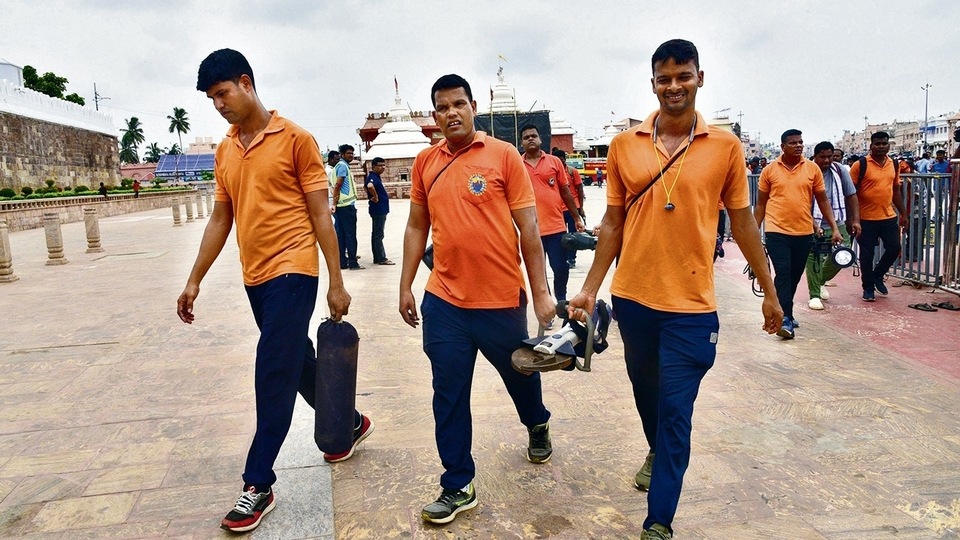
The temple’s treasury has also been engulfed in superstition, with tales of mythical snakes guarding the riches becoming a part of the folklore. This prompted the officials to keep members of the Snake Helpline and doctors on standby. However, no snakes were found when the chamber was opened.
“We were asked to discharge our duty in the process of opening the Ratna Bhandar. However, we were not called up into the inner chamber,” said Subhendu Mallick, the Snake Helpline chief.