E-Paper



Agnipath shadow over Punjab in poll season
The Agnipath model was a major departure from the military’s decades-old recruitment system that was scrapped when the NDA govt introduced it in June 2022.

 Prefer HTon Google


The grizzled 55-year-old farmer looks much older than he is, but Virsa Singh’s wrinkled visage lights up when he begins to talk about his youngest son, Sepoy Gurtej Singh from 3 Punjab, who was among the 20 Indian soldiers killed in action during the Galwan Valley skirmish with the Chinese People’s Liberation Army (PLA) in eastern Ladakh.
Also Read: The impact of Agnipath
That was almost four years ago, on June 15, 2020.
Gurtej was only 22 and was awarded India’s third-highest wartime honour, the Vir Chakra, for his heroism during the savage seven-hour brawl near Patrolling Point 14 along the contested Line of Actual Control (LAC).
According to some estimates, the young soldier killed several Chinese troops in hand-to-hand combat that saw Indian soldiers fight against extraordinary odds and heroically reverse the advance of a numerically superior and treacherous enemy that launched a premeditated charge when talks were on to defuse border tensions after the military standoff began in May 2020.
“My boy, the youngest of my three sons, killed 12 Chinese soldiers before he fell,” says Singh, pointing towards a plaque installed outside a memorial built for Gurtej on a patch of land owned by his family in Birewal Dogran village in Punjab’s Mansa district. A gate has also been installed at the village’s entrance in Gurtej’s memory.
Also Read: In CDS’s Uttarakhand village, murmurs against Agnipath
“He brought glory and honour to the village and his sacrifice fuelled tremendous patriotic fervour. Gurtej became a role model for several young men in and around the village and they were inspired to join the army. But that enthusiasm petered out after the government scrapped the legacy recruitment system and introduced the Agnipath model for the short-term induction of soldiers.”
To be sure, many may not have had a chance to join the army soon after the incident as the force suspended its recruitment rallies across the country in 2020 for more than two years to check the spread of the Covid-19 outbreak. Recruitment then began under the new scheme in 2022.
It’s a scheme that’s been met with opposition.
Also Read: Congress pledges to scrap Agnipath, reintroduce old army services recruitment scheme
The Agnipath model was a major departure from the military’s decades-old recruitment system that was scrapped when the National Democratic Alliance (NDA) government announced the new scheme in June 2022. It seeks to recruit soldiers for only four years, with a provision to retain 25% of them in regular service. Those recruited under the new scheme are called Agniveers.
Singh’s contention that the Agnipath model has been a dampener for youth resonates across several villages in Punjab. And many believe it could influence voting patterns in the upcoming Lok Sabha elections in that state on June 1.
The Congress party has promised in its manifesto that it will scrap the Agnipath scheme and bring back the legacy recruitment model if voted to power. The NDA government itself has suggested that it is not averse to refining the scheme to enhance its appeal.
Singh’s son was one of the four soldiers from Punjab who fought and were killed in action in Galwan on the fateful night of June 15, with the skirmish stretching the India-China relationship to a breaking point, the trust deficit it triggered still haunting the ongoing talks to resolve the dragging border row in Ladakh.
Agnipath has also triggered a different kind of trust deficit.
At Seel village in Patiala, Honorary Captain Nirmal Singh (retd) strokes his flowing black beard with one hand, while using the other to scroll through thousands of images in his mobile phone. The 55-year-old former gunner stops suddenly.
“That’s him. That’s my cousin Naib Subedar Mandeep Singh (from 3 Medium Regiment) who was killed in action in Galwan,” says Nirmal Singh, showing photographs of the fallen soldier to this correspondent that show Mandeep’s bruised face. He was awarded Sena Medal (Gallantry) for his actions in Galwan.
There was a noticeable increase in the number of young men wanting to join the army in this area after the Galwan clash, he says. “It was like a big wave. Agnipath, however, has changed things. The wave has vanished. No one wants to go and serve for just four years,” says the retired captain.
Agnipath has cut short the dreams of thousands of young men in the state, and it is bound to influence voters, he adds. Several people HT spoke to in Seel and other villages in Mansa, Sangrur and Patiala echoed the sentiment.
India , on June 14, 2022, announced the Agnipath scheme replacing the legacy system to lower the age profile of the armed forces, ensure a fitter military and create a technically skilled war fighting force capable of meeting future challenges. It sparked widespread protests and forced a concerted outreach by the government to scotch apprehensions about the scheme.
Fewer young men can be seen training at village grounds in Punjab, reflecting that the Agnipath scheme doesn’t have many takers, says a serving lance naik who is currently on leave and spending time at his village Bhawa in Mansa. It’s not too far from Birewal Dogran, Gurtej’s village.
“There was a time when you would find 70 to 80 kids training to be physically fit for recruitment at our village ground. That’s no longer the case. I have travelled around quite a lot, and the same story is unfolding all around. Agnipath has taken away the charm of military service. I will be retiring in a year with ex-serviceman status and will get all the benefits of military service, including pension, health services and canteen facility. But what about Agniveers?,” he adds.
Soldiers who were recruited through the legacy recruitment system serve in the armed forces for about 20 years before they retire in their late 30s with pension and other benefits.
“I always thought of joining the army but will not do so under Agnipath. I plan to pursue a course in nursing,” says 18-year-old Satti Singh, also from Bhawa village. “I will be the first one to reconsider my decision if the old system is brought back.” His friends nod their heads in agreement.
Agniveers draw an annual salary of ₹4.76 lakh in the first year of service and ₹6.92 lakh in the fourth, get a non-contributory insurance cover of ₹48 lakh, and an additional ex-gratia payment of ₹44 lakh for death attributable to service. Those released after four years will get ₹11.71 lakh as Seva Nidhi severance package, including ₹5.02 lakh contributed by them during their service. They will also have job quotas in different government organisations, paramilitary forces and other departments.
But the scheme is not cutting ice with Punjab’s youth who want the government to return to the legacy system of recruitment, says Gurpreet Singh from Tolawal village in Sangrur. His brother, Sepoy Gurbinder Singh (from 3 Punjab), was also killed in action in Galwan and was later awarded the Sena Medal (Gallantry).
“The youth in Punjab want to serve in the armed forces, but they do not find the new scheme appealing. It’s nowhere close to what it used to be,” says Gurpreet Singh, who was appointed a librarian at a government school following his brother’s supreme sacrifice.
The army said it is constantly obtaining feedback from Agniveers to refine the recruitment model for best outcomes.
“The army conducts regular reviews to ensure efficacy and currency of its HR policies. The Agnipath scheme was introduced two years ago as a transformational approach to human resource management in the armed forces. Regular feedback is being obtained from all stakeholders and this has been instrumental in ensuring smooth, timely and error-free implementation of the scheme and adequacy of policies,” says a senior officer who asked not to be named.
The induction of recruits in the desired numbers under the Agnipath scheme is progressing smoothly, he adds.
Returning to the legacy recruitment model may not be feasible, strategic affairs expert Lieutenant General DS Hooda (retd) earlier told HT.
“However, we should look at reducing the percentage of Agniveers in service. About 25-30% can be recruited under the Agnipath scheme and the remaining should be selected following the legacy model. We can keep fine-tuning the model as per our needs.”
The army has got positive feedback on Agniveers from its units and the recruitment scheme was finalised after extensive consultations, army chief General Manoj Pande said in January 2024.
Pande’s comments came weeks after his predecessor General Manoj Mukund Naravane (retd) created a stir by revealing that the Agnipath scheme caught the army by surprise and was a bolt out of the blue for the air force and the navy. Naravane’s take on the scheme figured in the excerpts of his yet-to-be released autobiography titled Four Stars of Destiny.
The excerpts of the memoirs, reviewed by news agency PTI, revealed that Naravane sounded out the Prime Minister about the ‘tour of duty’ scheme for the short-term induction of soldiers in the army in early 2020, but months later the PMO came out with a formulation with a wider scope to include all the three services. He wrote in the book that the army’s initial view was that 75% of the personnel to be recruited could be retained while 25% should be released.
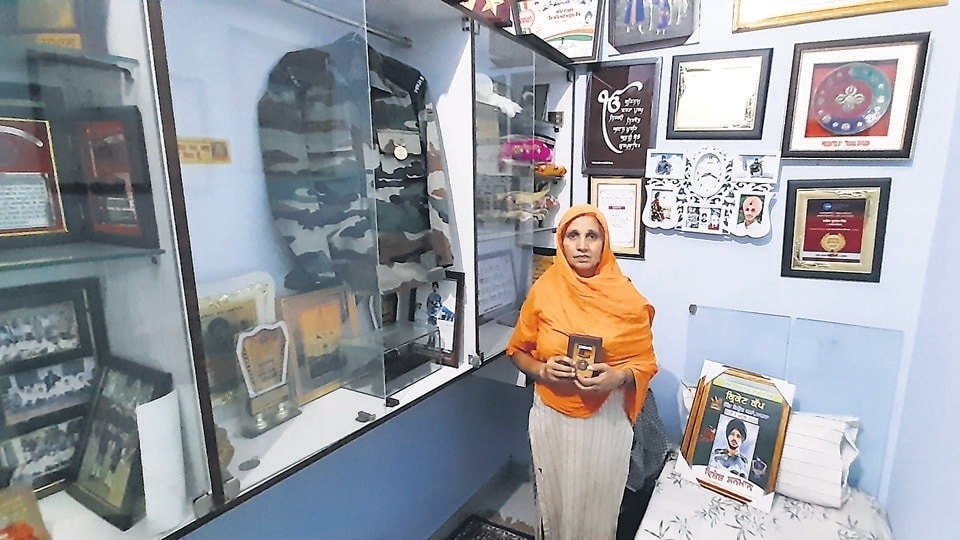
Gurtej’s mother Parkash Kaur politely asks this correspondent to remove his shoes as she shows him into a small room in their house that has been converted into a memorial for her son. A glass cabinet in the room displays his Vir Chakra, his battle fatigues, photographs from his growing up days and trophies and medals won in school.
Gurtej Singh’s citation for the medal says he displayed undaunted bravery, raw courage and exceptional combat skills in resisting the enemy troops in fierce hand-to-hand combat. “He was seriously injured, but with utter disregard for his personal safety, he continued to fight the enemy valiantly and also extricated injured troops, thereby saving several fellow soldiers of his patrol party before making the supreme sacrifice.”
On Republic Day 2021, Gurtej, Naik Deepak Singh and Naib Subedar Nuduram Soren Havildar K Palani (all three from 16 Bihar) were posthumously honoured with Vir Chakra. Havildar Tejinder Singh, an artillery soldier who fought fiercely and survived with injuries, also received a Vir Chakra. Colonel Santosh Babu, the commanding officer of 16 Bihar, was awarded the Maha Vir Chakra, the country’s second-highest wartime honour.
The choice of medals --- wartime decorations, as opposed to the peacetime Shaurya Chakra and Kirti Chakra awards --- was a message from the Indian Army and government that the situation in Ladakh was being formally regarded as a live conflict between the two countries.
“My brave son is gone. The other debates are meaningless to me,” says the 52-year-old Kaur.