
 E-Paper



AIADMK, DMK at loggerheads again
The latest incident that aggravated the tension between the Dravidian majors is the AIADMK boycotting an important state event on Monday when President Ram Nath Kovind commemorated the centenary celebrations of the Madras Legislative Council, where he unveiled a portrait of late DMK patriarch M Karunanidhi.


A period of amiability between the DMK and AIADMK parties in Tamil Nadu seems to be winding up as the ruling and opposition parties have begun cold-shouldering one another.
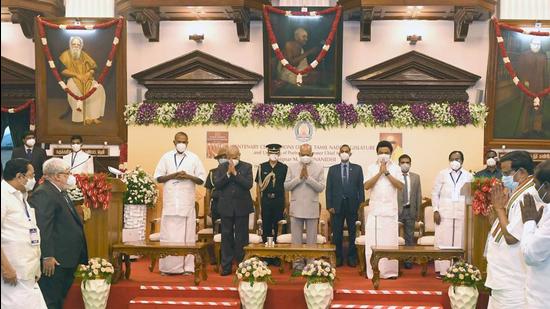
The latest incident that aggravated the tension between the Dravidian majors is the AIADMK boycotting an important state event on Monday when President Ram Nath Kovind commemorated the centenary celebrations of the Madras Legislative Council, where he unveiled a portrait of late DMK patriarch M Karunanidhi.
On Tuesday, DMK’s water resources minister S Duraimurugan revealed that he rang up former chief minister Edappadi Palaniswami to personally invite him to attend the event on chief minister M K Stalin’s instruction. Stalin had also decided to reserve a chair for Palaniswami so he could be seated along with the President and governor Banwarilal Purohit on the dais. “I conveyed these details to him,” Duraimurugan told reporters in the secretariat. “He said he will consult his party and respond but he didn’t tell me anything while he informed the Assembly Secretary that AIADMK will not participate.”
The AIADMK skipped the event saying that the DMK had boycotted a similar event when they had unveiled J Jayalalithaa’s portrait in 2018. “She’s a global leader and we invited them just like they have invited us now. But why did they boycott then? They didn’t respect our party,” said AIADMK spokesperson and former minister D Jayakumar. “In 2012, when Amma (Jayalalithaa) was the chief minister, diamond jubilee celebrations were conducted, in which Pranab Mukherjee had participated. But they (DMK) didn’t participate in that either.”
He added that the AIADMK celebrated its 60th anniversary in 2012 as the first assembly was set up in Tamil Nadu in 1952 while the legislative council was established in 1921. Due to all this utter confusion, our party decided to stay away,” Jayakumar said. The AIADMK’s ally the BJP was present at the event.
Tamil Nadu isn’t a place of usual bitter politicking. For more than 50-years, from the time MG Ramachandran (MGR) founded ADMK (later AIADMK), by breaking away from the DMK, the state has seen politics of hatred between the leaders of the two parties, which was elevated when Jayalalithaa succeeded him MGR. Jayalalithaa and Karunanidhi never saw eye-to-eye and she had even jailed him in a dramatic midnight arrest a month after she came to power in 2001.
This transformed into a healthier political culture after Stalin, Palaniswami and O Panneerselvam took over the respective parties. Despite a heated political campaign, Palaniswami graciously accepted the election results and Panneerselvam attended the DMK’s swearing-in. Post the event, Panneerselvam was seated along with Stalin, something that was unprecedented in Tamil Nadu.
This began to go back to square one after the three-month-old DMK government, via the Directorate of Vigilance and Anti-Corruption (DVAC), raided former AIADMK transport minister M R Vijayabhaskar on July 22, and filed a case of disproportionate wealth. This got the AIADMK jittery as it was seen as the beginning of a crackdown. The DMK had promised in its election manifesto to establish a special court for trying AIADMK ex-ministers on corruption charges. Soon after the raid, Palaniswami and Panneerselvam flew to Delhi to meet with Prime Minister Narendra Modi where this was discussed, according to the AIADMK leaders privy to the meeting. After returning, the AIADMK conducted a state-wide protest against the DMK for not abolishing NEET and not cutting fuel prices as they had promised. The protest didn’t have much traction with the public, but it was more of a booster for the party cadre, amid expelled AIADMK leader V K Sasikala trying to make her way into the party.
This also comes ahead of ensuing local body elections, where polls in nine districts will be held in September as per a Supreme Court order and the remaining will be held later this year.
Political experts also say while the political exchange was respectful, it has gone back to the old ways. “Ugly politics is raising its head once again,” says political commentator Durai Karunanidhi. “After elections, Tamil Nadu was looking like Delhi’s political culture where they will fight inside the parliament but once outside they will be friendly.”


