
 E-Paper



Gyanvapi mosque panel moves HC against ASI survey
The Gyanvapi mosque management on Tuesday moved the Allahabad high court against a district court order of an extensive survey of the mosque to ascertain whether it was built over a pre-existing Hindu temple.

 Prefer HTon Google


The Anjuman Intezamia Masjid Committee (AIMC), which manages the Gyanvapi mosque, on Tuesday moved the Allahabad high court against a district court order of an extensive survey of the mosque to ascertain whether it was built over a pre-existing Hindu temple.
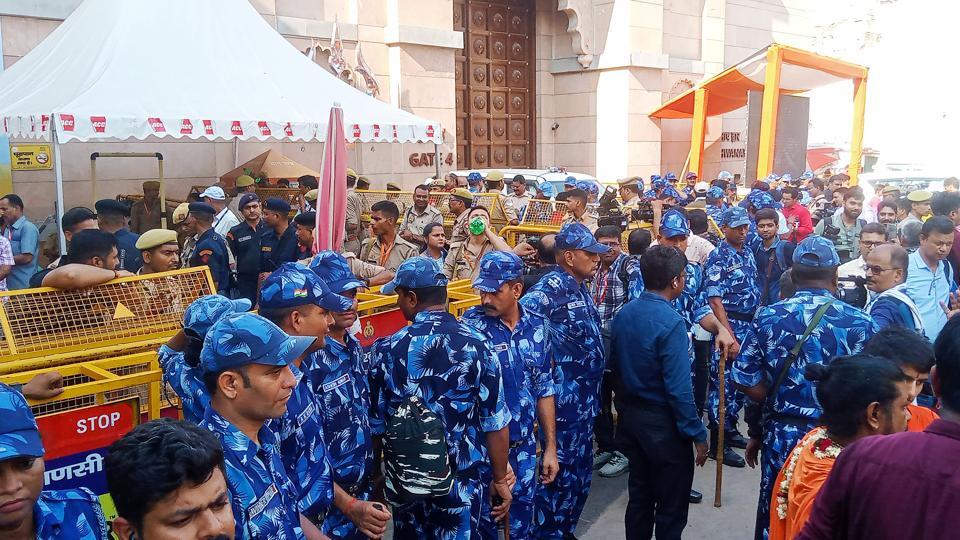
The development came after the Supreme Court on Monday stayed, till 5pm on Wednesday, the “scientific survey” of the mosque by the Archaeological Survey of India (ASI), which had started earlier in the day. A 30-member ASI team was inside the mosque complex to carry out the survey – as directed by the Varanasi district court on July 21 – when the mosque management committee rushed to the top court, pressing for an immediate stay of the contentious order.
In its petition, AIMC urged the high court to set aside the district court’s directive, saying the latter had acted in haste by ordering the ASI survey. The mosque management also said that the district court did not give them sufficient time to challenge the order before an appropriate forum as per law.
Appearing for AIMC before a bench of chief justice Pritinker Diwaker, senior advocate SFA Naqvi said the July 21 directive of the district court will create chaos and confusion among the people. He also said that the district court passed the order for the survey without impleading ASI as a party to the suit.
“The application seeking an ASI survey of the mosque was itself premature as neither the issues were framed nor parties were called to produce evidence in the original suit till date,” Naqvi said, adding that any attempt to excavate any portion would harm the property in dispute.
On the other hand, advocate Vishnu Shankar Jain, who appeared for the respondents, made a reference to the Ram Janmabhoomi-Babri Masjid dispute and said an ASI survey of the premises was held and subsequently accepted by the high court as well as Supreme Court. “Thus, the order passed by the Varanasi court in the Gyanvapi case was just and proper,” he said.
After hearing the arguments, chief justice Diwaker posted the matter for further hearing at 9.30am on Wednesday.
On July 21, a Varanasi court ordered an extensive survey of the barricaded area of the Gyanvapi mosque, excluding its sealed section, by ASI to ascertain whether it was built over a pre-existing Hindu temple, holding that the scientific investigation is “necessary” for the “true facts” to come out. The court, however, ordered excluding the section which has remained sealed since the Supreme Court order in May 2022 from the survey. This is where the Hindu side claims a Shivling has been found; the Muslim side claims what has been found is part of a fountain.
The order came on two applications moved by four of the five Hindu plaintiffs who filed a suit in August 2021, demanding the right of unhindered worship at Maa Shringar Gauri Sthal, located inside the complex that houses idols of Hindu gods. Rekha Pathak, Manju Vyas, Sita Sahu, and Lakshmi Devi filed the application for the survey. Their pleas were argued by advocates Hari Shankar Jain, Vishnu Jain, Sudhir Tripathi and Subhash Nandan Chaturvedi.
The mosque management committee, in its reply, refuted that the mosque was built over a temple, maintaining the structure at the spot was always a mosque.
On Monday, as a top court bench headed by Chief Justice of India (CJI) Dhananjaya Y Chandrachud stayed the survey till Wednesday, it also directed the registrar (judicial) of Allahabad high court to ensure that the mosque management committee’s petition is placed before an appropriate bench in the high court “so that it can be heard before the order of status quo, which has been granted by this court today, comes to an end”.


