
 E-Paper



Air quality dips in northern plains as temperature drops, farm fires rise
An analysis by Union earth science ministry’s SAFAR said that contribution of farm fires in Punjab and Haryana to northern plains’ total pollution load increased from 25% on Thursday to 36% on Friday


Chandigarh/Rohtak/Jaipur: Air quality deteriorated from very poor to severe in several parts of the northern plains on Diwali night (Thursday night) due to poor dispersal of local pollutants and more instances of stubble burning in paddy growing areas of Punjab and Haryana, according to pollution control board officials in the northern states.
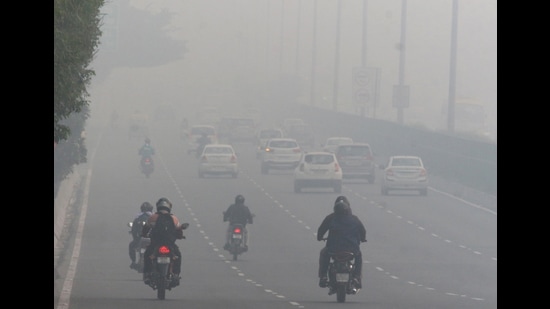
Air pollution, mainly particulate matter 2.5 microns, increases during this period of the year as temperature dip, wind speeds fall, and instances of farm fires increase. Fireworks exacerbate the problem and despite a ban on their use in the National Capital Region spanning Delhi, Haryana, Uttar Pradesh and Rajasthan, people set them off till early on Friday, the officials added.
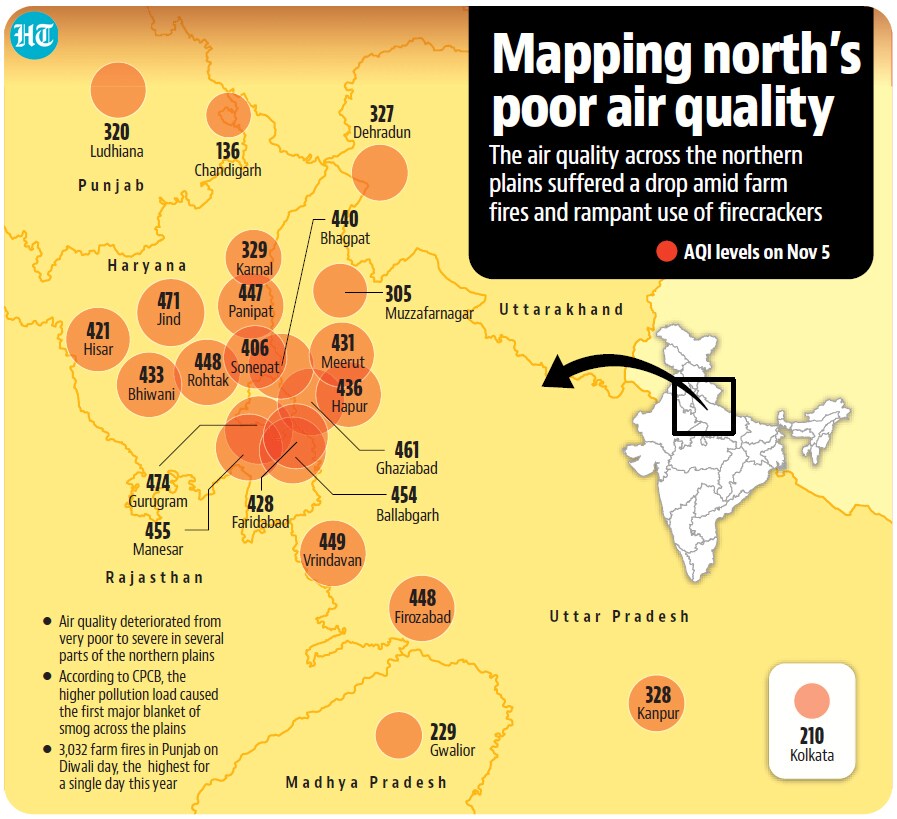
According to Central Pollution Control Board, the higher pollution load caused the first major blanket of smog across the northern plains with places such as Jind (Air Quality Index of AQI of 471) in Haryana and Baghpat (440) in Uttar Pradesh recording high toxicity in air, described as severe on the national Air Quality Index (AQI). The air quality in most of the big towns in the three states neighbouring Delhi, UP, Rajasthan and Haryana, was in very poor to severe category.
A Haryana government official, who monitors air quality in the state, said the fireworks ban was not strictly enforced in any of the 14 districts in the state and no case was registered for defying the ban till Friday morning. Gurugram reported an AQI of 474, Jind 471, Rohtak 448, Panipat 447, Bhiwani 433, Faridabad 428, Hisar 421 and Sonepat 406. The official said the situation may improve in the next few days with wind speeds expected to increase.
An analysis by Union earth science ministry’s System of Air Quality and Weather Forecasting and Research (SAFAR) on Friday said that contribution of farm fires in Punjab and Haryana to the region’s total pollution load increased from 25% on Thursday to 36% on Friday. Last year, the share of stubble burning in Delhi’s pollution peaked at 42% on November 5. In 2019, crop residue burning accounted for 44% of Delhi’s PM2.5 pollution on November 1.
The Punjab government’s satellite based farm fire monitoring centre in Ludhiana said stubble burning incidents reported on Wednesday and Thursday were highest thus far this season. The highest number of farm fires on Diwali was reported from Ludhiana, followed by Sangrur, Barnala and Ferozpur.
Of about 23,465 farm fires reported this season from Punjab, 55% were reported in the last five days with 3,032 reported on Diwali day, the highest for a single day so far this year. However, the number is still half of 44086 cases reported for the corresponding period (till November 4, 2020). On November 4 last year, 4,908 farm fire incidents were reported and in 2019, 5,953 cases were reported, showing a clear decline in stubble burning incidents from the paddy bowl state of India. To be sure, the lower cases this year are a result of a delayed monsoon and it’s very likely that the numbers are yet to peak.
Officials said that while farmers in some districts are exploring possibilities of ex-situ and in-situ handling of straw , many farmers with small and mid-sized holdings are burning stubble. Jugraj Singh, farmer leader, said that if the government wants to end the practice of stubble burning it should implement the Supreme Court order that provided for Rs. 100 per quintal incentive to farmers to scientifically treat stubble. “This will help in long way, as small and marginal farmers can’t spend money to clear fields using machines.”
Emissions from stubble burning from farms in Punjab and Haryana in India and from Pakistan travel with air to the northern plains of the country, increasing the air pollution levels and creating smog weather conditions. “This is what has exactly happened in the last two days,” said Gufrain Beg, who heads SAFAR’s air pollution monitoring unit. “Local pollution coupled with stubble emissions and bursting of crackers has created smog conditions in the NCR region.”
Normally, stubble burning incidents decline in first week of November as farmers start sowing the winter crop. However, this year due to delay in paddy harvesting in Punjab and Haryana, the stubble burning started late and its peak coincided with Diwali.
Member secretary of Rajasthan Pollution Control Board, , Anand Mohan said that in 2020 there was a restriction on movement of people due to Covid-19 during Diwali “This year there were no restrictions and therefore, the air quality in Jaipur and Jodhpur was in very poor category,” he said. He added the situation will worsen if the smog from NCR disperses to other regions.
The bad air even affected the hills of Uttarakhand and Himachal Pradesh.
Dehradun in Uttarakhand saw an AQI of s 227, 10 points higher than on Diwali day in 2020. Shimla in Himachal Pradesh reported AQI of 320, five points more than in 2020. Bihar’s capital city of Patna and Muzaffarpur recorded very poor quality with index value of 302 whereas air quality in Kolkata dipped to 174. Air quality in Bhopal, Gwalior and Jabalpur was in poor category. Air quality in Mumbai entered the ‘poor’ category, recording 215 on the air quality index (AQI), SAFAR said. This is up from a ‘moderate’ reading of 164 the day prior. Chennai’s air quality was satisfactory.


