
 E-Paper



Amid India-China face-off, Dalai Lama’s 85th birthday spotlights uneasy ties
India had given refuge to the Dalai Lama when he, as a 23-year-old, crossed into Arunachal Pradesh’s Tawang in April 1959 to escape the Chinese that had invaded Tibet nine years earlier and had brutally suppressed the uprising against Beijing’s rule.

 Prefer HTon Google


As soldiers of India and China stay locked in a bitter stand-off along the Line of Actual Control in eastern Ladakh, another aspect of the uneasy relationship between the two countries will be under a spotlight on Monday when India, and the world celebrates exiled Tibetan supreme spiritual leader His Holiness the 14th Dalai Lama’s 85th birthday.
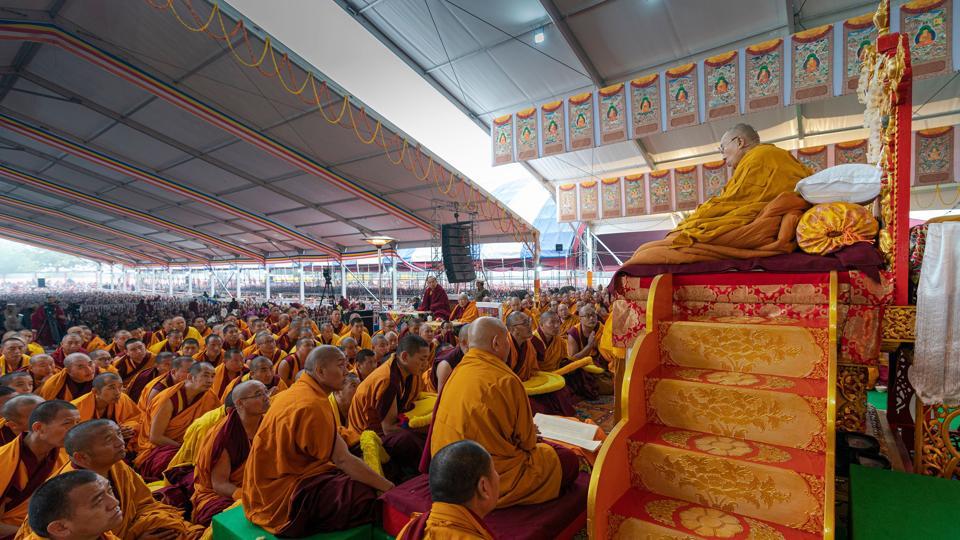
On Twitter, the Dalai Lama has announced plans for a special online screening of a new film about the American physicist David Bohm, who the spiritual leader describes as “one of my science gurus”. On Sunday, the Dalai Lama gave what he described as a general teaching on mind training to mark his 85th birthday celebrations being held in Taiwan.
Prime Minister Narendra Modi had called to wish him on his birthday last year. The Dalai Lama had been travelling and was on his way back home when the call came. Home Minister Amit Shah couldn’t call in 2019 but his wife and son had stepped in for him, and wished the Tibetan spiritual leader on his behalf.
India had given refuge to the Dalai Lama when he, as a 23-year-old, crossed into Arunachal Pradesh’s Tawang in April 1959 to escape the Chinese that had invaded Tibet nine years earlier and had brutally suppressed the uprising against Beijing’s rule. India settled the Dalai Lama and the thousands of Tibetans who followed him in the Himalayan town of Dharamshala in Himachal Pradesh where he has been living in exile ever since. There are over 80,000 Tibetans living in exile in India; 150,000 more around the world particularly in US and Europe.
But China hasn’t let him, or the Tibetan people be. Beijing has called the Dalai Lama who delivers a message of humanity, harmony and peace with his infectious smile names, even a terrorist, and attempted to dismantle Tibetan Buddhism. It arrested a young boy Gedhun Choekyi Nyima in Tibet, just three days after he was proclaimed as the 11th Panchen Lama, the second highest Lama of Tibetan Buddhism, on 14 May 1995. He has never been seen since. Instead, Beijing selected its own six-year old Gyaltsen Norbu as the 11th Panchen Lama six month later and enthroned him at Shigatse monastery.
China is determined to replay this tactic for the next Dalai Lama too to further divide the world of Tibetan Buddhism, where religious leaders of all the four major schools have sought refuge sometime or other in India.
On his part, the Dalai Lama told Hindustan Times in a 2018 interview that he had made it clear far back in 1969 that the Tibetan people should decide if the institution of the Dalai Lama should continue. “My thinking is more liberal than Chinese thinking which is more orthodox,” he told HT.
The Chinese have already initiated the process to identify the reincarnation of the 14th Dalai Lama, declaring that it was not the Dalai Lama’s decision to cease the reincarnation just as it was not his decision to become the temporal and spiritual head of Tibet.
That means if the Tibetan people decide to continue with the institution of the Dalai Lama, there could be two Dalai Lamas. Just as there are two Panchen Lamas and two claimants to the title of the 17th Karmapa, the head of wealthy Karma Kagyu school.
There has been no indication yet that the Dalai Lama could change his stance on this. But he has spoken, in a reflection of the values of Tibetan Buddhism, that there was nothing to prevent a woman from being chosen as the next Dalai Lama. She should be attractive, he said last year in a lighter vein but apologised when some pointed out that it amounted to objectifying women.
It was in context of his democratic values that in 2011, the Dalai Lama relinquished his political and administrative powers over the Tibetan exile movement. “Tibetans need a leader, elected freely by the Tibetan people, to whom I can devolve power,” he had declared.
He didn’t give up the opportunity to take a hard, but polite swipe at Beijing though. “Modern times call for a democratically elected political leadership so I have, sort of retired and we have achieved, at least within our refugee community, an elected political leadership”.
Also Read: In 2012, Dalai Lama spoke of Chinese plot to murder him
He continued: “The Chinese won’t allow (this in Tibet) as their own leader is not elected through free elections”.
To be sure, the Dalai Lama hasn’t directly commented on the stand-off at the border triggered by China’s misplaced aggression through the occupied territory of Tibet. But he did deliver his message to Beijing when he underlined that the concept of warfare is an outdated one.
“In the past, the feudal system, king, queen, sometimes even religious leaders who are thinking and concerned about their own power. So then very strong concept of ‘we’ and ‘they’, then conflict, killing. So I feel, warfare, killing is related with feudal system. So that is gone. Now democratic world,” he said.
A section within the ruling BJP’s mentor RSS wants the government to send out a strong message to China by conferring India’s highest civilian award Bharat Ratna to the Dalai Lama. The Nobel Peace Prize winner is despised by China’s communist party and vilified as a “wolf in monk’s clothing”. There have also been suggestions on social media that the government rename Shantipath, the road running through the national capital’s diplomatic enclave to Dalai Lama Marg (road), that would force the Chinese embassy to put the Dalai Lama’s name on its official address. But then Tezin Gytso is all about compassion, not confrontation.


