
 E-Paper



ASEAN looks towards India as an alternative
Despite Indo-Pacific being a normal construct with India and the United States being two ends of the Asean countries on a world map, China sees this coinage as a threat to its hegemony in South East Asia.

 Prefer HTon Google


On November 29, India and Singapore signed an agreement to deepen cooperation in maritime security and called for ensuring freedom of navigation in critical sea lanes such as Malacca, Sunda and Lombok straits — all connecting the Indian Ocean to the Pacific Ocean via the South China Sea.
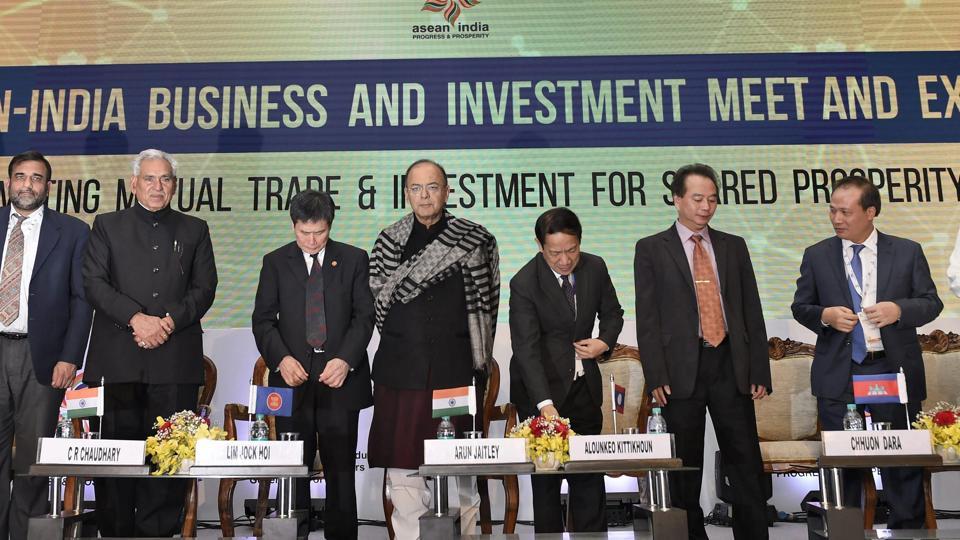
Within days, China served a demarche to Singapore, whose Prime Minister Lee Hsien Loong is the current chair of Asean, virtually accusing this move as being one targeted at Beijing despite assurances to the contrary. The insecurities of the middle kingdom are bound to increase now with the heads of all 10 Asean countries here to celebrate 25 years of Indo-Asean dialogue and witness the growing military might of India at the Republic Day parade (where all 10 are chief guests).
Despite Indo-Pacific being a normal construct with India and the United States being two ends of the Asean countries on a world map, China sees this coinage as a threat to its hegemony in South East Asia. It has done its utmost to fuel fears among Asean nations that Indo-Pacific is a containment strategy conjured up by US, India, Japan and Australia — the Quad dialogue partners.
It is another matter that in Beijing’s world view militarisation of coral reef islands in South China Sea, its close military ties with Russia and Pakistan, economic muscle flexing in one belt one roadway initiative, and unilateral moves to change ground situation on disputed border with Bhutan are not directed at any third country and that its rise to global superpower should not be disputed.
It is safe to assume that Beijing will latch on and dissect each and every sentence said by leaders at the January 25 commemorative conference. This will perhaps be followed by Chinese diplomatic arm twisting, even the use of trade and military levers in case any of the Asean countries dare step out of line. While India recognizes Asean as a single entity, the 10 member inter-governmental grouping is at the crossroads after 50 years of its formation with serious fissures within over China’s military assertion in South China Sea and in the region as a whole.
Asean leaders are looking towards the Trump administration to stand up to China and not behave like his predecessor whose response was, at best, muted to the Chinese nine-dash line territorial claims on South China Sea maps in 2009. The regional grouping is also in search of a rising power like India, which acts as a counter-vailing force to China and provides an alternative option of trade and security to the Tiger economies.
It is in this context that the 90-minute afternoon retreat at Rashtrapati Bhawan on January 25 becomes important. Prime Minister Narendra Modi will likely use this to discuss the way forward to the relationship with all the Asean leaders and also lay to rest all fears that the term Indo-Pacific has invoked.
Committed to freedom of navigation and security of sea lanes, India is willing to join Indonesia, Thailand, Malaysia and Singapore to jointly patrol the critical Malacca Straits — which provides access to South China Sea and facilitates more than $ 3 trillion each year.
While Singapore has supported the Indian proposal and is even willing to sign the logistics agreement with India for the refueling of ships of each other’s navy, there’s still work to be done with Indonesia to assure it that its primacy over Malacca is not threatened by patrolling Indian Navy ships.
While maritime security and freedom of navigation in Indo-Pacific is one crucial aspect of India-Asean ties, the two sides need to move fast on growth of bilateral trade if New Delhi wants to be considered as an alternative option.
The China-Asean trade constitutes more than 15.2 % of the grouping’s total trade as compared to a meagre 2.6% for India-Asean trade with bureaucracies on both sides refusing to budge from their past positions. Both India and the Asean countries should use the forthcoming commemorative summit to push forward the much -awaited Regional Comprehensive Economic Partnership (RCEP) by drawing a fine balance in trade in goods and trade in services to address each other’s concerns.
Currently, China-Asean trade continues to grow, while India-Asean trade is showing a dip. Under these circumstances, Beijing with its trade and connectivity levers will continue to hold a veto over India-Asean relations. Road connectivity between India-Asean also continues to dampen the trade and tourist potential of the partners.
The fact is that India-Myanmar-Thailand trilateral highway is still stuck on the drawing board despite sections, the Moreh-Tamu-Kalewa road or the India-Myanmar Friendship Road being inaugurated amidst much fanfare by then NDA Foreign Minister Jaswant Singh in February 2001. The blame for its non-completion does not entirely lie on India.
There is recorded evidence that India-Asean Hindu-Buddhist linkages go way back to 2500 years. Time is now ripe to build on the past.


