
 E-Paper



Assembly polls: What the verdict means for top leaders
Narendra Modi Barely three months ago, the Bharatiya Janata Party (BJP) and Prime Minister Narendra Modi appeared to be facing political headwinds in Uttar Pradesh


Narendra Modi
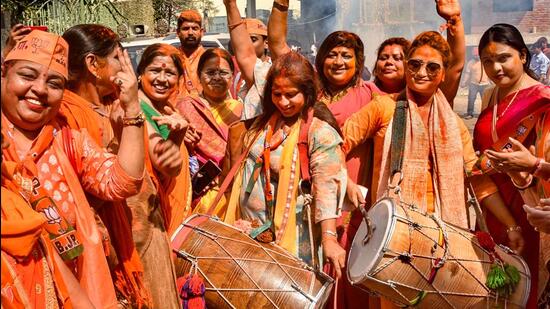
Barely three months ago, the Bharatiya Janata Party (BJP) and Prime Minister Narendra Modi appeared to be facing political headwinds in Uttar Pradesh. Its bastion in the western part of the state was roiled by protests against three controversial farm laws. Its eastern citadel was rumbling from talk of stray cattle devouring crops. And Akhilesh Yadav’s Samajwadi Party was stitching key caste alliances in both parts of the state with smaller parties to dent BJP’s carefully constructed rainbow Hindu coalition on the back of rising inflation and pandemic-induced uncertainty.
That’s when Modi, banking on his personal popularity and emotional connect with people, changed the narrative in India’s most politically sensitive state. He repealed the farm laws despite his government investing political capital on it, promised a solution to the cattle problem, and launched a blistering campaign in which he reminded voters of the dangers of a “dynastic Yadav-raj” under the SP.
The BJP has now roared back to power in UP – the state that was the fulcrum of his 2014 and 2019 general election victories – and Modi has again emerged as a teflon-coated leader with the ability to swing elections. The win in UP, and in three other states where the party bucked anti-incumbency, now makes him the odds-on favourite in 2024. Two years may be a long time in politics, but the victories in UP, Uttarakhand, Manipur and Goa, have that shown Brand Modi shines brighter than ever.
Yogi Adityanath
Yogi Adityanath was a surprise choice as chief minister after the BJP’s record win in 2017. A religious leader dressed in saffron robes, hugely popular among core Hindutva constituents but without broad acceptability, it was unclear how he would govern, and how his hard approach to issues such as law-and-order would be received. On Thursday, Adityanath become the only man to complete a full five-year term as chief minister and return to power with a full majority in Uttar Pradesh. This has never happened in UP, and it changes forever how he will be perceived.
There have been other CMs who have won multiple terms in other states, but the state being Uttar Pradesh,Adityanath has now cemented his place in the top echelon of BJP leaders -- perhaps after only Prime Minister Narendra Modi and home minister Amit Shah -- and as a future legatee of the BJP’s hold over mass sentiment in India. The BJP has leaders that have won multiple terms, even consecutively, but none with quite the messaging of Adityanath, or his popularity. Even before these results, he was already one of the BJP’s star campaigner outside of Uttar Pradesh.
The run up to the elections saw criticism of Adityanath’s strongman image, his “baba” credentials, the metaphor of bulldozer trampling over criminals who cross the line. Much of the opposition campaign was also centered around his “Thakurvaad” (favouritism for his Thakur clan). But with his win, Yogi has risen above these now-narrow definitions, and put himself in line for a long innings in state and national politics.
Akhilesh Yadav
These elections were Akhilesh Yadav’s chance to prove several things -- that he could command his father Mulayam Singh Yadav’s support base on his own; that he had the energy and guile to engineer election victories in political landscape re-engineered by the BJP; and that he was one of the regional satraps who could defeat India’s most domineering electoral engine.
To some extent, Akhilesh did things right in the run up to the elections. He ended a family feud with his uncle Shivpal Singh Yadav. He made key OBC leaders switch from the BJP. He stitched important alliances -- with the Rashtriya Lok Dal (RLD) in the west and the Suheldev Bharatiya Samaj Party (SBSP) in east UP. And he garnered huge crowds at rallies, accusing the BJP on riding his developmental coat tails, and of being anti-farmer and pro-big business.
All this got Akhilesh what the Samajwadi Party (SP) never had before -- a 36% vote share for the party and its allies. But the end result, in the face of a stronger consolidation for the BJP in a bipolar contest, was still a heavy defeat.
Now, in the short-term, Yadav’s challenge will be to hold on to his party workers and the newly acquired OBC leaders. In the longer term, he faces a more fundamental question -- does the caste combination thrown up by Mandal politics retain the ability to stop the BJP?
But there is a silver lining -- the political demise of the Mayawati’s BSP and the Congess has made him the pre-eminent Opposition face in Uttar Pradesh, one around whom any anti-BJP sentiment could coalesce. It now depends on what he does with this opportunity -- expand his party for prepare for the next fight, or allow the demoralising defeat to push him into a shell.
Arvind Kejriwal
The rise of Kejriwal from a bureaucrat to a social activist to a political leader to a two-term Delhi chief minister in a short span of time is a fairy tale in Indian politics. Now, in what turned out to be a monumental day for his Aam Aadmi Party (AAP), another unprecedented chapter has been added to the volume. The AAP becomes the only party apart from the Bharatiya Janata Party (BJP) and the Congress to be at the helm in two states after a sweep in Punjab that ended up decimating both the ruling Congress and the long-time regional powerhouse the Shiromani Akali Dal. And so emphatically that all the prominent leaders of the two parties -- CM Charanjit Singh Channi and Navjot Singh Sidhu of the Congress, and the entire Badal clan of SAD -- were defeated by AAP canidates.
Taking its second state makes the AAP a legitimate rising force in Indian politics (it also won two seats in Goa) and Kejriwal a legitimate contender in the fast-changing Opposition space after the consistent decline of the Congress.
These results also mark a political crossroads for Kejriwal. Bhagwant Mann may be AAP’s chief minister in Punjab, but if the BJP means Narendra Modi, Kejriwal embodies the AAP. Taking off from Punjab, the AAP will now look to expand further. Going forward, the party’s face being the chief minister of city-state Delhi could become a structural imbalance, and one that doesn’t give him an opportunity to effectively expand his base. Will Kejriwal decide to relinquish the Delhi throne in the future, and wade into the national arena, building a cross-country cadre of “aam”, or common, workers? It’s a question that could be central to AAP’s political rise.
Rahul Gandhi
There can be no debate that this is a crushing day for Rahul Gandhi and the Congress and fundamental questions, already being asked about the grand old party, its leadership, messaging and political strategy will all get louder. In Uttar Pradesh, India’s political heartland, the Congress is now completely irrelevant, winning less than 3% of the vote, despite a Priyanka Gandhi campaign that boasted over a hundred rallies. These resources may well have been better spent in the states of Uttarakhand and Goa where the party had a fighting chance.
On the face of it, these five states presented the Congress and Gandhi with the best chance of revival. There was Punjab, a state where the BJP and Shiromani Akali Dal were taking heavy criticism because of the farm laws. But a bickering Congress, right up until the last few days of the campaign, never got its house in order, despite the intervention of Rahul Gandhi. The decision to remove Captain Amarinder Singh and the never-ending clash between Navjot Singh Sidhu and Charanjit Singh Channi hurt the party. In each of the four other states, the Congress faced an incumbent BJP government with myriad problems. In Uttarakhand, the BJP changed two Chief Ministers, in Goa there was clear disaffection with Chief Minister Pramod Sawant, and in Manipur, against N Biren Singh. Yet, the Congress failed to encash these opportunities.
Nationally, the exodus among its national and state leaderships will only get worse, and the calls for a leadership change will increase in both frequency and intensity.
Mayawati
The decline has taken just a decade, and it is stark and staggering. In early 2012, Mayawati was chief minister of Uttar Pradesh, and one of most powerful women in Indian politics. The inheritor of Kanshi Ram’s legacy, arguably the tallest scheduled caste leader in India, the administrator who fixed UP’s infamous law and order, the leader who would, in 2009, make an audacious play for Prime Minister. In 2022, she has lost it all.
The end has been precipitous. Even in the BJP’s mammoth victory in 2017, she could take succour in the idea that her Jatav votebank backed her strongly, and her vote share stood at 22.23%, higher than the SP’s, even though her seat share wasn’t. On Thursday, even that evaporated, falling to under 13%. The BSP has all of one seat. Raja Bhaiyya’s Jansatta Dal Loktantrik has two.
The path back to relevance will be long and arduous, and it is unclear if Mayawati has the stomach for the fight. In this campaign, a party that was built by workers on the ground, by UP’s poorest was relegated to fighting a campaign on Twitter, her silence deafening. The BJP has eaten into her scheduled caste base, wooing the marginalised with a welfare web. The upper castes, with whom she formed an unlikely but powerful alliance, have found their natural home in the BJP. The SP, even in a morale sapping defeat, has become the clear sole opposition in the state. Where Mayawati goes from here is a difficult question to answer, even for her most ardent supporters. For now, she stands diminished.


