
 E-Paper



ECI to announce 2024 Lok Sabha polls schedule at 3pm today
The term of the 17th Lok Sabha along with assemblies in Andhra Pradesh, Sikkim, Arunachal Pradesh and Odisha ends in June and a new House has to be constituted.


The Election Commission of India (ECI) will announce the schedule for the Lok Sabha polls and assembly elections in some states on Saturday, the poll watchdog announced on Friday, setting the stage for the world’s largest democratic exercise that is likely to span several phases across a month.
The term of the 17th Lok Sabha ends on June 16 and a new House has to be constituted before that. The term of the assemblies in Andhra Pradesh, Sikkim, Arunachal Pradesh and Odisha is coming to an end in June.
“Press conference by Election Commission to announce schedule for General Elections 2024 & some state assemblies will be held at 3 pm tomorrow ie Saturday, 16th March. It will livestreamed on social media platforms of the ECI,” the poll body posted on X.
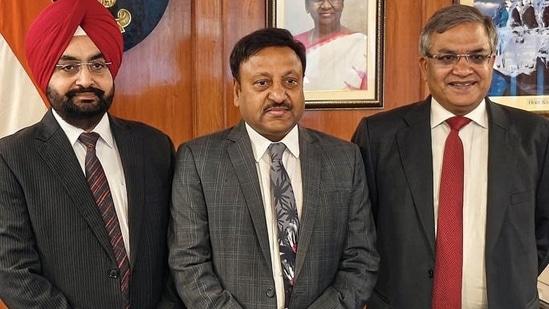
The announcement came a day after the President appointed retired bureaucrats Gyanesh Kumar and Sukhbir Singh Sandhu as election commissioners after a high-level selection committee headed by Prime Minister Narendra Modi met — the first time that election commissioners have been chosen under a controversial new law. On Friday, the Supreme Court refused to stay the appointments and said it will hear the case challenging this law.
Read Here | BJP's Lok Sabha election candidates list: 21% sitting MPs dropped from respective constituencies
The elections to the 18th Lok Sabha will see Prime Minister Narendra Modi attempt to become the first man since India’s first PM Jawaharlal Nehru to win three consecutive national mandates, squaring off against a coalition of opposition parties that will hope to cut into the Bharatiya Janata Party’s (BJP) formidable rainbow Hindu coalition.
Prime Minister Narendra Modi on Friday sought suggestions from people for shaping the Union government’s “Viksit Bharat” (developed India) agenda as he underlined his administration’s record over the last decade.
In a letter, issued on the eve of the announcement of the general elections, the PM said: “I need and indeed, look forward to your ideas, suggestions and support as we work to fulfil the resolve of building a Viksit Bharat.”
Congress leader Sandeep Dikshit said the party was well prepared for the elections.
“Our preparations are really good. Our campaign to raise relevant issues among the public started with Rahul ji’s Bharat Jodo Yatra,” he said.
Lok Sabha elections 2024: Can tech reshape the poll campaign?
Last time, the Lok Sabha polls were announced on March 10, 2019 and held in seven phases beginning April 11. Votes were counted on May 23.
This time, nearly 970 million people are eligible to cast a vote at over 1.2 million polling stations, making the polls the largest democratic exercise in the world. The number of eligible voters is almost four times the number of voters in the next largest democracy, the United States, and is also more than the entire population of Europe.
In 2019, the BJP won 303 seats while the Congress got 52 seats. This time, Modi has set a target of 370 seats for the BJP and 400 for the National Democratic Alliance (NDA). The turnout stood at 67%, the highest ever in all Lok Sabha elections since the first one in 1951-52. Women’s participation outstripped that of men — 67.18% to 67.01% — for the first time.
This time, the BJP has aggressively moved to acquire allies ahead of the polls and will look to defend its fortress in northern India while making inroads in eastern and southern India. For the Opposition’s Indian National Democratic Inclusive Alliance (INDIA), the challenge will be to counter Modi’s popularity and the party’s potent mix of polarisation, welfare politics and development . The Opposition coalition will look to make the contests as local as possible.
Read Here | ‘All previous records will be broken’: PM Modi ahead of Lok Sabha poll dates announcement
The poll body announced last month that 26.3 million new electors were included in the electoral rolls, out of which around 14.1 million were women who surpassed the newly-enrolled male voters (12.2 million) by 15%, the poll authority said.
The number of “third gender” voters increased from 39,680 in 2014 to a little over 48,000. At the same time, more than 20 million young electors, spanning the 18-19 and 20-29 year age groups, were added to the electoral rolls. At least 18.5 million voters were identified as above 80, the total number of centenarians (those who are 100 and above) stood at 238,000.
As on February 8, Uttar Pradesh had the maximum number of voters at 153 million. Lakshadweep has 57,000 registered voters.
Elections in independent India were first held in 1951 but the months-long effort spilled over into 1952 as ECI struggled to reach remote areas in a country where the vast majority of the electorate was illiterate at the time. The turnout stood at a measly 45%.
To facilitate universal adult franchise as mandated in the Constitution, ECI devised the idea of prominently using election symbols for parties and used elephants to transport ballot boxes in rugged terrain. Since then, the independent poll panel has become a model for major democracies.


