
 E-Paper



At pre-budget meet, sops for rural sector, SC/STs among suggestions
A senior party functionary said that the focus of the annual budgetary exercise will be the upliftment of the poor, expansion of the reach of benefits to the poorest and the most deprived and a financial boost to job generating sectors such as like agriculture and small enterprises.

 Prefer HTon Google


More sops for scheduled tribes and castes, the agriculture and the rural sectors, apart from measures to revive the economy were some of the suggestions presented to Union finance minister Nirmala Sitharaman by her party colleagues at a pre-budget interaction on Thursday.
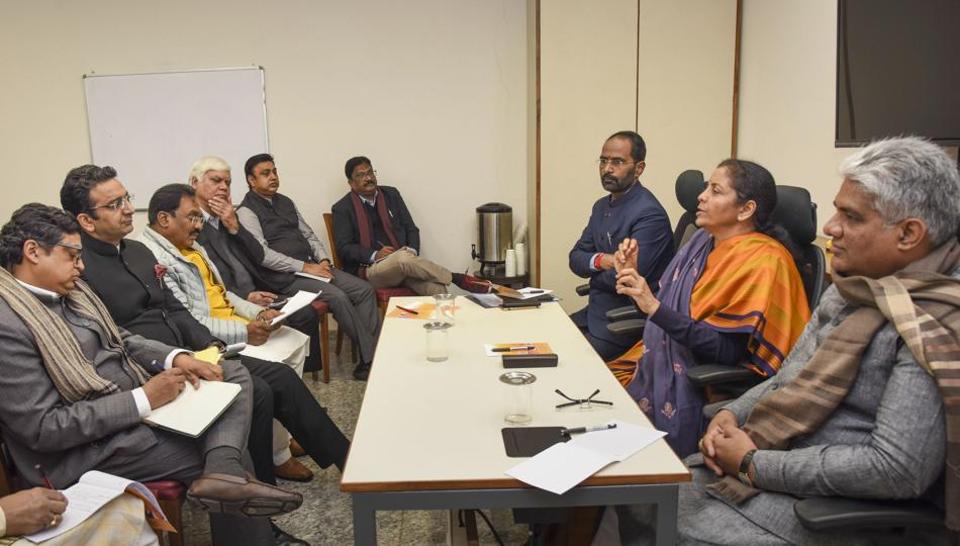
While Prime Minister Narendra Modi met economists and several union ministers at the Niti Aayog here, Sitharaman presided over meetings with four groups of spokespersons, party functionaries, heads of cells and intellectuals.
These groups, people familiar with the matter said, had gathered suggestions for the upcoming budget from sectoral meetings held by Bharatiya Janata Party leaders over a period of two months.
A senior party functionary said that the focus of the annual budgetary exercise will be the upliftment of the poor, expansion of the reach of benefits to the poorest and the most deprived and a financial boost to job generating sectors such as like agriculture and small enterprises.
“There is no denying that this government has come up with the most people-friendly schemes, but it is imperative that more funds are allocated to schemes that are targeted at the socially and economically backward,” said a party functionary who attended the meeting, speaking on condition of anonymity.
The suggestions included increasing the scholarship amount for SC/ST students.
Another suggestion was to ask nationalized banks to offer loans to five SCs instead of just one for green field projects under the ‘Stand-Up India’ scheme. “There are over 1.25 lakh branch of nationalized banks; if each bank gives loan facilities to five SCs, the number of entrepreneurs will go up. Also, there is a need to give recognition to as many as 10,000 SC/ST welfare organisations that work in various sectors. Doing this will enable them to be recognised as trade unions and allow them provisions such as offices and salaries for staff,” a second functionary who attended the meeting said, also on condition of anonymity.
The groups also suggested that the finance minister clear the air over the Goods and Services Tax, and the concerns raised by the states. “GST is not about a single party or leader; there is a GST council that has representation from states that takes all the decisions. But the opposition has been creating confusion by trying to portray that all decisions are taken without consultation. This needs to be checked,” a third functionary said, asking not to be identified.
Giving details about the process of gathering feedback that was presented to the FM, Gopal Agarwal, BJP’s spokesperson for economic issues said: “We met as many as 200 organisations over the last two months from various sectors and detailed reports based on these meetings were prepared. These sectors were identified on the bases of their potential for growth and development and we were given some concrete suggestions for policy inputs.”
While the party has met with leaders from the agriculture, real estate, pharma, food processing, automobiles, telecom, and heavy industry sectors, it has also discussed issues such as GST and the Insolvency and Bankruptcy Code (IBC). More meetings, especially with small enterprises and companies in the banking and financial services space are scheduled.
BJP working president JP Nadda, general secretary (organisation) BL Santosh, General Secretaries Bhupendra Yadav, and Arun Singh were also present at the meeting.
The finance minister will present the Union budget on February 1.


