
 E-Paper



‘Attach property for year’: SC advocates carrot and stick policy for farm fires
‘A carrot and stick policy is necessary for preventing farm fires. There has to be punitive action as registering FIR is not enough’: SC


New Delhi: Carrot and stick policy for farmers is necessary to prevent crop burning incidents, the Supreme Court told the Centre and states neighbouring Delhi as it saw little progress in controlling farm fires and left it to the concerned governments to take steps to ensure farm fires are stopped.
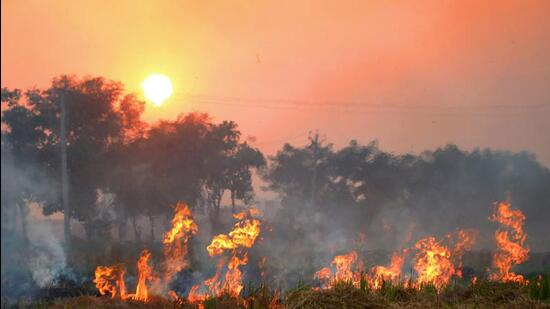
Monitoring the progress of its order passed on Tuesday directing the Cabinet Secretary (CS) to chair a meeting with chief secretaries of Delhi, Punjab, Haryana, Rajasthan and Uttar Pradesh and consider steps to bring down high levels of pollution gripping Delhi, a bench headed by justice Sanjay Kishan Kaul said, “We want farm fires stopped. You do it by whatever means. It is up to you whom you haul over the coals. We are not getting into the nitty gritty.”
Posting the matter for November 21, the bench, also comprising justices Sudhanshu Dhulia and Ahsanuddin Amanullah said, “We are not saying follow this or that policy but only saying that a solution must be found. Work must go on. The nitty-gritty of administration is your job. The decline in farm fires must go on during these holidays.”
Attorney General R Venkatramani informed the Court that the meeting chaired by the CS found 93% farm fires took place in Punjab. He said that the Commission for Air Quality Management (CAQM) informed the meeting that for 2023, the target to bring down farm fires by 50% in 18 Punjab districts and eliminate the same from Haryana was not achieved and instead a sharp increase in stubble burning in Punjab was witnessed in the last 10 days (October 29 to November 8) that pushed up AQI levels in Delhi.
“Every time you pick up speed after we intervene,” said the bench, wondering that if CAQM knew that farm fires are rising and “this season will be troublesome” why no steps were taken.
Referring to its earlier order of Tuesday where it listed out certain short term and long term measures, the Court said, “A carrot and stick policy is necessary for preventing farm fires. There has to be punitive action as registering FIR is not enough. Anybody who does farm fire must be visited with consequences. You may attach his property for a year.”
Senior advocate Aparajita Singh appearing as amicus curiae along with senior advocate ADN Rao pointed out that farmers are a constituency against whom no government takes action. The bench agreed but sought to send a message to farmer community too. “Farmers are also part of society. Let them be responsible. We are also sensitive to their needs but the object cant be to let people die.”
Also Read: ‘Murder of our young people’: SC bans stubble fires in UP, Raj, Haryana, Punjab
The Court pointed out that the stubble burning is found to be due to a particular paddy crop grown in Punjab over a large area which is also depleting the water table level. “Why is this paddy which is a water guzzler still used. You don’t want to create a desert there,” the bench said, seeking action on its earlier order on giving incentives in form of MSP and farm machines to farmers to shift to alternate crops such as maize or millets.
“How can you expect the farmer to switch from paddy to sowing any other crop unless there is an incentive,” the bench said. “If both Centre and states want it will happen,” said the Court, stating that all governments are responsible. “It’s your business how to control farm fires. If it doesn’t occur, we will keep your chief secretary or secretary here till it occurs. Till that happens, take some action.”
The Court further indicated that some emergency measures are required “Pollution level, by whatever level, must come down. It can’t wait till tomorrow. If you say, we will examine the financial implications, this season will go.”
The AG told the Court that the meeting decided on some short-term measures to be immediately implemented with the focus being on bringing down farm fires. A note submitted by the Centre showed that ₹3,333 crore was released by the Agriculture ministry under crop residue management (CRM) of which, Rs. 1,531 crore was released to Punjab and ₹1,006 crore to Haryana.”
It further stated that nearly 1.20 lakh seeder machines are available under the CRM Scheme in Punjab and 76,000 in Haryana. “Optimum utilisation of these machines could have prevented stubble burning to such a large extent,” the note said.
Senior advocate Rao, also assisting the Court as amicus curiae, said even after the Court’s Tuesday order, Punjab recorded more than 2,000 farm fire incidents. The Court asked Punjab government represented in Court by advocate general Gurminder Singh on why the implementation was not carried out. “The chart shows your figures are 10 times more. Till a year earlier, you (AAP) were focusing on Punjab and now you are not focusing on Punjab,” the Court said. The state said that it is a “herculean task” but farm fires have been significantly brought down with total farm fires recorded on Thursday being around 600.
Noting the steps taken by the Committee, the Court said that the Cabinet Secretary should continue to monitor the situation. In its order, the Court said, “The meeting held by Cabinet Secretary and representatives of states has prescribed certain immediate steps to be taken. Those steps are to be proceeded with by all stakeholders. Every endeavour is to be made to bring farm fires under control.”


