
 E-Paper



Bengaluru Metro looks to cut inter-train interval to 3min on Phase-I lines
Since the inauguration of the Metro line in Delhi in 2002, the entire country has a total of around 730 kms operational in 18 different cities and another 1,049 kms under various stages of construction, according to government data.

 Prefer HTon Google


Bengaluru
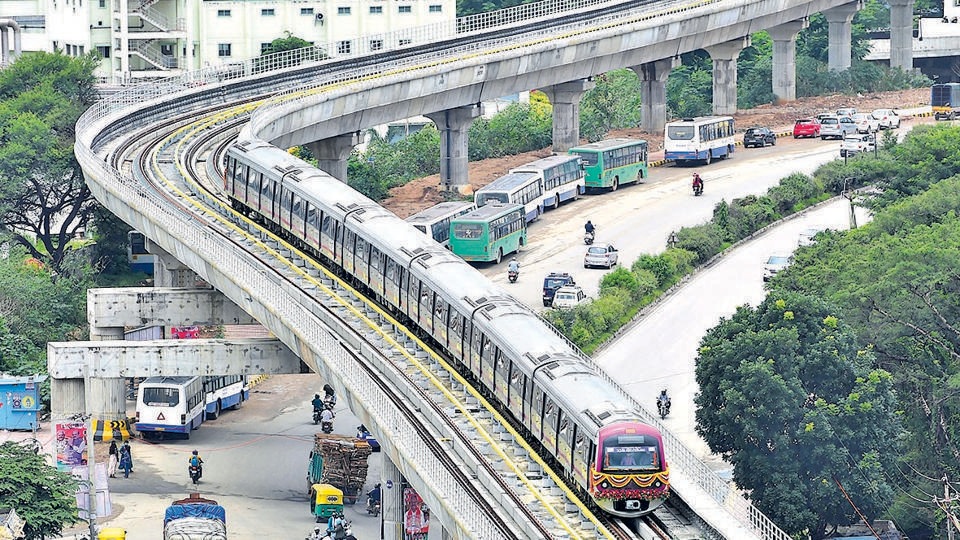
The Bengaluru Metro will soon start retrofitting works on its existing phase-I lines to keep it on par with the technology used in subsequent phases to enable trains to run in 3-minute intervals rather than the limitation of the 5 minutes between them.
This will not only increase frequency but also reduce wait times and encourage more people in India’s IT capital to use the Metro as a viable public transport over private vehicles, said officials of the Bengaluru Metro Rail Corporation Limited (BMRCL).
“The new technology in phase-II is that I can run a train even with a gap of three minutes. As and when the passengers increase, we can increase frequency,” BMRCL managing director Anjum Parvez told Hindustan Times. “BMRCL will start retrofitting gates in phase-I to make it compatible with the National Common Mobility Card (NCMC).”
Parvez said signalling systems in phase-II will be different from those in phase-I, which will reduce time between two train services. “Even gates have to be compatible to NCMC and they would be changed as well to make the technology uniform across phases to allow seamless travel within the city.”
Bengaluru has 56 kms of operational Metro tracks in a city that is over 800 square kms wide. Around 120-km tracks are in various stages of construction in the city, which has been a challenge for ordinary commuters to deal with amid traffic snarls.
Bengaluru, which has a vehicular population of 9.4 million, was judged in 2019 to have the world’s worst traffic globally, according to TomTom, a Netherlands-based global provider of navigation, traffic and map products.
The poor quality of roads, lack of viable public transport options and last-mile connectivity, delays in completion of the Metro, and now the fear of contracting the coronavirus in public spaces have forced more people to opt for private transport options, adding to the number of vehicles on the already congested roads of the city.
BMRCL has also started using prestressed slabs in its construction to save time, Hindustan Times reported on August 26.
Since the inauguration of the Metro line in Delhi in 2002, the entire country has a total of around 730 kms operational in 18 different cities and another 1,049 kms under various stages of construction, according to government data.
Karnataka chief minister Basavaraj Bommai on Sunday announced to extend the Metro’s existing services to rural Bengaluru and other parts, which would in effect double the entire network to around 317 kms. He has instructed officials to draw up plans to increase the Metro’s network that extends to Ramanagara, Magadi and Rajanakunte, that are over 30-40 kms from the outskirts of the city.
But almost every single stretch of the Metro has been delayed invariably. The latest, Nayandanahalli to Kengri on Mysuru road, that was inaugurated on August 29, was delayed by two months. According to BMRCL officials, there is a minimum 5% escalation in the cost of the Metro for every year the project is delayed.
The chief minister has brought down the deadline for some of the existing lines under construction by a year from 2025 to 2024. By 2022, an additional 36 kms of Metro lines are scheduled to be completed, Bommai announced on Sunday.


