
 E-Paper



BJD stance tilts RS balance as Delhi bill is introduced in LS
The BJD’s support to the BJP-led NDA on the bill is crucial as its nine MPs will take the number of those supporting the bill in the Upper House to 123.

 Prefer HTon Google


The Government of National Capital Territory of Delhi (Amendment) Bill, 2023 was introduced in the Lok Sabha on Tuesday, and with the Biju Janata Dal (BJD) indicating its support for the legislation on the floor of the house, its passage in the Rajya Sabha, never really in doubt, is now a certainty.
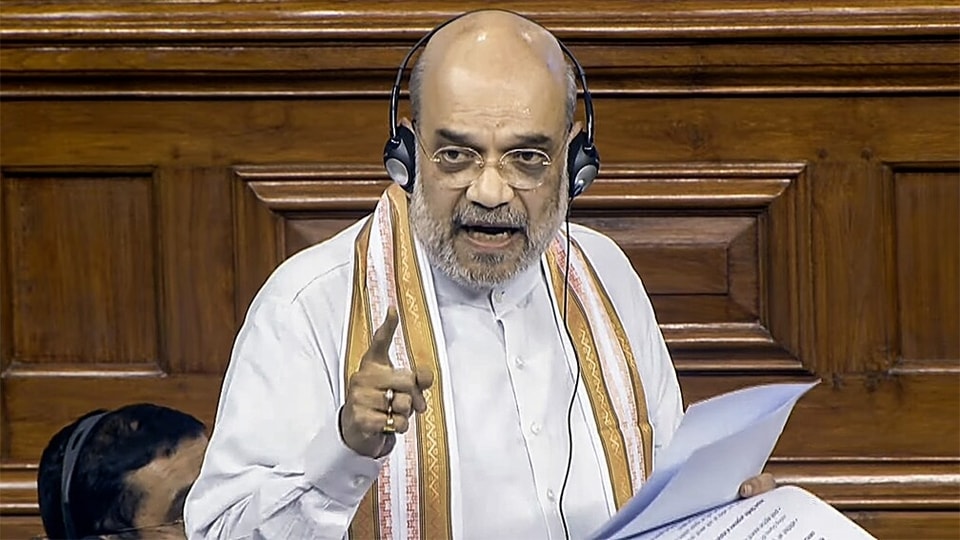
Union minister of state for home Nityanand Rai introduced the contentious bill -- it replaces an ordinance that effectively overrides a Supreme Court judgment and gives the Centre control over Delhi’s bureaucracy -- in the Lok Sabha, where it is expected to sail through, given the NDA’s brute majority.
The BJD’s support to the BJP-led National Democratic Alliance’s (NDA) on the bill is crucial as its nine MPs will take the number of those supporting the bill in the Upper House to 123. In the 245-member house, the majority mark is 120 as some seats are vacant. The Opposition grouping, Indian National Developmental Inclusive Alliance (INDIA), has 107 MPs, including seven of the Bharat Rashtra Samithi (BRS). The YSR Congress Party with nine Rajya Sabha MPs has already confirmed its support for the bill .
Union home minister Amit Shah dismissed the Opposition’s efforts to question the government’s legislative competence to bring the bill, saying it was a “political” move. He cited a paragraph in the Constitution bench’s May 11 verdict. which handed the charge of the Capital’s bureaucracy to the elected government, excluding departments connected to police, public order and land.
“The legislative assembly of NCTD has competence over entries in List II and List III except for the expressly excluded entries of List II. In addition to the Entries in List I, Parliament has legislative competence over all matters in List II and List III in relation to NCTD, including the entries which have been kept out of the legislative domain of NCTD by virtue of Article 239AA(3)(a),” the verdict’s Para 164 [c] said.
The ordinance has inflamed the tussle between the elected Aam Aadmi Party (AAP) and the centrally appointed lieutenant governor over control of the national capital. The AAP government in Delhi has called the ordinance “illegal”, “unconstitutional” and a “black law”. Senior AAP leaders, including party chief and Delhi chief minister Arvind Kejriwal, traversed the country to rally support against the ordinance. The party also hinged its entry into the INDIA grouping on the Congress taking a stand on the ordinance.
The Opposition was hoping to put up a stiff fight in the Rajya Sabha, where the gap between the government and the Opposition is far narrower than the lower House, and where the NDA doesn’t enjoy a majority. But the BJD‘s announcement will ensure a smooth passage for the bill in the Upper House.
“Biju Janata Dal has decided to support the passing of the Delhi bill and we will be opposing the no-confidence motion brought by the Opposition. In this regard, a three-line whip has been issued by the party,” Rajya Sabha member Sasmit Patra said.
HT reported last week that the YSR Congress Party, which also has nine members in the Upper House, has decided to back the Delhi services bill.
In the Lok Sabha, BJD leader Pinaki Mishra countered the Opposition over the issue of legislative competence. “The government has brought a law pursuant to the Supreme Court’s judgment. How can you challenge its legislative competence? On a point of law, you can’t challenge the introduction of this bill,” he told Opposition leaders.
The issue is also before the top court. On July 20, the apex court referred to a Constitution bench the Delhi government’s challenge to the ordinance. To be sure, the top court’s decision to have the legality of the ordinance tested by a Constitution bench has no bearing on the introduction or passage of the ordinance in Parliament as a legislation.
In the Lok Sabha, Shah underlined that Article 249 of the Constitution empowered Parliament to even make laws on a matter in the state list in national interest. Article 249 says, “Parliament should make laws with respect to any matter enumerated in the State List specified in the resolution, it shall be lawful for Parliament to make laws for the whole or any part of the territory of India with respect to that matter while the resolution remains in force.”
Shah’s intervention -- after Rai moved the bill for introduction -- came after several Opposition leaders objected to the bill’s introduction. Congress leader Adhir Ranjan Chowdhury said the bill “vindicates the outrageous infringement of the powers of the Delhi government” and claimed the Union government was making a “graveyard of cooperative federalism”.
“This bill takes away the power to make laws for services. The Delhi government should have the power to make laws in services. It raises serious concerns about the Centre’s intention. This bill aims to offset the SC verdict. This bill expands the power of the LG,” Chowdhury alleged.
AAP MP Raghav Chadha criticised the legislation, claiming it will turn democracy into “babucracy.” “This bill essentially takes all powers away from Delhi’s elected government and transfers them to the lieutenant governor and babus. This bill will give the bureaucracy and the LG overriding powers,” Chadha said.
Also read: Deadlock persists in Parliament as Manipur discussion stalls
AAP leader Sanjay Singh, who was suspended from the Upper House for the rest of the monsoon session, said the bill was against the decision of the Supreme Court, the Constitution, and the country’s federal structure.
All India Majlis-e-Ittehadul Muslimeen leader Asaduddin Owaisi said the bill violated Article 123 (about the President’s power to promulgate an ordinance when Parliament is in recess) and the theory of separation of power. Owaisi sought division of votes on the introduction of the bill.
Saugata Ray of the Trinamool Congress complained that the bill was outside the legislative competence of the government. Ray said the government was attempting “total abrogation of the power of the Delhi government”.
Congress leader Gaurav Gogoi, who labelled the bill as “unconstitutional”, and Dravida Munnetra Kazhagam (DMK) leader TR Balu argued that no substantive motion could be brought till the Lok Sabha took up the no-confidence motion . The no-confidence motion is scheduled to be taken up on August 8.
Congress leader Shashi Tharoor argued that the bill undermined the Delhi assembly and the top court judgment. “If the Delhi government is not able to control or hold officers accountable, a government can’t function,” he said.


