
 E-Paper



BJP banks on collective leadership, aggressive campaign in 3 of poll-bound states
Bharatiya Janata Party lost power to the Congress in 2018 in three of the five poll-bound states—Madhya Pradesh, Rajasthan and Chhattisgarh


The Bharatiya Janata Party (BJP) is banking on collective leadership and an aggressive campaign in three of the five poll-bound states—Madhya Pradesh, Rajasthan and Chhattisgarh—where it lost power to the Congress in 2018.
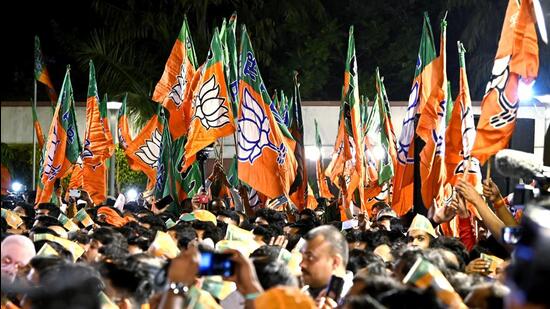
In Telangana and Mizoram, the other two states going to the polls next month, it won a seat each in 2018. BJP’s ally Mizo National Front (MNF) won 26 of the 40 seats to form government in Mizoram five years back while the Congress lost power to the BJP in Madhya Pradesh in March 2020 after the resignations of 22 legislators.
The BJP hopes to retain Madhya Pradesh and wrest Rajasthan and Chhattisgarh from the Congress even as 26 Opposition parties formed the Indian National Developmental Inclusive Alliance (INDIA) in July. INDIA bloc has cornered the BJP on a host of issues and demanded a caste-based census at the national level on the lines of Bihar. It has raised issues such as unemployment, floundering economy and disharmony.
The BJP appears confident of overcoming the challenges on the back of welfare programmes, a muscular foreign policy, landmark legislation for the women’s reservation and Prime Minister Narendra Modi’s popularity.
Collective leadership
The BJP is counting on the “collective leadership” to buck anti-incumbency, enforce a generational shift and weave a coalition of castes by moving away from personality-oriented elections. BJP functionaries said the party’s election campaign will continue to pivot on the social welfare schemes and Modi’s decisive leadership without chief ministerial faces.
“There are advantages and disadvantages of going with a face. But the party feels at this stage, it is better to go to the polls as a collective unit and then let the legislative party pick the names of chief ministers,” said a BJP leader, who did not want to be named.
Recent state elections have highlighted the electors, including supporters of parties, prefer strong faces in the states as well. The BJP’s assessment after the loss in Karnataka in May indicated the decision to replace chief minister BS Yediyurappa with BS Bommai had an adverse impact on the poll outcome.
The party has been averse to projecting Shivraj Singh Chouhan as the party’s face in Madhya Pradesh, where three Union ministers are among the contestants in an indication that the party does not want any leader to be seen as the chief ministerial candidate ahead of the November 7 polls.
Party leaders cited the “fatigue factor” associated with Chouhan, who has been in power since 2005 except for an 18-month period when Kamal Nath ousted him from power in 2018, and the need for newer leadership for the reluctance to project a chief ministerial candidate. A second leader said there is a widespread anti-incumbency associated with Chouhan.
The same strategy has been adopted in Rajasthan, which goes to the polls on November 23. The BJP lost the 2018 election to the Congress when it won 73 of the 200 seats. The Congress won 100 seats.
In Rajasthan, the BJP has been divided on naming former chief minister Vasundhara Raje as the face even though she is considered a leader with pan-state support.
In states such as Telangana and Chhattisgarh, the BJP is struggling to find leaders with mass appeal and support. “There are some states where the local leadership is not quite strong for various reasons—from caste to governance issues. [In Chhattisgarh] after Raman Singh’s exit in 2018, the state unit has been weak. There is no strong OBC [Other Backward Class] or ST [Scheduled Tribe] leader in the state who can be named as the chief ministerial candidate. So the collective leadership strategy will address this problem,” said the first leader.
Election narrative
The elections are being held amid a growing demand for caste-based enumeration, which the BJP has been opposed to. This means the party will have to work harder to retain support from OBCs who want the existing quotas to be revisited. BJP’s leaders cited the Bihar government’s move to announce the findings of the caste survey and said they fear similar demands would come from other states as well.
Modi called the caste enumeration divisive to counter the clamour for it even as the BJP is hoping its social welfare programmes will keep the larger Hindu vote bank together. The party is also relying on its ideological fount Rashtriya Swayamsevak Sangh to steer the campaign on the ground to prevent a split in the Hindu vote.
The leaders said the BJP is hopeful of retaining OBC support, which is critical to winning polls in four of the five states. The party is banking on welfare programmes, some of which have been specifically designed for the OBCs, such as the most recent Vishwakarma Yojna for artisans and craftspeople.
The first functionary said the BJP has ensured the political empowerment of the OBCs, giving them space in the organisational structure and the government. “Similarly, the SC [scheduled castes] and STs have been empowered by giving them avenues for education through scholarships, interest-free loans and opportunities to earn. The opposition’s narrative will not stand a chance.”
In the non-BJP-ruled states, the party has focused on “exposing” the lapses of the governments. The BJP has identified issues with resonance such as corruption and unfulfilled promises just as the Congress successfully used the allegations of corruption against the BJP government in Karnataka.
Trouble with allies
The party does not rely on allies in four of the five states. In Mizoram, its ties with ally MNF have been strained. The BJP won a seat in Mizoram in 2018 even as it fielded candidates on 39 out of 40 seats. Its vote share went up from 0.37% to 8%.
The BJP has made promises such as financial aid of up to ₹5 lakh for those wanting to start their own business and interest-free Kisan Credit Card. MNF’s concern over the continued violence in Manipur has cast a shadow on its ties with the BJP.
A BJP leader said chief minister Zoramthanga’s comments against his Manipur counterpart, Biren Singh, did not go down well with the leadership. The BJP wanted the chief ministers in the northeast to “not appear adversarial.”
Zoramthanga’s decision against collecting biometric data of Chin-Kuki refugees from Myanmar and MNF’s support to the no-confidence motion against the government in the Lok Sabha in August was also seen as a snub to the ally.


