E-Paper



Number theory: Both Holi and heat have arrived early this year
Of the 73 years since 1951, Holi was celebrated on or after March 8 in 53 years and before March 8 in only 19

 Prefer HTon Google


A lot of people refer to Holi as Basanta Utsav (spring festival) in India. This Holi, however, is more likely to have summer than spring-like weather. While Hindu festivals are not exactly tied to the Gregorian calendar – being a solar calendar it is best synced with climate – the relatively hot Holi this year is the result of an early summer , despite Holi coming earlier than usual in the year. Here are four charts which explain this in detail.

2023 has one of the earliest Holi since 1951
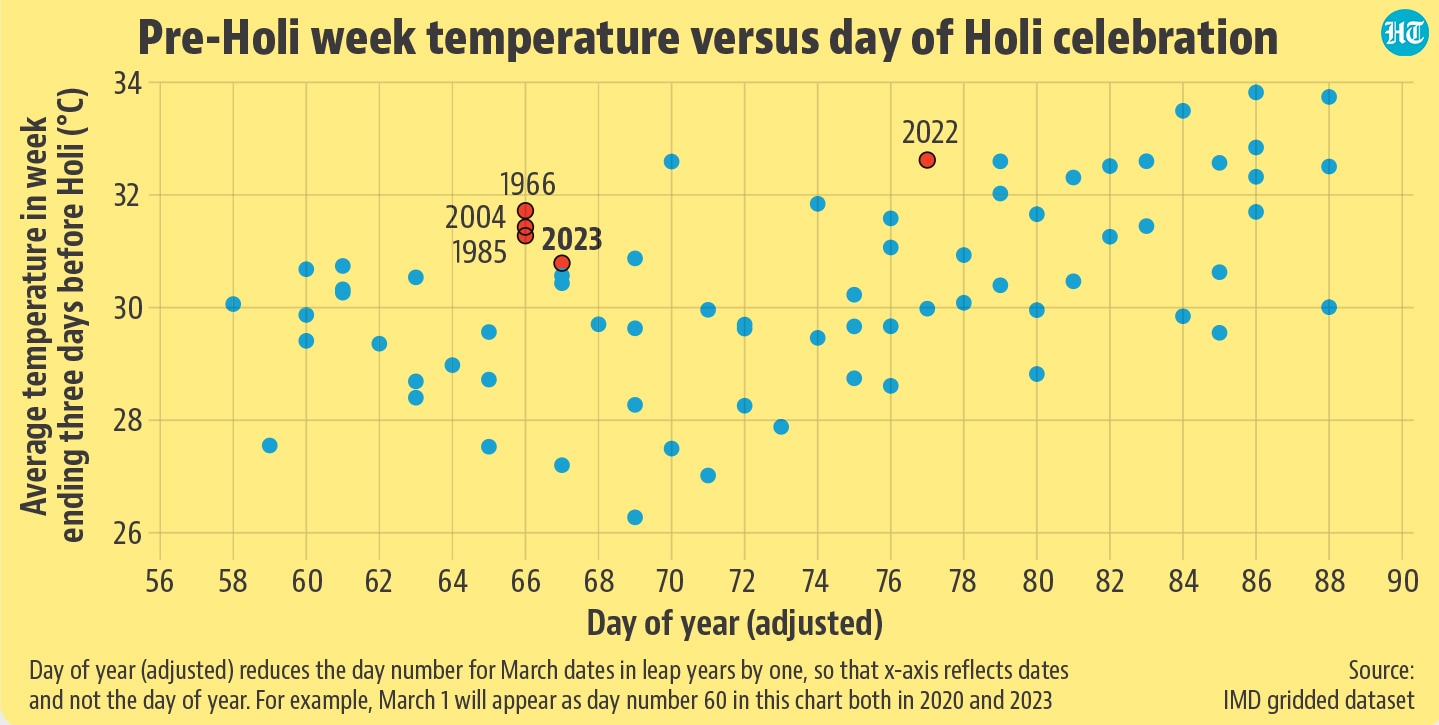
Of the 73 years since 1951, Holi was celebrated on or after March 8 in 53 years and before March 8 in only 19. We have chosen 1951 as the cut-off year for this analysis because it is the earliest year for which we have temperature data from the India Meteorological Department’s (IMD) gridded dataset. While IMD data shows that temperatures increase with every week in March on average, this may not be the case in a particular year. Of the 53 years since 1951 when Holi was celebrated on or after March 8, the week before Holi was warmer than in 2023 in only 23 years. On the other hand, there are also three years (1966, 1985, and 2004) among the 19 when Holi was celebrated before March 8 but the pre-Holi week was warmer than in 2023. However, in these three years, the festival was celebrated just a day before on March 7 . To be sure, since IMD’s data is published with a lag, the pre-Holi week for this analysis has been taken as the week ending three days before the festival (March 5 in 2023, for example) in every year.
How hot is the pre-Holi week in 2023?
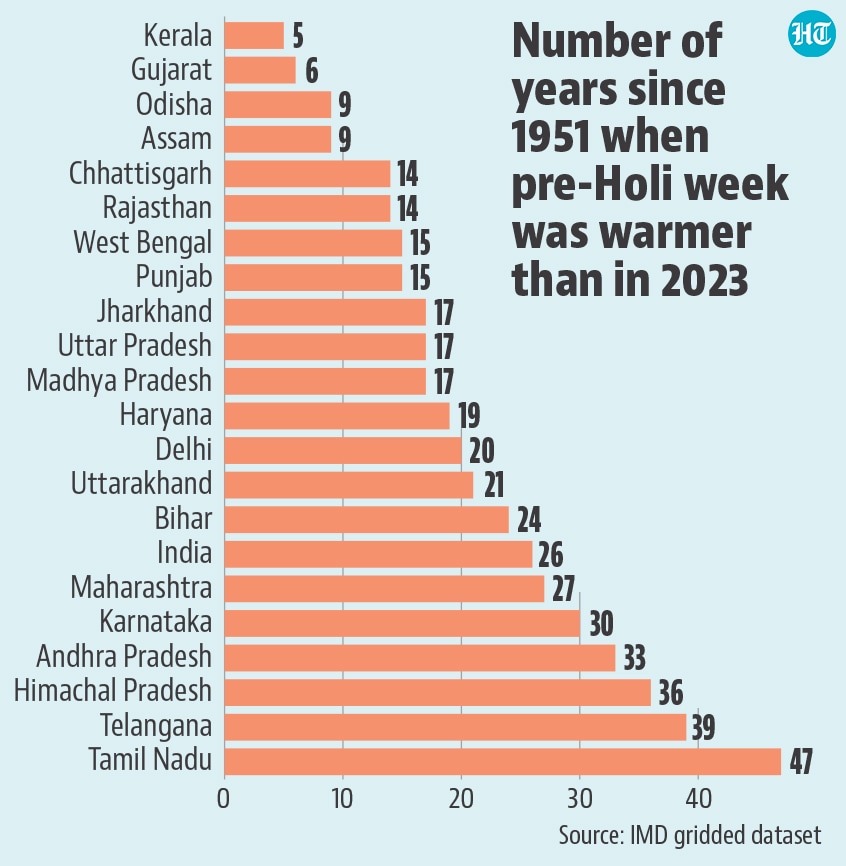
With an average maximum of 30.79 degrees Celsius, the 2023 pre-Holi week is the 27th hottest in 73 years since 1951, the earliest year for which IMD has gridded data. It is mostly states in the northern half of India that are experiencing one of their hotter run-ups to Holi. It is among the top ten hottest pre-Holi weeks in Gujarat, Odisha, Assam, Mizoram, Manipur, Tripura, and Kerala. It is among the top twenty hottest pre-Holi weeks in Rajasthan, Punjab, Haryana, Uttar Pradesh, Madhya Pradesh, Chhattisgarh, Jharkhand, and West Bengal. To be sure, because Holi has arrived ten days earlier than in 2022, all states (except Jharkhand) are cooler this year in the pre-Holi week than last year.
Why is this pre-Holi week so hot despite being celebrated early?
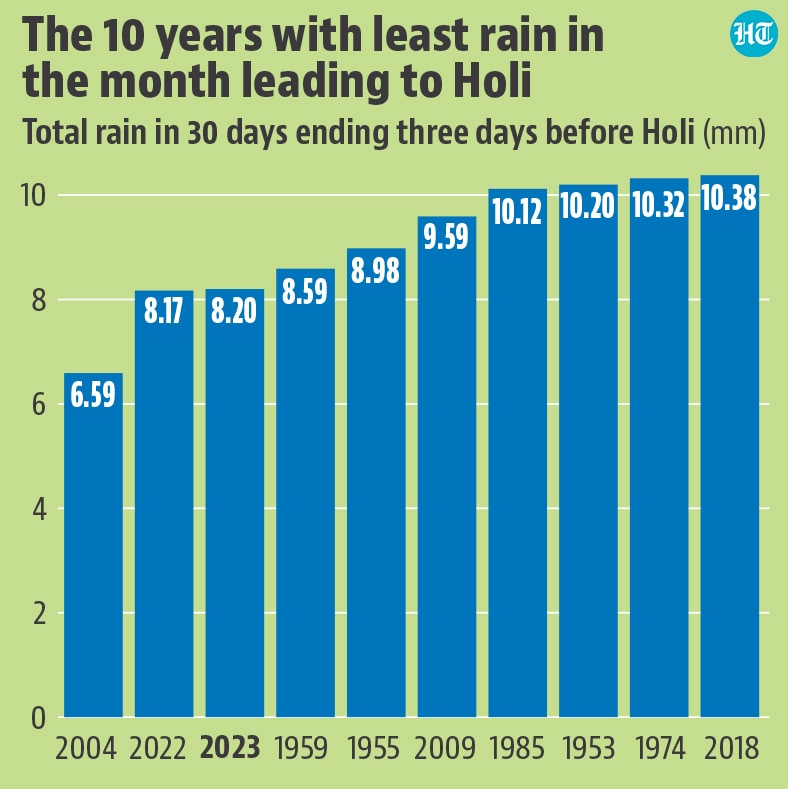
As the first chart shows, the pre-Holi week this year is hotter than 30 of 53 years when Holi came on or after March 8. This means that Holi is hotter this year despite being celebrated earlier than usual. What is the reason behind this? HT analysed rainfall in the 30 days ending at three days before Holi. This shows that the month before Holi has been one of the driest ever in 2023. India has received 8.20 mm rain this year in the past 30 days, the third least rain for the pre-Holi month since 1951. The only two years that perform worse are 2022 (8.17 mm rain) and 2004 (6.59 mm rain). This is the reason why pre-Holi week has been warmer than even some years when Holi came later than it has this year.
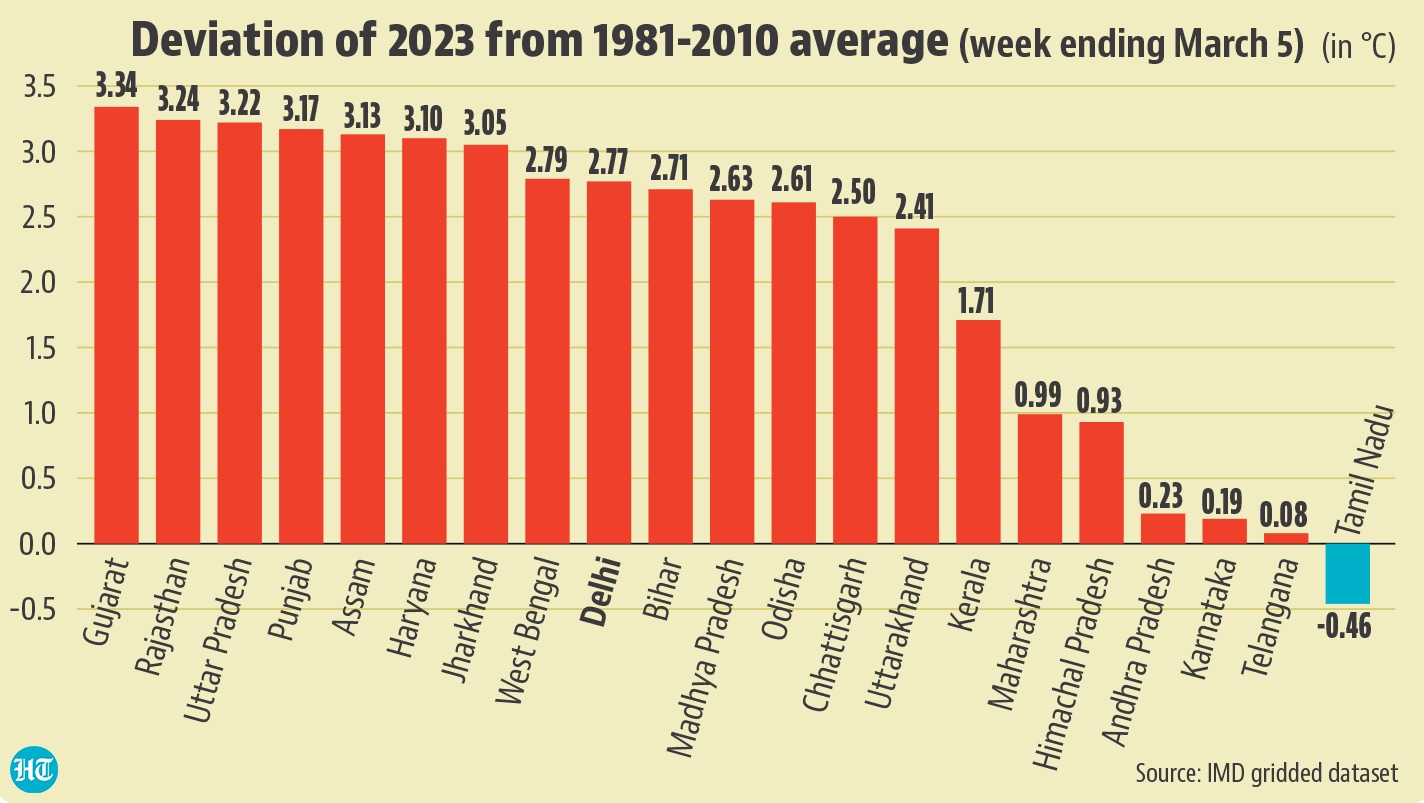
Forget Holi, the past week is simply way hotter than it has been
To be sure, the earth’s weather and seasons are more aligned to the Gregorian calendar than the festival season. This is why comparisons are made for the same calendar dates across years. This shows that the past week has been much hotter than the comparison with Holi dates shows. India’s average in the past week is 1.28 degrees Celsius warmer than normal (the 1981-2010 average) and ranked 19th since 1951. March was still cool up to this point last year. The week’s average last year was 28.82 degrees, 1.97 degrees cooler than in 2023 and ranked 50th since 1951. At the state level, the situation is starker. The week ending March 5 in 2023 is the hottest since 1951 in Gujarat; among the top three in Odisha, West Bengal, Manipur, Mizoram, and Tripura; among the top five in Assam, Bihar, Jharkhand, and Kerala; and among the top ten in Chhattisgarh, Madhya Pradesh, Uttar Pradesh, and Rajasthan. The average last year was ranked in the top ten only for Kerala, Assam, Manipur, Mizoram, and Tripura. This clearly shows that the heat has arrived earlier this year just as Holi has.