
 E-Paper



BRICS security advisers to meet in India to hammer out Goa summit agenda
National Security Advisers (NSAs) of BRICS nations will meet in New Delhi over two days this week to discuss the upcoming agenda for summit-level talks on October 15-16 in Goa.

 Prefer HTon Google


National Security Advisers (NSAs) of BRICS nations will meet in New Delhi over two days this week to discuss the upcoming agenda for summit-level talks on October 15-16 in Goa, with the focus firmly on terrorism, the Syria situation and developments related to the South China Sea. The meet is to be hosted by NSA Ajit Doval on September 14 and 15; all NSAs will meet Prime Minister Narendra Modi as well. The BRICS comprises of Brazil, Russia, India, China and South Africa.
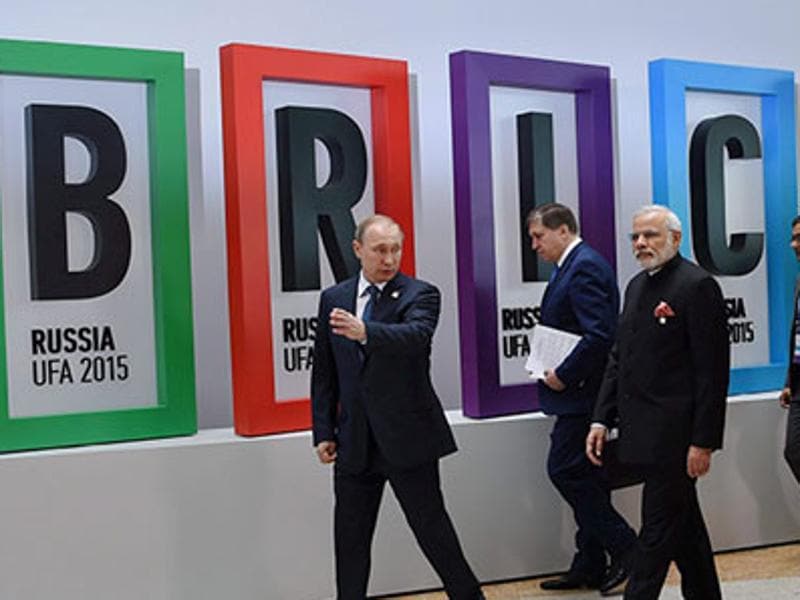
Top sources said Doval will be also holding bilateral talks with his Russian counterpart Nikolai Patrushev and Chinese State councillor Yang Jiechi on the sidelines. Yang and Doval are also the special representatives in the India-China boundary resolution process.
The BRICS focus will be on terror emanating from Afghanistan -- and Pakistan-based groups like Lashkar-e-Taiba (LeT), Jaish-e-Mohammad and al Qaeda in Indian subcontinent as well as the extreme violence perpetrated by the Islamic State in Syria and Iraq. India wants BRICS countries to forge a common front against terrorism in the subcontinent and would like to see the Islamic State rooted out of Syria.
On the bilateral front with Russia, the two NSAs are expected to discuss cooperation in strategic areas of defence, space and nuclear energy with the focus being on India leasing one more Akula-class nuclear submarine from Moscow. The submarine is critical as the lease of Russian built INS Chakra expires in 2021 with indigenous nuclear submarines still some time away in future.
As the India-China and India-Russia relationships are largely run through the NSA route, Doval’s meet with Patrushev, a close aide of President Vladimir Putin, will be important as India is keen to get into West Asia and wants to be part of the North-South corridor planned through Iran. Patrushev is also the Russian pointsperson on Afghanistan. Given that Russia and China have held joint navy drills in South China Sea, India does not want the close bilateral relationship to tilt away.
The Doval-Jiechi meeting is expected to be on bilateral issues focused on taking the relationship forward despite recognition of differences in some areas. Both countries recognize the need to keep the Line of Actual Control (LAC) peaceful as well as to ensure that freedom of navigation is practiced in the South China Sea as well as Indian Ocean. After Modi and Chinese President Xi Jinping met on the sidelines of the just concluded G-20 summit, Beijing is believed to have shown some flexibility to both India’s NSG membership as well as designation of Jaish leader Masood Azhar, main accused in the Pathankot airbase attack this year, as a global terrorist.


