
 E-Paper



Budget unveils sops, skilling, reforms to spur jobs
The unemployment rate in the world’s fastest-growing economy declined to 3.2% in 2022-23, according to the latest official data


The Bharatiya Janata Party (BJP)-led National Democratic Alliance (NDA) government announced job-creation plans worth ₹2 lakh crore in its Budget for 2024-25, unveiling incentives for firms to raise productivity, programmes to support skilling, and broader reforms to spur employment.
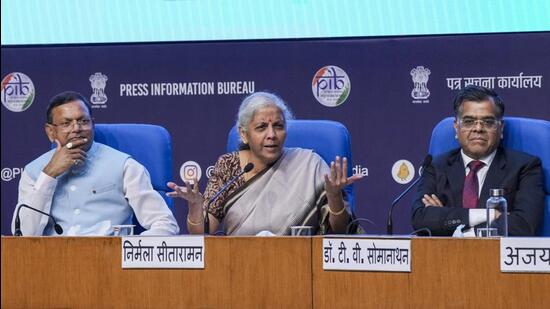
Employment-boosting measures announced by finance minister Nirmala Sitharaman include incentives for firms in manufacturing, cheaper loans for higher education, internship programmes, and credit flow to small businesses.
By a wide reckoning, India is not creating enough good-quality jobs for its rising workforce. The unemployment rate in the world’s fastest-growing economy declined to 3.2% in 2022-23, according to the latest official data. However, private estimates tend to show a higher joblessness rate. According to the data firm Centre for Monitoring the Indian Economy, the country’s unemployment rate was 9.2% in June 2024. A weak labour market is said to have cost the BJP a majority in the general elections this summer.
Sitharaman said the Budget is particularly focussed on employment, skilling, MSMEs (micro, small, and medium enterprises), and the middle class. In her Budget speech, she announced what she called the “Prime Minister’s package of five schemes and initiatives” to facilitate employment and skilling opportunities for 40.1 million youth over five years.
The budget outlined three schemes linked to the Employees’ Provident Fund Organisation (EPFO), the state-run retirement fund manager. One, first-time employees entering the workforce in all formal sectors will get one month’s wage in three instalments as direct benefit transfer (DBT), up to ₹15000.
Two, as an additional incentive tied to EPFO contributions, both first-time employees and employers in the manufacturing sector will get funds linked to a specified pay scale. Three, to push firms to hire more, an employer-focused scheme will cover additional employment created in all sectors, Sitharaman said. All additional employment within a salary of ₹1 lakh a month will be counted.
The government will reimburse employers up to ₹3000 a month for two years towards their EPFO contribution for each additional employee hired. “The scheme is expected to incentivise additional employment of 50 lakh (5 million) persons,” Sitharaman said.
Other job-spurring measures include a revised Model Skill Loan Scheme to offer credit up to ₹7.5 lakh with a guarantee from a government-promoted fund. The government expects this to help 25,000 students every year get employable skills.
Also, the government will give e-vouchers for loans up to ₹10 lakh for higher education for 100,000 students every year with an annual interest discount of 3% of the loan amount.
“This budget underscores the government’s dedication to enhancing education, employment and skilling, with a provision of Rs. 1.48 lakh crore specifically allocated for these purposes,” Union labour and employment minister Mansukh Mandaviya said in a statement.
The Economic Survey 2023-24 tabled in Parliament on Monday said India needs to create 7.85 million non-farm jobs every year until 2030 to absorb its expanding labour force. “The increase in employment as reflected in the recent RBI KLEMPS data is largely driven by unpaid work and partly because of higher employment in agriculture because of reverse migration to villages,” said Ishwar Aravind, an economist with Delhi University.
The Economic Survey, authored by the government’s chief economic adviser V Anantha Nageswaran, said despite rising profits, companies were not hiring enough. Citing a survey of 33000 firms, the review said corporate profits had “quadrupled” between FY20 and FY23 but they had not created enough jobs. “Hiring and compensation growth hardly kept up with it,” the survey said.
The budget signaled next-generation reforms to balance factors of production towards boosting jobs. Factors of production are basic resources an economy needs to make goods and these, typically, are land, labour, capital, and technology.
Companies may be depending more on capital, known as capital deepening, at the cost of labour, the Economic Survey 2024 suggested. Capital-intensive processes lead to automation, eliminating jobs.
“Privileging capital over labour is inimical to long-term corporate growth prospects. Businesses have an obligation to themselves to strike the right balance between deployment of capital and deployment of labour,” the survey said.
Responding to this capital-labour imbalance in her Budget, Sitharaman said the government’s economic policy framework would be geared towards enabling more employment. “Our government will initiate and incentivise reforms for improving productivity of factors of production and facilitating markets and sectors to become more efficient,” Sitharaman said. “These reforms will cover all factors of production, namely land, labour, capital and entrepreneurship and technology as an enabler of improving total factor productivity and bridging inequality.”
Among other steps, the Budget spelt out plans to upgrade 1000 Industrial Training Institutes with industry collaboration and internships with companies with a monthly allowance of ₹5000.


