
 E-Paper



Can count on us, France tells India as Rafale fighters take to the skies
French defence minister Florence Parly had condoled the death of Indian soldiers in a letter in June, conveying France’s “steadfast and friendly” support in these “difficult circumstances”.

 Prefer HTon Google


On a quick visit to India to join the formal ceremony to induct the Rafale fighter jets into the Indian Air Force, French defence minister Florence Parly on Thursday spoke in glowing terms about the Indian and French strategic partnership. “You can count on us,” she said at the ceremony, recalling how New Delhi “was by our side” when France was going through a critical phase of the Covid-19 pandemic. “We will also be by your side,” she said, underscoring French support for India’s candidacy for the UN Security Council.
It is a sentiment that she had underscored well before she landed in India as well, describing India as France’s foremost ally in Asia. Speaking at a glittering ceremony at the Ambala air force station, Florence Parly underlined the “rock-solid” friendship between the two countries exemplified by the deal to buy the fighter jets.
Also Read: Strategic Paris-Delhi-Canberra axis gets off to a flying start amid China tension
“It takes a lot of confidence, for India, to bet on France; and a lot of confidence, too, for France, to share with India a capability that is so close to the core of our sovereignty,” she said before flying to New Delhi where she met with National Security Adviser Ajit Doval.
There was no formal statement on the details of her interactions with the Indian leaders. Or if China figured in the discussion. One diplomat said the conversations covered a gamut of issues between“two close friends”.
Back in June when 20 Indian soldiers laid down their lives to repel China People’s Liberation Army troopers in Galwan Valley, the French defence minister Parly had made it a point to write to defence minister Rajnath Singh to convey her country’s “steadfast and friendly” support in these “difficult circumstances”.
Diplomats said the expression of solidarity over the loss of life over the Ladakh stand-off wasn’t much of a surprise. France has been the most dependable and consistent supporter of India at the United Nations and elsewhere.
Like when India carried out the 1998 nuclear tests, France was the only country among the five permanent members of the United Nations Security Council that did criticise or back sanctions against India. Even Russia had criticised New Delhi’s move though it was not supportive of the United States-led push for sanctions against India. China and the United Kingdom had supported the sanctions.
It is a point that Prime Minister Narendra Modi acknowledges at internal discussions.
“This is a relationship that has commercial aspects to it. But it is a strong bond,” a senior government official said.
France initiated the strategic dialogue with India in 1998 when much of the world was criticising us, said a diplomat and was one of the early strategic partners that India had. It was the only country that was ready to sell INGPS (Inertial Navigation and Global Positioning System) for India’s Prithvi nuclear missiles that help them land on the targets.
In 1999, a retired air force officer recalled, it was the French Mirage 2000s that dropped the laser-guided bombs - in Muntho Dhalo in the Batalik sector and on Tiger Hill in Drass in June 1999 — that is seen as the turning point of the Kargil war.
This partnership extends to space as well. France has helped India launch heavy satellites and allowed New Delhi track satellites, and access telemetry data from Reunion island in the Indian Ocean.
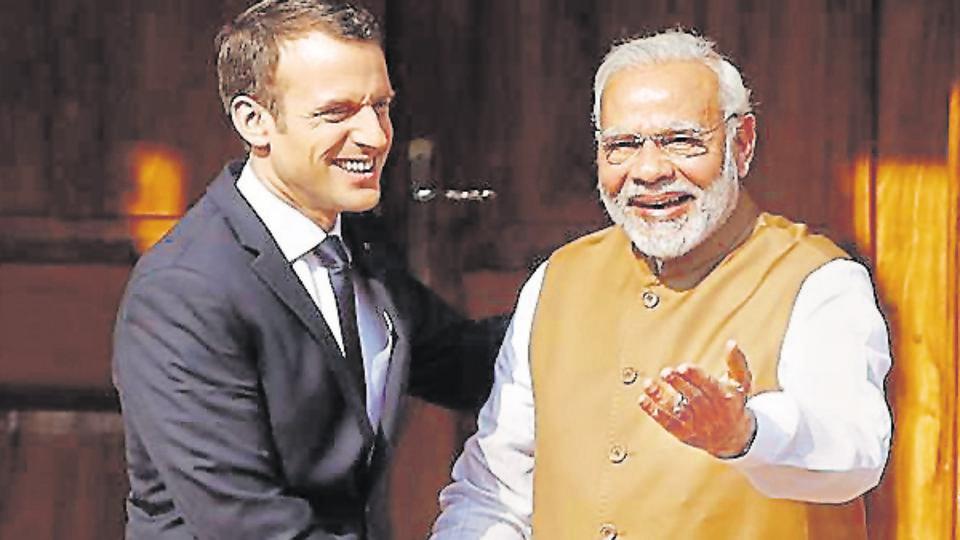
When the two countries signed a raft of pacts during President Emmanuel Macron’s India visit in 2018, PM Modi had summarised the relationship between the two countries in one line.
India and France strengthened their 20-year-old strategic partnership on Saturday, signing an agreement for reciprocal logistics support between their armed forces and unveiling a blueprint to step up cooperation in the Indian Ocean to counter China’s growing influence in the region.
“From the ground to the sky, there is no subject on which India and France are not working together,” PM Modi had famously said in 2018. The two leaders met again the next year, weeks after Parliament revoked the special status for Kashmir. France, along with the United States, blocked a China-sponsored attempt at Pakistan’s behest to get the UNSC to issue a statement on the Kashmir move.
France and the United States again stood like a wall, as one diplomat put it, when China and Pakistan made desperate attempts to get the UNSC to designate five Indians as terrorists..
“While the United States is a key ally, the French relationship is an additional leverage that helps India in countering its global adversaries,” a top diplomat said, recalling how it took the two P-5 members years to break down the great wall that China had erected to stop UNSC from designating Jaish-e-Mohammed founder Masood Azhar as a global terrorist.


