
 E-Paper



Strategic Paris-Delhi-Canberra axis gets off to a flying start amid China tension
French President Macron was among the first to call for the strategic alliance to respond to challenges in the Asia-Pacific region and the growing assertiveness of China

 Prefer HTon Google


India, France and Australia on Wednesday jump started a new strategic alliance proposed by French President Emmanuel Macron two years ago with the first meeting of top foreign ministry officials of the three countries. Maritime security in the Indo-Pacific region got the top billing at Wednesday’s meeting held over video conference.
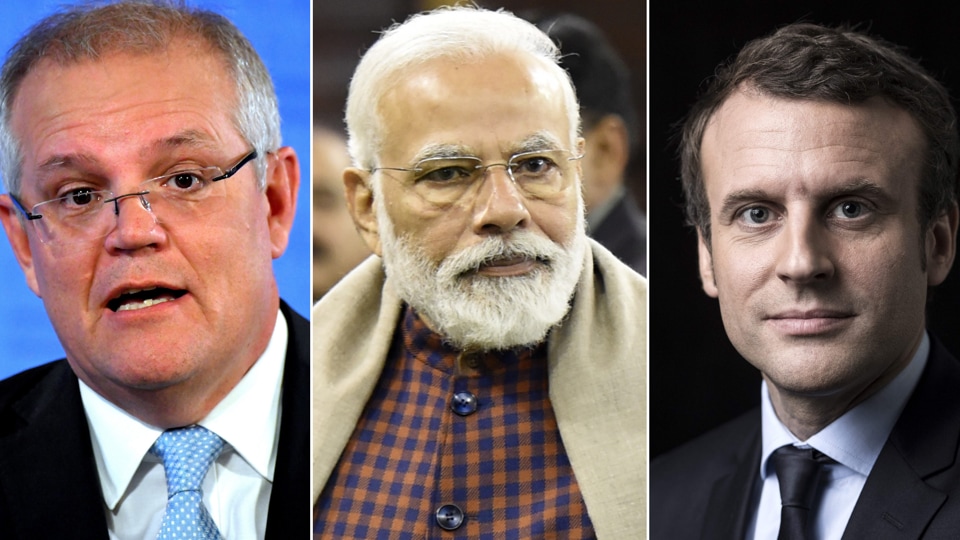
The officials spoke about “enhancing maritime security cooperation” including maritime domain awareness, mutual logistics support and capacity building of other friendly countries in the Indo-Pacific region, people familiar with the matter said.
There was broad agreement among the three partners that they should look at a multi-polar world where countries join hands for mutual benefit and support rather than a unipolar or multipolar world.
China did figure in the discussions but the meeting wasn’t focussed on one country. It took an overarching view, one Indian official later told Hindustan Times. The virtual meeting was co-chaired by foreign secretary Harsh Vardhan Shringla, secretary-general in French ministry for Europe and foreign affairs François Delattre and secretary in Australian department of foreign affairs Frances Adamson.
French President Macron was among the first to call for building a strategic alliance between the three countries that could respond to challenges in the Asia-Pacific region and the growing assertiveness of China. On a visit to Australia before he flew down to India back in May 2018, President Macron had spoken about the need for the partners to ‘organise’ themselves. “We’re not naive: if we want to be seen and respected by China as an equal partner, we must organize ourselves,” President Macron said in a speech at an Australian naval base. “This new Paris-Delhi-Canberra axis is absolutely key for the region and our joint objectives in the Indian-Pacific region,” he said, according to a 2018 Reuters report.
On the India leg of his trip, President Macron and Prime Minister Narendra Modi unveiled a blueprint to step up cooperation in the Indian Ocean to counter China’s growing influence in the region.“The Indian Ocean, like the Pacific Ocean, cannot become a place of hegemony,” President Macron said as the two countries signed pacts that gave Indian warships access to French naval bases in the Indian Ocean.
At Wednesday’s meeting, Indian foreign secretary Shringla underscored PM Modi’s vision for the Indo-Pacific that he had articulated at the Shangri-La Dialogue in 2018 to promote the concept of Security and Growth for All in the Region or SAGAR.
The three countries also discussed cooperation on marine global commons – blue economy, marine biodiversity and environmental challenges such as marine pollution. Shringla spoke about India’s interest in collaborating on sustainable fisheries in the Indian Ocean, technologies for harvesting of Deep Ocean Resources and Ocean Thermal Energy Conversion.


