E-Paper



Cause of crash identified, CBI should investigate: Railway minister Vaishnaw
Railway Board seeks CBI probe into Balasore train accident that killed 275 and injured nearly 1,100; authorities investigating possible sabotage attempt.

 Prefer HTon Google


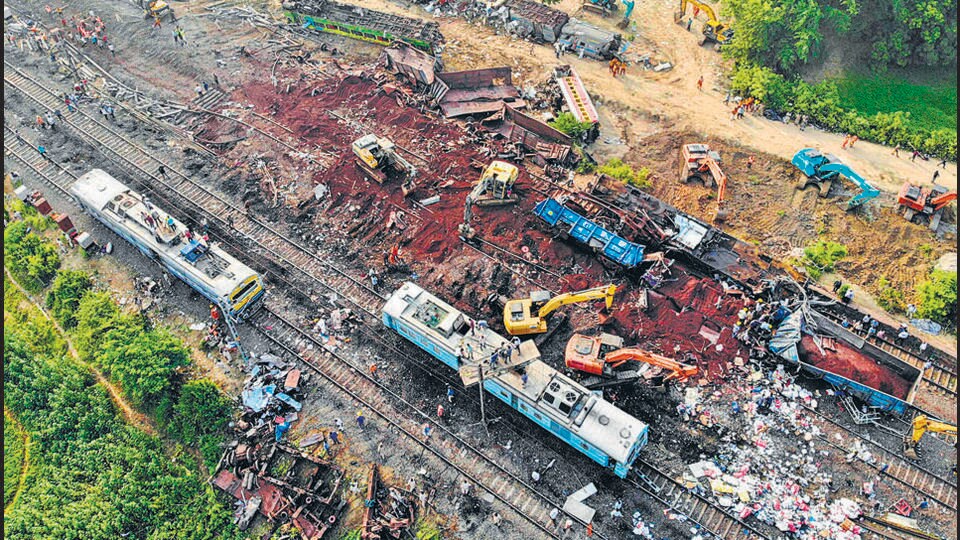
The Railway Board has sought a Central Bureau of Investigation (CBI) probe into the train accident in Odisha’s Balasore that killed 275 people and injured nearly 1,100, Union railways minister Ashwini Vaishnaw said on Sunday evening and suggested that authorities were looking into a possible sabotage attempt, even as officials on the ground bulldozed capsized coaches, relaid tracks, and installed fresh overhead lines in an attempt to restore operations on the impacted line.
Read here: How Coromandel Express derailed, set off triple-train collision, explains Railway Board
Earlier in the day, Vaishnaw said the cause of the accident, the fourth-worst on India’s extensive railway network, was a change in the interlocking and point machine, an intricate system of interconnected safety checks designed to keep trains from crossing each other’s paths.
Health care workers in the region, meanwhile, grappled with a herculean task, with hundreds of injured occupying hospital beds, even as families pored through lists and photographs to identify dead bodies, many of which were disfigured beyond recognition.
“We have recommended a CBI probe into the triple-train accident,” Vaishnaw said in Odisha’s capital Bhubaneswar on Sunday evening, amid pushback from Opposition groups, many of whom sought his ouster as minister.
The Chennai-bound Coromandel Express rammed into a goods train, bearing iron ore, at the Bahanaga Bazar station in Balasore around 6.56pm on Friday, the impact of the collision flinging several compartments into the adjacent track. A few of these coaches hit the last two cars of the Howrah-bound Yesvantpur Express, which was passing by on the opposite line at the same time. The death toll on Saturday evening was believed to be 294, but senior Odisha officials on Sunday clarified that the number had been revised to 275 after accounting for repetitions.
Earlier on Sunday, Vaishnaw, speaking in Balasore, said the tragedy took root in an alteration to a point machine.
“How and why it was done will be revealed in the probe report…The root cause of the horrifying incident has been identified... I do not want to go into details. Let the report (by the commissioner of railway safety) come out,” Vaishnaw said.
A point is essentially a moveable piece of track that changes a train’s direction. They are moved using switches operated from a control panel and form a key part of the Indian Railway’s extensive network across its 120,000km of tracks. Points along a line are “interlocked” and operate in sync with signals to ensure trains running on the same track do not collide and that a train does not enter an already occupied line – as happened on Friday evening.
Read here: Ashwini Vaishnaw prays as train movement at Odisha crash site resumes| 10 points
Railway Board member Jaya Verma Sinha, during a press briefing in Delhi on Sunday afternoon, called the interlocking system “error proof” and “fail-safe”.
“It means that even if it fails, all the signals will turn red and all train operations will stop… It could be that someone has done some digging without seeing the cables. Running any machine is prone to failures,” she said.
Verma said the preliminary investigations revealed that a signal was given to the high-speed Coromandel Express to run on the main track line, but the signal later changed, which led the passenger train to enter the adjacent loop line, where it rammed into the parked goods train.
Meanwhile, as of going to print, teams from the Indian Railways had restored two of the four lines (the XX and XX) on the track, even as work continued to restore the overhead electric lines that power the trains. The XX and XX lines were still being relaid.
Nearly 100 trains that cross the busy line have been affected, said officials.
National Disaster Relief Force (NDRF) director general Atul Karwal said the rescue operation was almost complete. “I don’t think there is any other possibility of locating any more survivors or bodies. I think operations will now resume,” he said in Balasore.
Nine teams and around 300 rescuers, however, continue to scour the site, Karwal said.
Odisha chief secretary PK Jena said that 88 of the 275 bodies were identified, of which 78 were handed to their families. The remaining 187 are still unidentified, he said.
“DNA sampling will be done and photographs of the deceased will be uploaded on government websites,” he said.
Opposition parties continued to target the Bharatiya Janata Party (BJP)-led central government over the accident, demanding accountability and that Vaishnaw resign as rail minister.
While the Congress asked if Prime Minister Narendra Modi would take responsibility for the “deadliest rail tragedy” of the century, West Bengal chief minister and Trinamool Congress (TMC) president Mamata Banerjee questioned the death toll.
Congress leader Rahul Gandhi on Sunday, demanding Vaishnaw put in his papers, said there was “no accountability even after 270+ deaths”.
The BJP, in turn, asked Opposition parties to not politicise the Balasore train accident and retorted that the record of the Congress-led UPA government’s railway ministers “was nothing short of a disaster”.
Read here: Odisha tragedy: Fragile coaches, restricted space thwarted rescue operations
BJP IT department head Amit Malviya shared on Twitter what he said were the details of accidents under Banerjee and Bihar chief minister Nitish Kumar, when they were railway ministers, and added such “worthies” are the ones demanding the resignation of the “most qualified” railway minister the country has had in seven-and-a-half decades.
To be sure, Nitish Kumar resigned as railway minister after the 1999 Gaisal train accident, which killed 290 people. Banerjee resigned after a train accident in Punjab in 2000, but then Prime Minister Atal Bihari Vajpayee asked her to continue in her position.