E-Paper



Odisha train accident: Fragile coaches, restricted space thwarted rescue operations
300 NDRF personnel, 24 Fire and Emergency teams, 5 teams of Odisha Disaster & Rapid Action Force and police and district personnel were involved in the rescue.

 Prefer HTon Google


At around 2pm on Sunday afternoon, SK Patra, a jawan of the National Distaster Relief Force, sat slumped, resting on a stone slab. For over 36 hours, through two straight blood-soaked nights, Patra worked feverishly, looking for a sliver of life among the dead; for a cry of pain that in his line of work, means a cry of someone alive. The 42-year-old has had a career spanning close to two decades, has gone multiple training programmes, and yet, very little prepared him for the aftermath of India’s worst train tragedies in last three decades on Friday.
Read here: Ashwini Vaishnaw prays as train movement at Odisha crash site resumes| 10 points
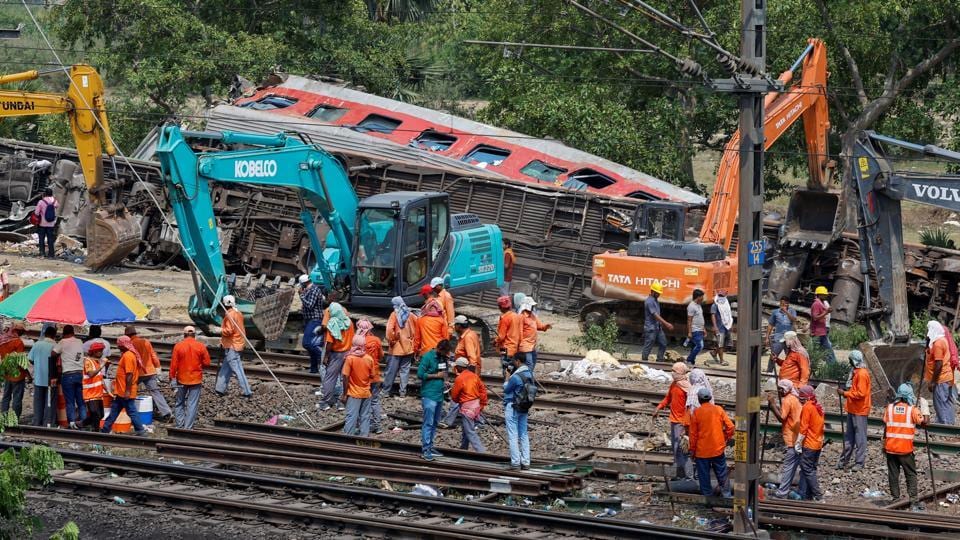
A little before 7 pm on Friday, the Coromandel Express hurtled into a stationery goods train at Bahanaga Bazaaar in Odisha’s Balasore district, several bogies derailing which in turn hit two bogies of the passing Yesvantpur Howrah Express, in an accident that left 275 dead and 1,100 injured. For two days then, there has been frantic relief and rescue, with workers from multiple agencies converging onto Bahanaga Bazaar. Only on Sunday afternoon, did Director General of NDRF Atul Karwal say, “The rescue operation is more or less complete. I don’t think any other victim, alive or dead, will now be located from the wreckage which has been checked a few times. Our response was prompt and effective. A total of nine teams comprising around 300 rescuers are at the location right now.”
Patra first arrived on the scene with his unit on Friday night, and was met with the stench of blood, and the desperate cries of those trapped inside the mangled train. He entered one compartment, which had bodies stacked against the other, following the feeble light of a torch from the mobile of a passenger. “She had little strength and in a feeble voice requested us to save her. But her leg was trapped in the seat. We had to use a cutter to saw through the seat but were so afraid that we would damage her leg. This one operation took several minutes,” Patra said.
Mini-operations like this, with their own in-built challenges, confronted rescuers over and over again. Patra’s NDRF colleague Gautam Kumar for instance entered one compartment that seemed to have only bodies. “But there was a 25-year-old calling for help. He was trapped under some bodies in one upper berth. He was gravely injured. The problem we faced was that we had to retrieve him without disturbing the other bodies that could fall on him. It took a great deal of ingenuity to extricate him,” Kumar said.
Read here: Rail minister says ‘change in electronic interlocking' behind Odisha tragedy. What it means
Overall, apart from the 300 NDRF personnel, there were 24 Fire and Emergency teams, 5 teams of the Odisha Disaster and Rapid Action Force and scores of police and district personnel that were involved in rescue. The ODRAF and Odisha fire services personnel were the first responders, arriving at the scene 11 minutes after the accident, with plasma cutters, ropes and ladders, senior officials said.
“By 11 pm, 24 fire teams comprising 250 people and 5 ODRAF teams comprising 120 people had lit up the place using inflatable light and started rescuing the injured passengers from the compartments. The teams had all the modern equipments such as hydraulic cutters needed to cut open the compartments ,” said senior police official Sudhansu Sarangi, director general of fire services.
Even as rescue operations continued, the other large group on the scene were over a thousand railway staff, led by Union Minister Ashwini Vaishnav, looking to restore normalcy to the trunk route that connects Kolkata and Chennai. By Sunday afternoon, officials said that they had made considerable headway. “All 21 coaches which capsized due to derailment of trains at Bahanaga Bazar Station have been grounded. Both the ‘Up’ and ‘Down’ railway tracks at have been repaired. Capsized bogies have been removed using poclain machines, a 140-tonne railway crane and 3 road cranes. Overhead electrification work has started as well,” said Aditya Kumar Chaudhary, Chief Public Relations Officer (CPRO), South Eastern Railway.
Read here: How Coromandel Express derailed, set off triple-train collision, explains Railway Board
Chaudhary however said that restoration work will continue over the next few days, and once the overhead electric lines are repaired, electric trains could resume plying, in a time period of three days. “ Till the overhead electric cable are repaired, only diesel locomotives can be run on the two lines which have been repaired. The South Eastern Railway will run two special MEMU trains from Howrah to Balasore and a special train will start from Bhadrak up to Chennai. It will have stoppages at Cuttack, Bhubaneswar and all other stoppages of Coromandel Express. Stranded passengers of the train that met with an accident and their relatives can avail of the service,” Chaudhary said.