
 E-Paper



Rail minister says ‘change in electronic interlocking' behind Odisha tragedy. What it means
The Union railways minister said the investigators have identified the cause of Odisha's triple train accident.

 Prefer HTon Google


The train accident in Odisha's Balasore that killed at least 290 passengers and injured hundreds more was caused by a change in electronic interlocking, railway minister Ashwini Vaishnaw said on Sunday. The minister told ANI that the commissioner of railway safety has investigated the matter and identified the cause of the incident as well as the people responsible for it.
“The commissioner of railway safety has investigated the matter and let the investigation report come but we have identified the cause of the incident and the people responsible for it... It happened due to a change in electronic interlocking,” Vaishnaw said.
Responding to West Bengal chief minister Mamata Banerjee's question over the absence of 'Kavach' system, Vaishnaw also said that the accident has nothing to do with the anti-collision system.
"This is an entirely different issue, it involves point machine, electronic interlocking. The change that occurred during electronic interlocking happened due to it. Whoever did it and how it happened will be found out after a proper investigation," he added.
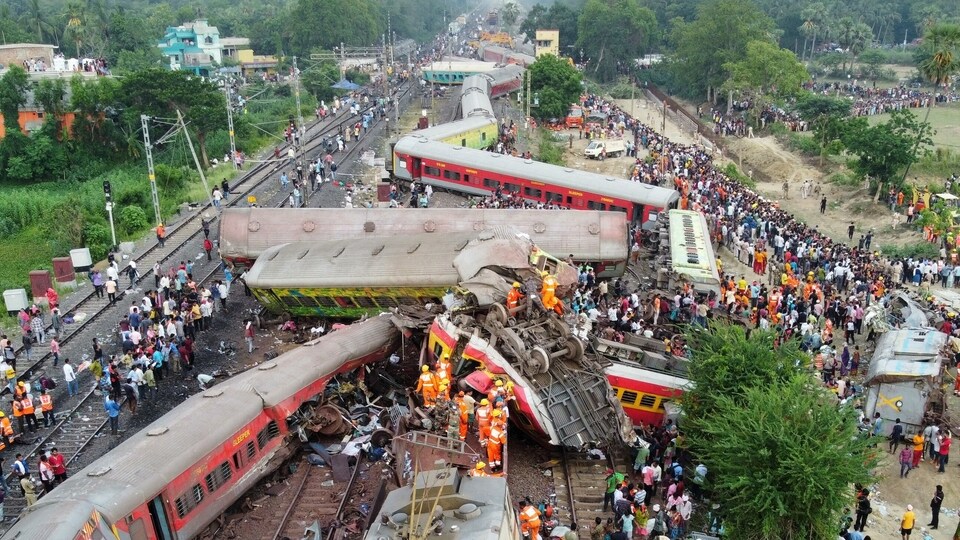
The explanation came as authorities worked to clear the mangled wreckage of the two passenger trains that derailed Friday night in one of the country’s deadliest rail accidents in decades.
Odisha train crash LIVE updates
What does 'change in electronic interlocking' mean?
To understand this, we have to first know what is interlocking.
An interlocking system refers to a safety mechanism that ensures the safe and efficient operation of train movements at railway junctions, stations, and signalling points. It typically involves the integration of signals, points (switches), and track circuits.
The interlocking system ensures that the points – movable sections of track that allow trains to change direction from one track to another – are properly aligned and locked in the correct position before a train can pass over them. Track circuits are electrical circuits installed on the track that detect the presence of a train. They help determine whether a section of track is occupied or vacant, enabling the interlocking system to control train movements accordingly.
The interlocking system monitors the status of signals, points, and track circuits and integrates these components to prevent unsafe situations, such as two trains attempting to use the same track or conflicting movements at junctions.
Electronic interlocking
Electronic interlocking is a modern form of interlocking technology in which the control and supervision of train movements are carried out through software and electronic components. It utilizes computers, programmable logic controllers (PLCs), and communication networks to manage and coordinate the signalling, points, and track circuits.
A "change" in electronic interlocking, as suggested by the rail minister, could have led to incorrect signalling or improper routing that forced the Coromandel Express off the main line. The train, running at over 120kmph, took the loop line, or side track, crashing into a parked freight train. To be sure, the exact cause of the accident will only be known after the commissioner of railway safety submits a detailed technical inquiry report.


